
Search myodfw.com
Showing 101 - 120 of 306 results
The granite peaks of Oregon’s Blue and Wallowa Mountains form the backdrop for many of this zone’s glacier-carved lakes and crystalline streams. Bull trout thrive in this zone’s cold, clear rivers, which also sustain whitefish and rainbow trout, and welcome returning runs of hatchery-reared steelhead. Chinook salmon travel over 300 miles up the Columbia to spawn in rivers such as the Imnaha and Wallowa. Warmwater fisheries are few, but the John Day River offers world-class fishing for smallmouth bass.

Find maps, boundary descriptions and the percent public land for the Catherine Creek Unit.

This colonial-nesting swallow places its nest at the end of a burrow dug into a soft cliff or bank. The nesting cliff often appears riddled with holes, but not all burrows are used for nesting. A highly social species, the Bank swallow is usually observed in flocks of its own or with other swallow species. It has dark wings and tail that contrast with the paler brown back. The underparts are whitish except for a distinct brown breastband. It is a generally uncommon, but locally common to abundant summer resident at mid- to low elevations east of the Cascades. Numerous…

Although a common breeding bird throughout Oregon's mountains, the Pine siskin retains an air of mystery due to its highly nomadic and unpredictable movements and its fondness for the inaccessible conifer canopy. It is most familiar in winter through early spring when flocks descend to foothills and valleys to feed on alder catkin seeds and many mingle with goldfinches in weed patches and at feeders. It is readily identified by its heavily streaked plumage and by the yellow wing and tail bars that are especially prominent in flight. The Pine siskin is a generally common resident in conifer forests throughout…

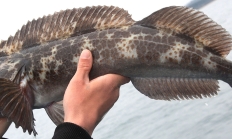
Features: Lingcod have an elongated body with a large mouth and sharp, canine-like teeth. They are generally mottled gray or brown but sometimes green or blue. A green-colored “ling” should not be confused with a greenling. Lingcod can get 5-feet long, but those caught in Oregon average between 2- and 3-feet. Habitat: Adults like to be near rocks, inshore and to 230-fathoms deep. Young lingcod prefer the sand or mud bottoms of bays and inshore areas. Technique: Bounce some bait along the bottom with 5/0 or 6/0 hooks, a 4- to 6-ounce sinker, and 20-pound line on a stout rod…
Features: Oregon is home to an estimated 25,000-30,000 black bears, which is North America’s most common bear species. They are the only type of bear found in Oregon. Despite their name, black bears are often brown in color. Habitat: Black bears are found statewide, with concentrations in the Coast and Cascade ranges and the Blue Mountains. Techniques: Oregon offers a controlled spring season (apply by Feb. 10) and a general fall season. Glassing open areas where bears are feeding on grass and shrubs works early spring season. Later in the season, some hunters turn to predator calls. Most fall bears…

Known as "bluebill" to most hunters, this species is one of the most abundant and widespread of North American ducks. The lesser scaup is similar to the greater scaup in appearance and habits, but is smaller and lacks the white on the primaries. In the field, however, the black-and-white drakes and brown hens are very similar to greater scaups. The common vocalization is the purr call of the female; drakes are usually silent, but utter a low single-note whistle in courtship. In general, the lesser scaup is more apt to be found in interior or freshwater habitats while the greater…

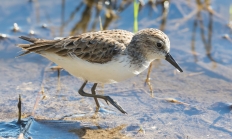
This tiny sandpiper is the rarest of the regularly occurring "peeps" in Oregon. Only a handful of individuals are reported in Oregon each year, mostly during fall migration and usually in mixed flocks with Least and Western Sandpipers. Like the Western sandpiper, the Semipalmated has black legs, but its bill is generally shorter, straighter and more blunt. Well-known as a transoceanic migrant, the Semipalmated sandpiper may be one of the fastest flying of the long-distance shorebirds. It is a rare irregular spring transient throughout Oregon, and a very uncommon coastal and rare inland fall transient. It is usually found inside…
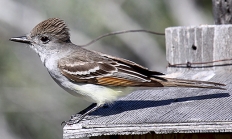
With its erect posture and stately manner, the Ash-throated flycatcher brings a touch of elegance to the oak and juniper woodlands of Oregon. A medium-sized flycatcher, it has a puffy crest and generally pale coloration, sexes are similar. It has gray-brown upperparts and an ashy gray breast; the throat may appear whiter. Belly and undertail coverts are pale yellow. It has two whitish wing bars, and rufous-colored inner webs of the tail and primaries. Juveniles have more extensively reddish tails. It is an uncommon to locally common summer resident in the Rogue and Applegate valleys and a rare vagrant in…
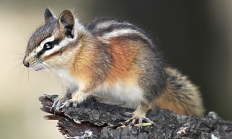
The least chipmunk is the smallest chipmunk in Oregon, but it is only slightly smaller than the yellow-pine chipmunk. As in all chipmunks, the face is marked with a dark stripe through the eye bordered on each side with a light- and a dark-colored stripe. The middorsum is marked with a dark-colored stripe followed on each side by two alternating light- and dark-colored stripes. The least chipmunk has the largest geographic range of any chipmunk. In Oregon, it occurs east of the Cascade Range except in the Columbia Basin and most of the Blue Mountains. In general, it is a…
Features: Rocky Mountain elk are one of two subspecies of elk found in Oregon, with a population estimate of more than 74,000 in the state. They are lighter in color and slightly smaller in size than Roosevelt elk, but their antlers are the largest of all elk and can weigh up to 40 pounds. Habitat: Rocky Mountain elk inhabit most of eastern Oregon with concentrations in the Blue Mountains and south-central Oregon. Techniques: Rocky Mountain elk live in much more open country that Roosevelts so try glassing, still hunting, spot and stalk and calling. Rifle, archery and muzzleloader seasons are…

Features: Drakes have a black head with a white spot below and in front of the eye -- rather than the crescent-shaped patch of the barrow's goldeneye -- white neck, breast and flanks and a black back and tail. Hens have a brown head, light neck, breast and belly, brown backs and flanks. Drakes and hens of both common and Barrow's goldeneye have a distinctive golden ring around the pupil. Habitat: It is a common migrant in northeastern Oregon and winter resident of the Snake, Columbia, Klamath, Rogue and Umpqua rivers. Techniques: These ducks travel in small groups of two…

Adult Klamath black salamanders that live in Oregon are fully black with a smattering of bronze or green specks across the top of their heads, backs, tails and legs. The black salamander is one of the lungless salamander species and it breathes through its skin. Female black salamanders are generally larger than males and grow up to five-and-a-half inches in total length. Black salamanders live in forest, open woodland, moist talus (rock fragment piles) and streamside habitats. They use crevices in moist decaying logs or stumps, wet talus slopes or just under surface debris for cover during warm wet weather…

SALEM, Ore.—ODFW is accepting public comments on the proposed 2027 Big Game Regulations and other agenda items the Commission will consider at their September meeting in La Grande. Comment using the links embedded with each agenda item provided on the September meeting agenda page. The deadline to submit written comments…
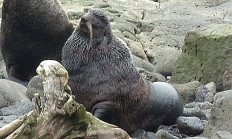
The Northern fur seal is the smallest member of the family in Oregon. The flippers are nearly twice as large as those of a comparably-sized individual of any other species of otariid. The ears are cylindrical and the auditory meatus is covered with wax to prevent entry of water. The pelage consists of coarse guard hairs and an exceedingly thick underfur that serves as waterproof insulation. Adult males are dark gray or brown dorsally and reddish brown ventrally; a grayish cape covers the neck and shoulders. Adult females are grayish brown dorsally and reddish brown ventrally. The Northern fur seal…
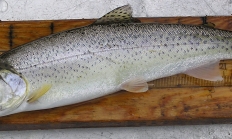
Features: Coastal cutthroat trout are typically are blue/green on top, red along the lateral line, and white on the belly. They are lightly or heavily spotted and adults have a red slash mark on the throat. Habitat: The most common variety of trout in Oregon is the coastal cutthroat, found in the streams and beaver ponds in coastal drainages. They also are stocked in high mountain hike-in lakes where the water stays cool throughout the summer. Techniques: Cutthroats that are year-round residents of small streams may not get any bigger than 8- or 9-inches, but can reward the angler with…
Features: Canada geese come in many sizes and colorations. All have the same general long, black neck and white chinstrap. Their breast color can range from light gray to a dark brown. Habitats: Canada geese have become abundant in many city parks and agricultural fields where forage grasses are available. They can be found floating in bays, estuaries, rivers, reservoirs and lakes as well. Techniques: Canada geese can be hunted like other waterfowl. From jump shooting to calling birds into a decoy spread, Canada goose hunting can be productive. Note: If you want to hunt geese in Northwest Oregon, a…
