
Search myodfw.com
Showing 1001 - 1020 of 1128 results
NEWPORT, Ore. – To reduce the risk of humpback whale entanglements in commercial Dungeness crab gear, the Oregon Department of Fish and Wildlife is moving the May 1 "late-season" regulations to April 1 this year. These regulations require commercial crab fishermen to fish in waters less than 40 fathoms, use…
SALEM, Ore.–The Fish and Wildlife Commission will meet virtually on Friday, Oct. 10 from 8:30 a.m.-noon for a training related to cultural resources, tribal sovereignty, and tribal treaty rights. The meeting will be livestreamed from the Commission page and via ODFW's YouTube channel. Invited speakers will share information with the…
Cole Rivers Hatchery was constructed by the US Army Corps of Engineers (USACE) in 1973 to mitigate for spawning and rearing areas blocked by the construction of Lost Creek, Applegate, and Elk Creek Dams. The hatchery was named in honor of Cole M. Rivers, a biologist on the Rogue River for 20 years. The facility is used for adult collection, spawning, egg incubation and rearing of spring Chinook, coho, summer steelhead, and winter steelhead, and egg incubation and rearing of fall Chinook and rainbow trout. Infrastructure Repair and Renovation Updates
CORVALLIS, Ore. — The Oregon Hatchery Research Center Board will meet in Corvallis on Tuesday, December 2 from 11:00 a.m. to 1:00 p.m. at the Oregon Department of Fish and Wildlife South Willamette Watershed District Office (7118 NE Vandenberg Avenue, Corvallis, OR 97330). In addition to the regularly scheduled items…
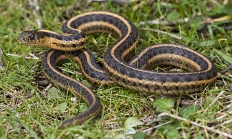
This highly aquatic snake is found in wet meadows, riparian areas, marshes, and moist forests near rivers, streams, lakes and ponds. It requires streams with thick riparian vegetation for escape and exposed boulders for basking. The Pacific coast aquatic garter snake takes aquatic prey such as small fish and fish eggs, salamanders, tadpoles, frogs, toads, earthworms, and leeches. Photo by Simon Wray, ODFW
Clark's grebe is very similar in plumage, habitat, and behavior to the western grebe. It breeds in inland lakes with emergent vegetation such as cattails and tules. It requires open water for foraging on the surface or diving below in pursuit of fish. It winters both along the seacoast and on major rivers. Like the western grebe, Clark's grebe is a specialist in fish, which make up over 80 percent of its diet. It will also eat other aquatic organisms like crayfish, amphibians, and aquatic insects. Its breeding range in Oregon overlaps that of western grebe, but Clark's is not…

This is a marine gull that breeds on both offshore islands and rocky cliffs along the Oregon Coast. It also uses structures for nesting and, occasionally, will nest on grass-covered headlands. The Western gull's food comes from the marine environment, estuaries, and the immediate shoreline. It eats small fish, clams, mussels, bird eggs, the young of other birds nesting nearby, sea urchins, starfish, squid, crustaceans, marine worms, and carrion. it will scavenge garbage or waste from fishing boats as well. It is present all year along the entire coast of Oregon. Hear the call of the Western gull Photo by…

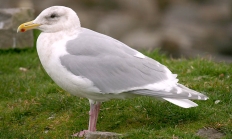
This gull nests on offshore islands, rocky coastal cliffs, and sometimes in grass on level parts of headlands. It forages in the marine and intertidal environments. Glaucous-winged gulls eat just about any animal material they find. They take small fish, barnacles, molluscs, sea urchins, bird eggs, carrion and animal waste discarded from fishing boats. It is rare but regular along the coast and the Columbia River; local and rare in the Willamette Valley. In can be uncommon midwinter at Sauvie Island. Most Glaucous-winged gulls in Oregon nest in the mouth of the Columbia River. Hear the call of the Glaucous-winged…
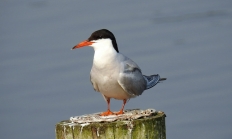
This is a small tern most often seen along the coast flying along the beaches or hovering and diving over a school of fish just offshore. Breeding-plumage adults have sharp black caps, reddish bills, and forked tails, and are pale grayish above and white to pale gray below. They are a common to abundant spring and fall transient over the ocean, usually within 15 miles, irregularly along the coast and in the estuaries. Nearshore and inland flocks are often observed resting in compact flocks on nearby shores or on floating objects, or flying about over the water in search of…
The kit fox is the smallest canid that occurs in Oregon. It has the typical canid conformation: the body is slim, the legs are long and thin, and the ears are large and erect. The tail is about 40 percent of the total length and is tipped with black, but has no dark mane on the dorsal surface. The feet and legs are whitish interiorly, light rusty-brown posteriorly. The dorsum is grizzled brownish-gray medially blending to grizzled gray then to light buff laterally and finally to white on the chest and venter. The head and posterior surface of the ears…

The Canada lynx is only slightly larger than the bobcat. Nevertheless, long legs and long fur produce the illusion that the lynx is considerably larger than it actually is. Documented accounts of wild lynx are rare and lynx are not expected to currently reside in Oregon. However, if lynx were to be observed, it is likely to occur at higher elevations such as in the Cascade Range, Blue Mountains or Wallowa Mountains. Habitats used by lynx often are defined in terms of habitats used by their primary prey species, thus good snowshoe hare habitat usually is considered to be good…

Cascade Hatchery was authorized under the Mitchell Act and began operating in 1959 as part of the Columbia River Fisheries Development Program – a program to enhance declining fish runs in the Columbia River Basin. The facility is used for egg incubation and rearing of coho.
Clackamas Hatchery began operation in 1979 and is used for adult collection, egg incubation and rearing of spring Chinook and winter steelhead, rearing of coho and acclimation of summer steelhead.
A big, well-mannered bird of friendly, even playful disposition, with an abundant curiosity as to human presence and activities within the realm of open ocean over which he presides. Long-winged, to seven feet, and dark sooty-brown; adults have a white rump and feathering, which juveniles lack, around the base of a large bill. Every sighting of these gentle giants gliding up to the boat evokes delight. The black-footed albatross is a regular visitant spring through fall offshore, but is irregular in winter. They glean squid, fish and fish eggs from the ocean surface and also eat galley scraps. Hear the…

The bottlenose dolphin is the most common of the oceanic dolphins and can be found in all tropical and temperate oceans. Flipper was a bottlenose dolphin. Their considerable intelligence and permanently-affixed smile make them a favorite of aquarium and television shows. The U.S. Navy also uses bottlenose dolphins to find mines and booby traps underwater. Oregon is the northern extent of its range on the West Coast. They are most often seen offshore during the summer by tuna and other fishers. They are gray with light gray to white on the undersides. In size they range from six to 13…
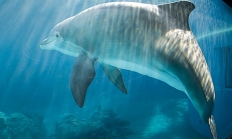
NEWPORT, Ore. – New research from Oregon's south coast highlights the positive economic impact of science and tourism within Redfish Rocks Marine Reserve. The study quantifies the number of jobs supported and income generated by these activities, providing important data for the local Port Orford community, policymakers, conservation practitioners, and…
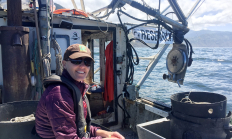
The major portion of Elk River Hatchery construction was completed in 1968. In 1971 the hatchery completed final construction on an intake and ten new ponds. The purpose of the facility is to supplement natural production of fall Chinook in the Elk and Chetco Rivers and winter steelhead in the Chetco River. The facility is used to collect Elk River fall Chinook, to incubate eggs and rear both natural and hatchery fall Chinook and winter steelhead.
NEWPORT, Ore. – ODFW is accepting nominations for a seat on the Pacific Fishery Management Council (Council). The three-year term for this Oregon at-large seat begins Aug. 11, 2026. Anyone interested in being considered, or wishing to nominate someone, must contact Jessica Watson at 541-351-1196 or jessica.l.watson@odfw.oregon.gov . Completed application…
Features: The purple varnish clam is named for the purple hue found inside the clam and the shiny varnish over the brown color outside the shell. It is oval in shape and is relatively flat with a prominent ligament near the hinge. Habitat: These clams can be found in cobble to muddy substrate. Technique: Purple varnish clams are found in very high densities. Limits are 72 a day. Learn more here before getting started clamming. See Oregon Sport Fishing Regulations for information on the daily catch limits for bay clams. How to dig purple varnish clams (video)

Bats are important pollinators and the only flying mammals; they use sound to locate their prey, and they live a long time. Oregon has 15 species of bats, and eight of those are Oregon Conservation Strategy Species. Strategy Species are those having small or declining populations, are at-risk, and/or of management concern. Some of Oregon's species migrate south in winter while some remain here and hibernate. Bats have echolocation which allows them to make high-pitched sounds then listen to the echo of those sounds to locate where objects are. Echolocation helps them find even the smallest insect.
