
Search myodfw.com
Showing 1081 - 1100 of 1416 results
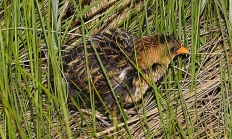
The Yellow rail is a small, secretive rail that is seen and heard far less than any other rail in Oregon. Males vocalize during the breeding season with a five-note tic-tic, tic-tic-tic repeated incessantly during hours of dark, and call infrequently during the day. The call sounds much like two small rocks being tapped together. Yellow rails are quite small and have a white patch on the trailing edge of the inner wing, more extensive than that on juvenile Soras. Males in the breeding season have a distinct yellow bill and are slightly larger but otherwise sexes are alike. Chicks…
This stocky, medium-sized shorebird is a denizen of Oregon's rocky shoreline, foraging as close to the crashing waves as possible, hence its name. It uses the rocky intertidal zone which includes jetties, offshore rocks and rocky shorelines, sea stacks, and tidal pools and is occasionally found on sandy beaches interspersed with groups of rocks, and on mudflats near the mouth of the Coquille River. It sometimes uses freshwater outfalls for bathing. Birds wintering in Oregon have the upperparts, head, neck, and breast slate gray with a whitish eye-ring. Indistinct supercilium and chin are white, wheres the belly and abdomen are…

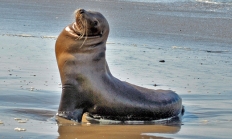
The California sea lion is the mid-sized Oregon otriid. The body is slender and tapering, the flippers are relatively small, and the rear flippers can be rotated beneath the body for moving on land. The short, course pelage lacks dense underfur; when dry, it usually is chocolate brown, but individuals with light-tan pelage are known to occur. The pelage appears black when wet. In older males, the pate is tan. The occurrence of the California sea lion along the Oregon coast is seasonal. The primary areas where it comes ashore are Cascade Head, Tillamook County; Cape Argo, Coos County; and…
The pintail is a large, long-necked duck of open spaces. The long-tailed, full-plumaged drake is striking with a chestnut head, gray back and flanks, bright white breast and front of neck, and iridescent green bronze speculum. The brown hen is nondescript, but shares the long neck and graceful shape of the drake. Common vocalizations are the two-note flute-like whistle of the drake and harsh gaak, either single or in a series, of the hen. In fall and winter, pintails travel in medium to large flocks. In Oregon, flocks seem to fly exceptional distances in daily foraging and can be seen…

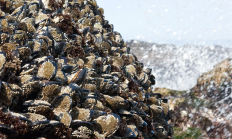
SALEM, Ore – Mussel harvesting is now closed from Cape Blanco to the California border the Oregon Department of Agriculture and the Oregon Department of Fish and Wildlife announced today. Recent mussel samples indicate levels of Paralytic Shellfish Toxin – a naturally occurring marine biotoxin that can cause Paralytic Shellfish…
SALEM, Ore – Mussel harvesting is now closed from the Washington border to the north jetty of the Siuslaw River (Florence) the Oregon Department of Agriculture and the Oregon Department of Fish and Wildlife announced today. Recent mussel samples indicate levels of Paralytic Shellfish Toxin – a naturally occurring marine…
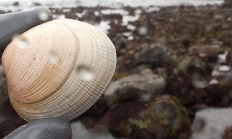
Features: Circular in shape and 1.5-2.5 inches across. Identified by concentric lines and radiating ridges. Longer lived and less abundant than cockles. Habitat: High salinity areas of sand, mud, gravel, or rock. Harvest them in Tillamook, Netarts, Yaquina, and Coos bays. Techniques: These clams can be found in rocky nearshore areas within 6 inches of the surface. Using a rake for these clams is the best harvest method. Learn more here before getting started clamming. See Oregon Sport Fishing Regulations for information on the daily catch limits for bay clams. How to dig for little neck clams (video)
In length, the Great gray owl is Oregon's largest owl, though it weighs less than the Great horned and Snowy owls. It is sooty gray to brownish above and lacks ear tufts. The prominent facial disc, outlined in black, contains a series of fine concentric rings that surround piercing yellow eyes. Despite its large size, both feet and bill are small. Sexes are similar. It is an uncommon to rare inhabitant of forests adjacent to openings above 3,000 feet in the Cascades, Blue, and Wallowa mountains. Most observations in the Cascades are from east of the crest, though they have…

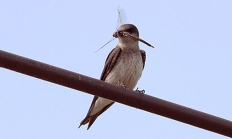
All have cause to marvel at the sight of a gorgeous male Purple martin. Adult males are entirely glossy bluish-purple, although they may look black in poor light. Females and yearling males are grayish below and darker above with a paler forehead and nape. The world's largest swallow, martins are uncommon in Oregon. They nest both solitarily and colonially in nest boxes specially put up for them, in crevices in human-made structures, and in cavities in snags and pilings. They are an uncommon local summer resident, principally inhabiting the Coast Range and Willamette Valley. They are also locally common at…
The song of the Yellow-headed blackbird, if it can be called a song as it lacks any musical quality, is a familiar sound in the marshes particularly of central and southeastern Oregon. The male, with its yellow head, neck, and breast, black body and wings, and white wig patches, is unmistakable. The female is more subtle with its dusky or sooty brown body plumage and yellow cheeks, chin, throat and chest, but is also distinctive. It is an abundant spring and summer resident in marshes of large alkaline lakes and wetlands in southeast Oregon, most notably the Klamath, Summer, Malheur…

Updated December 31, 2025 Subscribe for updates Starting Jan. 1, 2026, an Ocean Endorsement is needed for most recreational anglers fishing in the ocean. Check the Ocean Endorsement page for more information. Ocean Endorsement
The thick, dense feathering on its underparts allows this dainty shorebird to float high on the water. Its lobbed toes give it considerable maneuverability while swimming. It is equally at home on the roughest seas and the smallest farm pond. A highly sociable bird and extremely trusting. Smaller size and slender bill separate this species from the Wilson's and Red phalaropes. Offshore it concentrates along tide rips and over upwellings. In shallow waters it stirs the bottom with its feet or spins rapidly to expose the tiny organisms that it picks up with its needlelike bill. An opportunistic forager of…

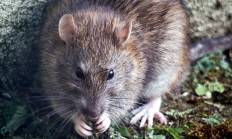
The Norway rat is the largest member of the subfamily in Oregon. This heavy-bodied rat has a scantily haired, scaly tail shorter than the length of the head and body. The ears are membranous and lightly furred. The pelage is course, a grizzled brownish or rusty gray dorsally and dirty white to yellowish gray ventrally. Albino, melanistic, and spotted specimens are known to occur in free-living populations. This rat is distributed throughout the world in association with humans and in Oregon is found in most of the counties west of the Cascade Range and from some counties along the Columbia…
The Steller (or Northern) sea lion is the largest member of the family Otariidae. Among adult females and subadult males, the upper body is slim, whereas in adult males it is heavy and muscular. The head is bearlike with a moderate step between muzzle and forehead. The rear flippers are relatively small and can be turned beneath the body for travel on land. The pelage is light buff to reddish brown, slightly darker in the chest and abdomen. Overall the pelage appears darker when wet. However, beneath the water it appears white, whereas the California sea lion appears black. In…


Leaburg Hatchery was built in 1953 to mitigate for lost fishing opportunity because of the many dams on Willamette Basin rivers. These dams include Cougar, Blue River, Carmen-Smith, Lookout, Dexter, and others. The hatchery rears rainbow trout, summer steelhead and Chinook salmon, and has a staff of four employees. Come visit our show pond and see huge white sturgeon and rainbow trout. There’s a viewing platform built by the McLaren School for Boys in 1993 to allow visitors to get a close up look at spring Chinook salmon spawning in the creek below.
SALEM, Ore – Mussel harvesting is now closed from Cape Blanco to the California border due to levels of paralytic shellfish poisoning above the safety threshold, the Oregon Department of Agriculture and the Oregon Department of Fish and Wildlife announced today. On the mid-coast, marine biotoxin levels tested below the…
The Red crossbill is aptly named for its unusual bill configuration of crossed upper and lower tips of the mandibles which it uses to pry seeds primarily from native conifer cones. Degree of bill crossing is variable depending on wear, and it can have a right or left cross. Adaption to varied conifer cone structures and sizes has resulted in a diversity in body size, bill size and shape, and palate configurations in Red crossbills. Juveniles are brown with heavy streaked undersides and faint buff wing bars. Mature males are red with dark brown flight feathers and tail; first-year males…

The common muskrat is the largest arvicoline rodent on Oregon. The body is heavy and rounded, and except for the tail and feet, heavily furred. The eyes are beady; the ears are rounded and almost covered with fur; the tail is flattened laterally, scaly, keeled, and naked except for a few hairs on the keel. The forefeet are relatively small, but the hind feet are large and partly webbed. The pelage consists of an exceedingly dense underfur usually overlain by glossy dark-brown guard hairs; the underfur is waterproof. Reddish, blackish, silvery, and white individuals have been recorded. In Oregon, muskrats…
