Search myodfw.com
Showing 1101 - 1120 of 1204 results
Although these species are quite different, they are both in the same family, Procyonidae.
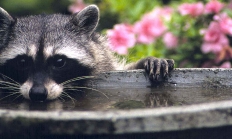
The ringtail is shaped somewhat like a marten with an elongated body and tail of approximately equal length. The ringtail is named for its tail which has has eight dark bands alternating with seven buffy bands. The dorsum is buff overlain with blackish or dark-brownish guard hairs; the venter is whitish or light buff. The face mask is whitish, but the eyes are fringed with a narrow band of black. The toes are equipped with semi-retractile claws, and except for the pads, furred on the ventral surface. The ears are long and set wide apart on a nearly horizontal plane…

This group of mammals includes the American marten, fisher, and wolverine which are all Oregon Conservation Strategy Species.

The American marten is weasel-like with a long body and pointy face. The legs are short; the toes, including the pads, are completely furred; and the nails are semiretractile. The tail is bushy and long. The pelage in winter is luxuriant, with a dense underfur and sparse covering of guard hairs. The color varies, but usually is a golden brown shading to dark brown on the feet and tail; the head is lighter. The throat and chest are splotched with orange or yellow. A small dark stripe extends upward from the medial corner of each eye, giving the appearance of…

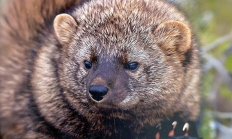
The Fisher is considerably larger than the marten and males are considerably larger than females. It is more stockily built than the weasels, but is similar in that the head is somewhat pointed, the body elongate, and the legs short. The pelage is long except on the face. The fur is dark brown grading to black on the rump and legs; the tail is black. Fishers once occurred throughout the coniferous and mixed forests of Oregon's Coast Range and Cascade Mountains. Currently, there is a native population in the Siskiyou Mountains and an introduced populations in the southern Cascades that…
The Ermine is the smallest member of the genus in Oregon. It has a long, cylindrical neck and body and short legs, but the tail is relatively short. The head is flattened and somewhat triangular, the eyes are small and slightly protruding, and the ears are rounded. The summer pelage is brown dorsally, usually white or yellowish ventrally; in some individuals the throat and belly are splotched with brown or are entirely brown. In some populations east of the Cascade Range, ermines replace brown summer pelage with a white winter pelage. The tip of the tail remains black at all…

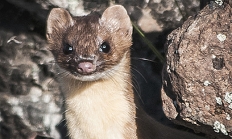
The Long-tailed weasel is the larger of the two weasels in Oregon, but smaller than the other member of the genus, the mink. Males are considerably larger than females. The head is flattened and somewhat triangular; the body and neck are elongate and almost cylindrical; the legs are short, and the tail is long. The summer pelage is brown dorsally; the venter is yellowish to orangish except for a white chin and sometimes one or more scattered brown spots. The tip of the tail is black. The pelage is molted twice annually. In the Cascade Range and eastward through the…
The Mink is a semiaquatic species. The body is elongate and cylindrical, the legs are short and stout, the tail is bushy and about half as long as the head and body. The head is flattened, the ears small and rounded, and the nose is pointed. The pelage consists of dense grayish underfur and long lustrous guard hairs. Dorsally, it is dark brown to blackish but somewhat lighter on the venter. In Oregon, the mink is found throughout the state and is associated with river, lake, pond, or marsh environments. They forage along overhanging banks, and in holes and crevices…

The Wolverine is the largest terrestrial mustelid in Oregon that, to some degree, resembles a small bear. It is powerfully built with a broad, dog-like head; short round ears; small eyes; a slightly humped back; relatively short legs and a bushy, somewhat drooping tale. The pelage consists of a dense, wooly, crimped under fur overlain by course, stiff and somewhat shaggy guard hairs. Fur on the tail is about twice as long as on the body. The base color is blackish brown with a pale brown stripe extending along the sides from the head or shoulders to the base of…

The American badger is a medium-sized, powerfully built carnivore strongly adapted for digging. The body is flattened and the legs are short but stout; the toes of the forefeet are partly webbed and equipped with long, curved claws; the hind feet are shaped like miniature shovels; and each eye is equipped with a membrane that can be extended to cover it. The ears are rounded and densely covered with fur but seem large in comparison with those of many digging mammals. The tail is short and brushlike. Dorsally, the long, shaggy pelage is mottled grayish blending on the venter to…

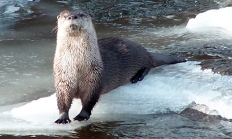
The River otter is adapted for both terrestrial and aquatic environments. The heavily muscled, somewhat cylindrical body is thickest at the thorax and tapers posteriorly to a thick, flattened tail. The body tapers to a blunt and slightly flattened head. The legs are short and powerful; and the toes are webbed. The eyes are small, forwardly directed and set high on the head. The underfur is grayish, short, and dense, and overlain by longer, stiff and shiny guard hairs. The dorsum is brown and the venter a lighter brown or tan; the lower jaw and throat are whitish. In Oregon…
The Western spotted skunk is smaller and more weasel-like than the Striped skunk. The pelage is black with a somewhat pentagonal white patch between the eyes, a round white patch on each side of the head and four or six segmented white body stripes. This skunk is endowed with a muscle-encapsulated musk gland similar to those of the Striped skunk and so similarly, can eject musk from two papillae located under the tail. The odor of the musk is considered somewhat more pungent or acrid but is less spreading than that of the Striped skunk. In Oregon, this skunk occurs…

The Striped skunk is about the size of a house cat with a pointed head; slightly upturned, nearly spherical nose pad; and beady black eyes. The pelage is entirely black except for a narrow white stripe on the forehead and nose, a white pate leading to two diverging white stripes on the back that extend partly or completely to the rump. Entirely white skunks, or skunks with the black replaced by seal brown or the white replaced by yellow are also know to occur. Without doubt, the most widely recognized characteristic of the Striped skunk is the pungent odor of…

Oregon's three cat species all belong to the same family as the domestic house cat. Cats are muscular but graceful and have retractable claws to hold prey.
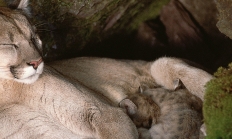
The Canada lynx is only slightly larger than the bobcat. Nevertheless, long legs and long fur produce the illusion that the lynx is considerably larger than it actually is. Documented accounts of wild lynx are rare and lynx are not expected to currently reside in Oregon. However, if lynx were to be observed, it is likely to occur at higher elevations such as in the Cascade Range, Blue Mountains or Wallowa Mountains. Habitats used by lynx often are defined in terms of habitats used by their primary prey species, thus good snowshoe hare habitat usually is considered to be good…

Oregon's hoofed mammals include three sub-species of deer, along with moose, elk, goat, and sheep. Otherwise known as ungulates, these animals are herbivores.
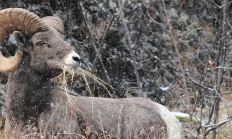
The moose is the largest member of the family Cervidae. The pelage is blackish or dark brownish grading to dark gray or grayish brown on the venter and leg. The muzzle is broad and overhanging, the palmate antlers of adult males are massive, and a "bell" (waddlelike flap of skin on the throat) is present. The first moose to come to Oregon wandered south from Washington or west from Idaho across the Palouse Prairie. They stayed to establish a herd in the Blue Mountains north of Elgin, and today there are an estimated 50 adults and calves in the area…

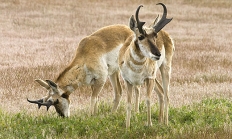
The pronghorn, often called "antelope," is deer-sized with relatively long and thin legs and feet with just two digits on each foot, a relatively small tail, and unique horns consisting of deciduous keratin sheaths set on bony cores arising from the fontal bones. Among males, the laterally flattened sheaths are long, branched and recurved, but in those females that possess horns they are short and simple. The horns and hooves are black. The front feet are larger and carry most of the weight when the pronghorn runs. The pelage is course. The dorsum is a light buff and is separated…
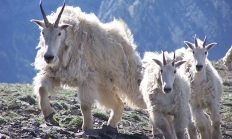
The mountain goat is a stockily built bovid with black scimitar-shaped horns, large black hooves and prominent dew claws, and an entirely white, wooly pelage. Sometimes the pelage contains scattered brown hairs on the dorsum and rump. A long beard, pointed ears, and a squarish muzzle are also characteristic. Males are larger, and have longer, larger-diameter, and more evenly curved horns that females. Mountain goats are denizens of high altitudes, remote, and barren montane regions where they are capable of moving through exceedingly rugged and precipitous terrain with speed and agility. Nevertheless, mountain goats are known to fall occasionally, whereupon…