

Search myodfw.com
Showing 141 - 160 of 785 results
Press Release
WALDPORT, Ore. — The Oregon Department of Fish and Wildlife and First Baptist Church of Waldport will host the 27th annual family fishing event at Eckman Lake on Saturday, May 16. The event will take place from 9 a.m. to 2 p.m. for youth ages 17 and younger. Each participant…
May 11, 2026
Zones or Areas
Wide open spaces, wild windy places, and extreme temperatures characterize Oregon’s largest, most remote fishing zone. Redband trout are native to its rivers and streams, including the Williamson, Malheur and Chewaucan. Brown and hatchery rainbow trout can grow to trophy-size in many of its lakes and reservoirs, many of which also feature crappie, yellow perch and bass.
Zones or Areas
Oregon’s beaches, bays and ocean waters have more kinds of fishing than anywhere in the state. From chasing surfperch in the… well, surf, to hooking cabezon from a rocky jetty, to going deep after rockfish and halibut, to the line-screaming runs of an albacore tuna, this zone offers a species and fishing technique for every angler. Subscribe for updates Starting Jan. 1, 2026, an Ocean Endorsement is needed for most recreational anglers fishing in the ocean. Check the Ocean Endorsement page for more information. Ocean Endorsement
Zones or Areas
The Snake River and its impoundments offer first class fishing for warmwater species such as channel catfish, crappie and smallmouth bass. That part of the river running through the spectacular Hells Canyon Wilderness may have some of the best summer steelhead fishing in the state.
Press Release
SALEM, Ore.--Oregon's Fish Passage Task Force will meet Wednesday, March 11, from 8:00 a.m. to noon online. The meeting agenda includes numerous ODFW Fish Passage Program updates, Task Force business items, and a round table discussion by Fish Passage Task Force Members and ODFW staff on fish passage guidance documents…
March 4, 2026
Species and Subspecies
Features: These fish are light silvery-white, dark on top, and have up to 8 dark, broken stripes running along the sides of their bodies. They are typically less than 10 lbs but can grow to 22 lbs. They have two dorsal fins, the front one with eight or nine spines and the rear one with one spine and 13 or 14 soft rays. Habitat: Hybrid bass were originally stocked in Tenmile Lakes on the south coast and in Ana Reservoir in Lake County. They have since been introduced into Thompson Reservoir, also in Lake County. The only established population is…

Species and Subspecies
Features: Tiger trout are a hybrid between a female brown trout and a male brook trout. They are greenish yellow to brown with dark patches along their sides creating a maze-like pattern. Their belly is yellowish orange and the tail fin is square. Habitat: These sterile fish have been introduced to Diamond and Fish lakes to help combat several invasive bait fish species. Since they do not reproduce, tiger trout are catch-and-release only. Techniques: Tiger trout will go for flies, spoons, spinners and bait. Because tiger trout are piscivorous (they eat other fish), fishing a minnow imitation can be effective.

Species and Subspecies
Features: When in the ocean chum salmon are bluish green on their backs. Their tails lack spots but tend to have silver streaks like the coho. Their lower jaw will be dark at the gum line and white or pink both inside and outside of the gum line. Once in freshwater, chums become dark green to brown with red to purple marks going vertically down their sides. Habitat: Like other salmon species, chum spend most of their lives at sea and return to their natal streams to spawn. Most spawning runs are over a short distance. Adults are strong swimmers…

Species and Subspecies
Features: Common carp are deep-bodied, heavy-looking fish with short heads and forked tails. They have large (really large) scales ranging from grey to bronze. Two barbels hang from each side of the upper lip of their subterminal (near the bottom of the head) mouth. This distinguishes them from goldfish that have no barbels. The dorsal fin is elongated. Habitat: Though tolerant of most conditions, common carp prefer large bodies of slow moving or standing water with soft sediments like mud or sand, and good growths of aquatic vegetation. They’re omnivorous bottom feeders that prefer aquatic insects, worms, mollusks and zooplankton…

Species and Subspecies
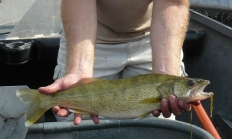
Features: Color varies, but walleye are generally dark olive-brown on top grading to almost white below. Walleye have two well-separated dorsal fins; the first fin has a large black spot at its rear base. The opaque eyes, giving the fish its common name, and canine teeth are other prominent features. Habitat: Walleye are found in the Columbia, Willamette and Snake rivers. In the Willamette River, the walleye fishery is generally limited to the section downstream from Willamette Falls at Oregon City, although a few have been documented as far upstream as Dexter Dam. Walleye prefer large, clean and cold or…
Press Release
CLACKAMAS, Ore.—Following an in-season assessment of the upriver spring Chinook return, fishery managers from Oregon and Washington added more recreational spring Chinook fishing days on the mainstem Columbia during a joint state hearing yesterday. Six additional fishing days downstream of Bonneville Dam and five additional fishing days upstream of Bonneville…
May 13, 2026
Species and Subspecies
Features: Largemouth bass are greenish on the back and sides with a white belly and usually a dark horizontal stripe along the side. They are distinguished from their close cousin, the smallmouth, by a large mouth with the upper jaw extending behind the eye. Largemouth bass in Oregon can exceed 25 inches in length and a weight of 12 pounds. Habitats: Their preferred habitats are shallow ponds and lakes, or the backwater sloughs of rivers where aquatic plants or submerged logs and brush provide abundant cover. Largemouth bass begin life feeding on zooplankton (tiny crustaceans), but soon switch to insects…

Species and Subspecies
Features: Like all cutthroat trout, this species boasts bright red streaks on either side of its “throat.” You can tell it’s a westslope cutthroat by its spot pattern – the majority of the black spots are found on the back end of the fish with rather few ahead of the dorsal fin. Habitat: While westslope cutthroat trout was once the most widely distributed cutthroat in North America, its home in Oregon has always been limited to the John Day Basin. During the cooler months of summer you can find them in places like Strawberry Creek and upper Canyon Creek. As…

Species and Subspecies
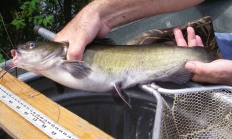
Features: Channel catfish are pale bluish-olive above and bluish-white below with a deeply forked tail, dorsal and pectoral spines, and an adipose fin. Like all other catfish, channel catfish have “whiskers” or barbels extending from the chin and upper jaw. Young fish have a varying number of small black spots over much of the body, while older fish may be partially or entirely without spots. Maximum size in Oregon approaches 40 pounds, but most are less than 10 pounds. Habitat: Channel catfish in western Oregon are limited to the Columbia River, lower Willamette River, and a few ponds in the…
Species and Subspecies
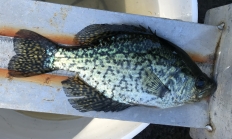
Features: Black crappie are silvery in color with numerous black or dark green blotches and no distinct vertical bars. This results in a darker overall color than seen in white crappie. The forehead is dished, but not as much as in the white crappie. The dorsal fin usually has seven or eight spines and its length is equal to or greater than the distance between the dorsal fin and eye. Habitat: Black crappie do best in clear waters of medium-sized lakes, reservoirs and large slow moving streams. They are less tolerant of flowing and muddy water than white crappie and…
Species and Subspecies
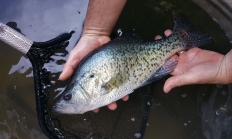
Features: White crappie are often confused with black crappie. White crappie have silvery bodies with blackish-green mottling forming narrow vertical bars on the sides. The forehead is more dished than in the black crappie. The dorsal fin has five or six spines and its length is less than the distance between the dorsal fin and eye. Habitat: White crappie do best in larger lakes and reservoirs and are more tolerant of turbidity and less dependent on aquatic vegetation than black crappie. They congregate around pilings, sunken logs, underwater brush, weed beds and rocks. White crappie begin life feeding primarily on…
Species and Subspecies
Features: Steelhead are rainbow or redband trout ( O. mykiss) that migrate to the ocean during their first or second year, returning one to three years later to spawn. While in the ocean, steelhead are silvery in color and typically grow significantly larger than their siblings who never leave fresh water. Once back in fresh water, they usually turn dark-olive in color, with silvery-white undersides, heavily speckled bodies and a pink to red stripe running along their sides. Habitat: Summer-run steelhead return to freshwater between May and October and require several months to mature and spawn. Winter-run steelhead return to…

Species and Subspecies
Features: These blue-green, silvery or light brown fish are a schooling fish and an important food source for larger fishes, sea birds and marine mammals. Habitat: Anchovy are frequently offshore, but can be caught inshore in harbors and large estuaries during spawning. Technique: Anchovy are usually targeted in bays with multiple-hook herring jigs.

Species and Subspecies
Features: Coastal rainbow trout are often residualized steelhead that spend their entire life cycle in fresh water, never migrating to sea. They are a silvery color with black spots on their backs and fins, and a pink band running down their sides. Often their gill covers are pink as well. The pelvic anal, and dorsal fins have a white edge to them. Habitat: They can be found in cold rivers, creeks, and inland lakes. However, they require streams with clean gravel, complex habitat, and cool temperatures for spawning and rearing. Techniques: Trout in stillwaters tend to be on the move…
