

Search myodfw.com
Showing 161 - 180 of 408 results
Site Sections
Oregon's diverse habitats and terrain offers something for every hunter. From the densely forested Coast Range to the expansive sage steppe of the Great Basin, hunting opportunities are practically unlimited. Visit e-regulations
Zones or Areas
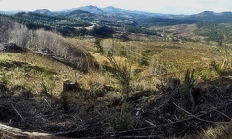
Trout fishing opportunities abound in this zone, known for its high desert climate, sage-covered canyons, glacial peaks and mountain lakes. Anglers will find year-round trout fishing in the Deschutes, Metolius, Fall and Crooked rivers, while several central Oregon lakes and reservoirs are renowned for their trout and kokanee fishing – and their beauty. The Hood and lower Deschutes – both tributaries of the Columbia River – offer high desert fishing for Chinook salmon and summer steelhead.
Species and Subspecies
Eastern Oregon mule deer are managed by Deer Hunt Areas, while all other big game, including Western Oregon deer hunts are managed by wildlife management units. Plan ahead by checking the boundaries of where you want to hunt. Hunters in Oregon can access millions of acres of public land open to hunting ( national forests, BLM land, state forests, wildlife areas) plus many private lands open through Oregon’s Access and Habitat program. See www.oregonhuntingmap.com to find a place to hunt.

Landing page
The Columbia Basin Wildlife Areas are a composition of four Oregon Dept. of Fish & Wildlife managed wildlife areas located along the Columbia River in the Columbia Basin. The four wildlife areas (Power City, Irrigon, Coyote Springs, and Willow Creek) are within the Columbia Plateau ecoregion. Management agreements for these areas were initially established between 1971 and 1977 between the department and Federal agencies which own the lands. The Columbia Basin Wildlife Areas, which total approximately 1,885 acres, provides an important landbase for the conservation and recreation of fish and wildlife within a highly privatized and altered landscape and play…
February 21, 2018
Landing page
The Columbia Basin Wildlife Areas are a composition of four Oregon Department of Fish and Wildlife (department) managed wildlife areas located along the Columbia River, in the Columbia Basin. The four wildlife areas (Power City, Irrigon, Coyote Springs and Willow Creek) are within the Columbia Plateau ecoregion. Management agreements for these areas were initially established between 1971 and 1977 between the department and Federal agencies which own the lands. The Columbia Basin Wildlife Areas, which total approximately 1,885 acres, provide an important landbase for the conservation and recreation of fish and wildlife within a highly privatized and altered landscape and…
February 21, 2018
Press Release
THE DALLES, Ore. – Several California bighorn sheep along the John Day River have recently tested positive for Mycoplasma ovipneumoniae (M. ovi), the respiratory pathogen associated with pneumonia outbreaks in wild sheep. The detections mark the first known cases of M.ovi in the John Day River herd, the state's largest…
September 8, 2026
Article
Historic harvest statistics can guide you to areas with good habitat that support healthy bird populations.
March 20, 2026
Zones or Areas
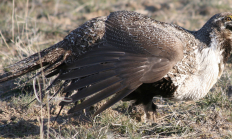
Wide open spaces, wild windy places, and extreme temperatures characterize Oregon’s largest, most remote fishing zone. Redband trout are native to its rivers and streams, including the Williamson, Malheur and Chewaucan. Brown and hatchery rainbow trout can grow to trophy-size in many of its lakes and reservoirs, many of which also feature crappie, yellow perch and bass.
Article
Lane County offers so much to explore — from coastal lakes and rivers to mountain lakes and streams. The Willamette River runs through the Eugene-Springfield metro area and is fed by three major rivers: the McKenzie, Middle Fork Willamette and Coast Fork Willamette. Florence is surrounded by large dune lakes, the Siuslaw River and Pacific Ocean. With so many places to fish, it’s no wonder Lane County is an angler’s paradise. For current regulations, call your local ODFW office or check MyODFW.com.
Article
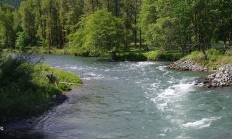
Successful steelhead fishing is more about developing a good strategy for finding fish than about fussing over gear, techniques and colors. (Although pink worms really do work!)

Press Release
Image: The circles show monitoring stations in the basin and the green shows detection of a tagged salmon. KLAMATH FALLS, Ore. — Salmon are making exciting progress in their return to the upper Klamath Basin, with fisheries biologists from ODFW and The Klamath Tribes celebrating a series of firsts as…
October 17, 2025
Landing page
Fire Closure: As of July 29, 2026, the northern portion of the wildlife area is closed. More information here: https://myodfw.com/news/odfw-closes-northern-portion-white-river-wildli… White River Wildlife Area was established in 1953. Located along the east slope of the Cascade Mountains in the north central part of Oregon, the wildlife area encompasses 29,480 acres. An additional 1,280 acres of land owned by the Bureau of Land Management (BLM) is managed by the ODFW bringing the total acres managed by the department to 30,760. The primary purpose of White River Wildlife Area is to provide winter range habitat for black-tailed deer and Rocky Mountain elk…
February 26, 2018
Article
The southeast area covers the high desert country of Harney and Malheur counties and is the most arid region of Oregon. Extended dry periods or droughts can affect the warmwater fisheries in this area, but these can be quick to rebound when water returns. The area’s most popular warmwater fishery is found in Owyhee Reservoir, a huge nearly 14,000 acre reservoir located on the Owyhee River south of Ontario that offers outstanding fishing for bass, crappie and catfish. There are few roads to and along Owyhee, but those with a boat will be rewarded with remote and spectacular scenery. Other…

Landing page
The FRWA was created by a licensing agreement signed in 1957 and modified in 1982 and 2008, between the US Army Corps of Engineers and the Oregon Game Commission. This agreement authorized the state to develop, conserve, and manage all wildlife resources on 5,261 acres of land and water within the Fern Ridge Project. ODFW also acquired the 309 acre Coyote Creek South and 224 acre Coyote Creek Northeast units in 2013 and 2015, respectively. The wildlife area now totals 5,794 acres.
February 26, 2018
Press Release
SALEM, Ore.—Manulife will not renew its cooperative agreement with ODFW's Access and Habitat program, the company informed ODFW late last week. This means Manulife properties in northeast Oregon and Jackson County that are currently open to hunter access through the Access and Habitat "Welcome to Hunt" program will no longer…
January 21, 2026
Article
An exceptionally mild and warm 2025/2026 winter across much of Oregon has provided good over-winter survival for Oregon's deer and elk herds. Drought impacted areas got a short reprieve in spring before dry conditions returned in late summer and recent rains with cooler temperatures offer a temporary fix as fall moves into winter. Big game fitness and resiliency heading into fall hunting seasons will vary by region. Scroll down to find the field reports for Oregon hunt zones. Get your animal tested for CWD: While it's never been found in Oregon, CWD has been detected in most surrounding states and…
September 2, 2026
Landing page
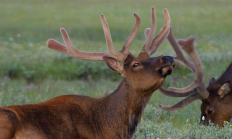
The Bureau of Land Management maintains a series of pastures along Oregon Highway 38 that are a year-round residence for a herd of 60-100 Roosevelt elk. Elk are visible almost every day of the year!
May 08, 2018
Article
Starting in 2026, deer hunts in Eastern Oregon will be organized by Deer Hunt Areas instead of traditional Wildlife Management Units (WMUs). This transition is based on new research showing that deer move across multiple WMUs throughout the year, making old systems less effective for population monitoring and harvest management. Learn more below. Use this map to compare new Deer Herd Ranges vs Wildlife Management Units. Zoom in to see WMU boundaries which are in white. View the interactive map View Individual Hunt Areas 2026 Hunt Transition Guide
November 21, 2025