
Search myodfw.com
Showing 161 - 180 of 276 results
Round Butte Hatchery was constructed in 1972 to mitigate for the fishery losses caused by Pelton/Round Butte (PRB) Hydroelectric Complex. Round Butte and its satellite, Pelton Ladder, are used for adult collection, egg incubation and rearing of spring Chinook, summer steelhead, and sockeye salmon.
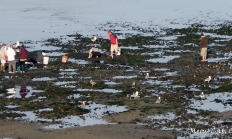
SALEM, Ore. — ODFW's Fish Restoration and Enhancement Board will meet in person on Tuesday, Sept. 30 from 8:30 a.m. to 5 p.m., in Redmond at The Lodge at Eagle Crest. The meeting will occur in person and via Teams, and members of the public may attend the meeting in…
SALEM, Ore. – The Private Forest Accord (PFA) Advisory Committee will hold its regular virtual meeting on Tuesday, October 21, 2025. Oregon Department of Fish and Wildlife staff will present two new funding pathways for the PFA Grants Program, Land Transactions and Water Transactions, followed by Advisory Committee discussion of…
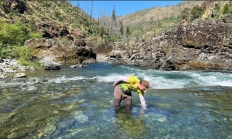
CLACKAMAS, Ore. – The two-rod validation will not be available for the Willamette River in 2026 as the forecast for hatchery-origin adult fish does not meet the minimum return threshold. The 2026 Columbia River spring-summer forecast anticipates 43,700 adult Willamette-origin spring Chinook will return to the mouth of the Columbia…
SALEM, Ore.—Manulife will not renew its cooperative agreement with ODFW's Access and Habitat program, the company informed ODFW late last week. This means Manulife properties in northeast Oregon and Jackson County that are currently open to hunter access through the Access and Habitat "Welcome to Hunt" program will no longer…
The Columbia River is renowned for its salmon and steelhead runs. In a year of good returns, over 1 million Chinook, coho and sockeye salmon, and summer steelhead travel up the river to spawn in its tributaries. Less known are the river’s excellent smallmouth bass and walleye fisheries. While most anglers fish this large river from a boat, there is plenty of good bank access at various parks, boat launches and beaches.
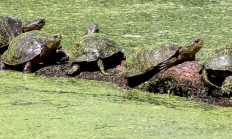
Fish counting through Willamette Falls fishway occurs at the main viewing window. Video cameras and time lapsed video recorders are used to record fish passage 24 hrs/day, 365 days/year. Our schedule for reviewing the tapes is Monday through Friday.
SALEM, Ore. – ODFW's PFA Grant Program began accepting applications on Nov. 14. The grant program is set to offer another $10 million to support innovative projects that drive real change. Applicants can find the PFA Grant Program's Grant Guidelines here and the streamlined application by logging into the Online…
Trout fishing opportunities abound in this zone, known for its high desert climate, sage-covered canyons, glacial peaks and mountain lakes. Anglers will find year-round trout fishing in the Deschutes, Metolius, Fall and Crooked rivers, while several central Oregon lakes and reservoirs are renowned for their trout and kokanee fishing – and their beauty. The Hood and lower Deschutes – both tributaries of the Columbia River – offer high desert fishing for Chinook salmon and summer steelhead.

Updated February 19, 2026 Subscribe for updates Starting Jan. 1, 2026, an Ocean Endorsement is needed for most recreational anglers fishing in the ocean. Check the Ocean Endorsement page for more information. Ocean Endorsement
Big Creek Hatchery began operation in 1941. It was refurbished in 1957 under the Mitchell Act as part of the Columbia River Fisheries Development Program – a program to enhance declining fish runs in the Columbia River Basin. The facility is used for adult collection, egg incubation and rearing of winter steelhead, fall Chinook, and coho.

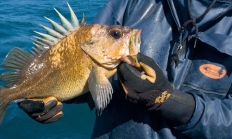
The granite peaks of Oregon’s Blue and Wallowa Mountains form the backdrop for many of this zone’s glacier-carved lakes and crystalline streams. Bull trout thrive in this zone’s cold, clear rivers, which also sustain whitefish and rainbow trout, and welcome returning runs of hatchery-reared steelhead. Chinook salmon travel over 300 miles up the Columbia to spawn in rivers such as the Imnaha and Wallowa. Warmwater fisheries are few, but the John Day River offers world-class fishing for smallmouth bass.
Abundant rainfall feeds the massive Willamette River watershed, tamed by a system of reservoirs that are stocked annually with hundreds of thousands of rainbow trout. Some of these reservoirs also grow trophy-size largemouth and smallmouth bass, as well as bluegill, brown bullhead and crappies. Smaller lakes and ponds nearer the valley floor provide springtime trout fishing close to home. Salmon and steelhead navigate the Willamette River and its tributaries, many of which are also home to rainbow and cutthroat trout.