
Search myodfw.com
Showing 1 - 20 of 509 results
ROSEBURG, Ore. – The Oregon Department of Fish and Wildlife is looking for a volunteer site host at its Canyonville winter steelhead acclimation site on lower Canyon Creek. This opportunity to work with hatchery steelhead and help improve Oregon's fisheries is from Jan. 1 – Apr. 30, 2026. The acclimation…
KLAMATH FALLS, Ore. – Recreation access sites within the restored Klamath River reach between Keno, Ore., and Hornbrook, Calif., will remain open as winter conditions allow. The five recreation day-use access sites now open until further notice are as follows: Pioneer Park West (Ore.) Moonshine Falls (Ore.) K'utárawáx·u (prounounced ku-ta-ra-wa-hhu)…

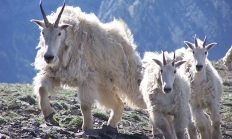
The mountain goat is a stockily built bovid with black scimitar-shaped horns, large black hooves and prominent dew claws, and an entirely white, wooly pelage. Sometimes the pelage contains scattered brown hairs on the dorsum and rump. A long beard, pointed ears, and a squarish muzzle are also characteristic. Males are larger, and have longer, larger-diameter, and more evenly curved horns that females. Mountain goats are denizens of high altitudes, remote, and barren montane regions where they are capable of moving through exceedingly rugged and precipitous terrain with speed and agility. Nevertheless, mountain goats are known to fall occasionally, whereupon…
Accessibility Statement for Oregon Department of Fish & Wildlife The Oregon Department of Fish & Wildlife is committed to providing a website experience that functions for all users regardless of ability, network speed, or device. We are continually improving the user experience for everyone, and applying the relevant accessibility standards. We invite feedback if you have issues accessing any part of https://myodfw.com/ Site features Each page on the site has a “Skip to Main Content” that’s visible on focus, giving visitors the option of jumping past navigation and into main content. A link to our Accessibility Statement and feedback form…


CLACKAMAS, Ore. – Angling will be closed on the lowest reach of Eagle Creek in the Clackamas basin from Sept. 27 through Oct. 31 to give coho salmon a safe resting area amid ongoing low water flows. The closure is from SE Dowty Road downstream to the Clackamas River confluence…


In 1925 the first fish hatchery on the South Santiam River began operations about 5 miles upstream from today’s present site, rearing annually approximately 100,000 spring Chinook in dirt ponds for release into the South Santiam River. The present site came about with the construction of Foster Dam. In 1968 the facility was dedicated for the rearing of spring Chinook and summer steelhead. This facility was built and annually funded in part by the US Army Corps of Engineers to compensate for the loss of spawning and rearing areas above the dams on the South Santiam River.
Greater sage-grouse are best known for their elaborate courtship displays that occur on traditional strutting grounds, known as leks, where males gather each spring. At all seasons, both sexes are readily identified by large size and chicken-like build. Adults are mottled dark gray, black and buff, with black bellies and pointed tails. Males have specializations used in display. Their tail feathers are long and pointed with white spots. They have yellow combs over each eye and a chest sac with two bare, yellow patches of skin which are inflated during display. The display lasts only a few seconds and is…

NEWPORT, Ore. – The Oregon Department of Fish and Wildlife is hosting a Feb. 2 public meeting beginning at 6 p.m. to get input on the number and timing of fixed and back-up dates for the central Oregon coast spring all-depth Pacific halibut season. The meeting is in the conference…
The FRWA was created by a licensing agreement signed in 1957 and modified in 1982 and 2008, between the US Army Corps of Engineers and the Oregon Game Commission. This agreement authorized the state to develop, conserve, and manage all wildlife resources on 5,261 acres of land and water within the Fern Ridge Project. ODFW also acquired the 309 acre Coyote Creek South and 224 acre Coyote Creek Northeast units in 2013 and 2015, respectively. The wildlife area now totals 5,794 acres.