Search myodfw.com
Showing 21 - 40 of 897 results
Features: Black rockfish are dark gray to black on top, with a lighter belly, and black spots on their dorsal fins. They can grow to be 25-inches long. Take the "Black Rockfish or Not?" quiz Habitat: They are found over rocky reefs most typically shoreward of 180 ft. of depth, and are common along jetties and other structure in estuaries. Occasionally schools of black rockfish will come all the way to the surface. Technique: Rockfish feed on squid, octopus, krill, and other fish . They readily take both bait and lures. Common lures include rubber-tailed lead head jigs and shrimp…

Features: Black scoters‘ plumage is pure black uninterrupted by any white. The swollen bright orange-yellow knob on the otherwise black bill is smaller than that of other scoters. Females' uniform soot upperparts and dark head cap are clearly delineated from paler cheeks. Habitat: This scoter can be uncommon to locally common along the coast fall through spring, usually on the ocean. Techniques: Like other scoters, black scoters are ducks of the open ocean, and inaccessible to most hunters.

The black rat is slightly smaller than the Norway rat, but much larger than the house mouse, the only other members of the subfamily in Oregon. The black rat is similar to other members of the subfamily in that it possesses a scaly, scantily haired tail; membranous, nearly naked ears, and a soft pelage. It differs from the Norway rat in having a tail much longer than the length of its head and body and commonly having a darker-colored pelage. The pelage ranges from black to sandy brown dorsally and from lead colored to nearly white ventrally. The black rat…

Along coastal shores and islands, the chatter and flight calls of Black turnstones invite an observer to look more closely at the rocky substrates to find these birds busily picking about in their search for food. They primarily use rocky shores, jetties, and offshore islands, but may also be found on shorebird flats and sandy beaches. The Black turnstone is a common transient and winter visitant on the coast. Hear the call of the Black turnstone Phogo by ©Keith Kohl, ODFW

Insects swept up in a rising air mass are favorite prey of this species nicknamed the "cloud swift." It prefers to nest near or even behind the curtain of a waterfall. This dark swift glides for long distances, often very high in the sky, with its wings held somewhat downward. It is larger and darker than the more common Vaux's swift, and has a slightly forked tail. The Black swift is a rare to uncommon spring and fall transient and summer visitant throughout the state. It's an Oregon Conservation Strategy Species in the West Cascades ecoregion. Hear the call of…

Features: Oregon is home to an estimated 25,000-30,000 black bears, which is North America’s most common bear species. They are the only type of bear found in Oregon. Despite their name, black bears are often brown in color. Habitat: Black bears are found statewide, with concentrations in the Coast and Cascade ranges and the Blue Mountains. Techniques: Oregon offers a controlled spring season (apply by Feb. 10) and a general fall season. Glassing open areas where bears are feeding on grass and shrubs works early spring season. Later in the season, some hunters turn to predator calls. Most fall bears…

For many, the rich, melodious song of the Black-headed grosbeak is the music of springtime in Oregon. The handsome males, with their bold pattern of cinnamon, black, and white, are among our most striking songbirds, and area familiar site in parks and gardens as well as in almost every forest type in the state. The buffy, streaked females are less conspicuous, but are also accomplished singers. The Black-headed grosbeak is a common to fairly common breeder and common migrant in forested regions throughout the state. Hear the song of the Black-headed grosbeak Photo by David Bronson


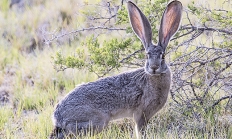
The black-tailed jackrabbit is slightly smaller than the white-tailed jackrabbit but considerably larger than the snowshoe hare. In conformation, it is much like the white-tailed jackrabbit. West of the Cascade Range, the dorsal hairs of this rabbit have gray blending to dark-brown or blackish base followed by a narrow band of buff and a black tip. Hairs on the throat, sides, and rump have gray bases blending to buff with short black tips. On the venter, hairs are white with light pinkish-buff tips. The tail is black on the dorsum and dark buff on the venter. The ears are dark…
Adult Klamath black salamanders that live in Oregon are fully black with a smattering of bronze or green specks across the top of their heads, backs, tails and legs. The black salamander is one of the lungless salamander species and it breathes through its skin. Female black salamanders are generally larger than males and grow up to five-and-a-half inches in total length. Black salamanders live in forest, open woodland, moist talus (rock fragment piles) and streamside habitats. They use crevices in moist decaying logs or stumps, wet talus slopes or just under surface debris for cover during warm wet weather…

This fragile-looking bird with bold black-and-white plumage and exaggerated, long, reddish legs is often associated with American avocets at shallow inland ponds and lakes. Very noisy and aggressive in protection of its nest and young, using a variety of distraction displays, including an impressive broken-leg act to lure away interlopers. The Black-necked stilt is a locally uncommon to fairly common summer resident of Klamath, Lake, Harney and Malheur counties. The largest Oregon breeding colony is at summer Lake. It has become a regular spring and fall migrant through eastern Oregon and irregular spring and casual fall migrant through western Oregon…

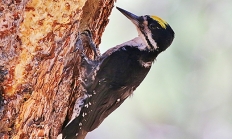
The Black-backed woodpecker can often be found in the open expanses of a recent forest fire or the twiggy closets of a bark beetle outbreak. It may be heard before seen, with its accelerating drum ringing from a prominent snag or its snarling call. Its nest is often low in a tree; both living and dead trees are used, but may require heartrot for excavation of nest cavities. Nest trees are often smaller in diameter than those used by other cavity nesters. It is a rare to locally common resident near the summit and on nearby plateaus and ridges on…
Noted for its familiar call, chick-a-dee-dee-dee, the Black-capped chickadee is widely heralded as one of Oregon's friendliest and cheeriest residents. Even in the midst of winter, this bird "fairly overflows with good spirits." The Black-capped chickadee is resident at low to moderate elevations in western Oregon from the Willamette Valley and coastal counties to Douglas County and in most of eastern Oregon with the exception of the southeastern corner of the state. Hear the song of the Black-capped chickadee Photo by Dave Budeau, ODFW

This is one of the most audacious of Oregon's resident avifauna both in appearance and behavior. Its black coat and streaming tail dappled in blue-green iridescence contrasts starkly with its flashing white wing feathers during flight. Common and conspicuous east of the Cascades, the magpie prefers open areas stippled with dense thickets or trees. They are highly social, often gathering in large flocks. Historically despised and persecuted by hunters, farmers, and ranchers, this trickster has flourished in the tradition of the coyote. Hear the call of the Black-billed magpie Photo by Kathy Munsel, ODFW

A big, well-mannered bird of friendly, even playful disposition, with an abundant curiosity as to human presence and activities within the realm of open ocean over which he presides. Long-winged, to seven feet, and dark sooty-brown; adults have a white rump and feathering, which juveniles lack, around the base of a large bill. Every sighting of these gentle giants gliding up to the boat evokes delight. The black-footed albatross is a regular visitant spring through fall offshore, but is irregular in winter. They glean squid, fish and fish eggs from the ocean surface and also eat galley scraps. Hear the…

Western Oregon observers enjoy these large, elegant plovers almost year-round, and as a consequence they are one of the most familiar larger shorebirds. Almost all migrants and winterers visiting Oregon inhabit mudflats and open wet dirt fields. A few can be found on sand beaches and even occasionally on rocks, but the great majority are found feeding and resting on open mud. In Oregon, it is a fairly common to common transient in western interior valleys. East of the Cascades, the Black-bellied plover is an uncommon transient in the Klamath Basin and at Malheur National Wildlife Refuge. In winter it…

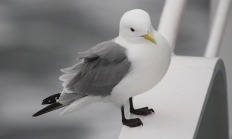
These small agile gulls are predominantly pelagic, but can often be seen from shore and even idling around lower estuaries. It is found primarily on salt water and does not usually forage in dumps and pastures as most gulls do; rather it stays over open ocean, along beaches and in lower estuaries, sometimes resting on the water or on jetties, sand spits and similar bare areas. They are often attracted to feeding swarms of loons, pelicans, tubenoses and other seabirds. The Black-legged kittiwake is a migrant and winter resident in Oregon along the outer coast and offshore. Peak numbers are…
One of the first migrants to brighten Oregon woodlands with song is the Black-throated gray warbler. As early as the first week in April, the distinctive buzzy song announces the male's arrival in habitats from riparian forests to juniper woodlands, chaparral to Douglas-fir forests. It sings even as it darts through the canopy and understory in search of insects. Except for the small yellow spot in front of the eyes, the male is an essay in black, gray and white. The cap and throat are black, as is the cheek which is outlined in white. The back is gray, striped…

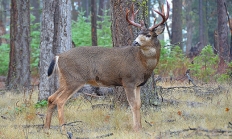
Nearly a dozen subspecies of Odocoileus hemionus are recognized. Of these, two occur in Oregon - the mule deer and Columbian black-tailed deer, often just referred to as "Black-tailed deer." The mule deer is larger, lighter in color, and often associated with more open habitats, whereas the black-tailed deer is smaller and darker, and frequents dense, early seral forest communities. The most distinguishing feature of the black-tailed deer is the tail. Although not as long or wide as that of the white-tail, it is much larger than that of the mule deer. Because of the differences in size, color, marking…
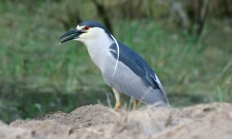
Although quite common in the U.S., the Black-crowned night-heron's nocturnal and crepuscular feeding habits can make it difficult to locate. Its habitat consists of marshes, lakes, rivers, and other wetlands, where it feeds mostly on fish. It is a thick-billed, medium-sized, stocky heron with relatively short neck and legs. Adults have a black back and cap which contrast with the pale gray or whitish underparts. Immatures have brown backs with large pale spots and heavily streaked underparts. A distinctive choking squawk call is often heard at dusk. It is a fairly common summer resident east of the Cascades where it…