Search myodfw.com
Showing 221 - 240 of 509 results
Find maps, boundary descriptions and hunts available in the new Elkhorn Hunt Area. Download printable PDF map
Find maps, boundary descriptions and hunts available in the new Painted Hills Hunt Area. Download printable PDF map
Find maps, boundary descriptions and hunts available in the new Sage Hen Hunt Area. Download printable PDF map
Large and primarily white, the American white pelican has the longest wingspan of any bird in Oregon. It also has an enormous orange bill, and flies with neck withdrawn. During the breeding season the top of the bird's head becomes dusted with black and a horn grows on the upper mandible; this projection serves as a target for aggressive encounters to avoid injury to the essential bill pouch, but is shed after the eggs are laid. This pelican makes unusually long flights for feeding and migration, and at great distances, soaring flocks have been reported as UFOs. In Oregon, it…

The bobcat is the smallest wild felid in Oregon, with females being considerably smaller than males. The bobcat is about twice the size of a domestic cat, but its legs are longer, its tail is shorter, and its body is more muscular and compact. The feet are relatively small and the bobcat is not well adapted to negotiate deep snow. In general, the variously spotted pelage is yellowish with grayish overtones in winter and with reddish overtones in summer, reflecting the two annual molts. The ears are black with a large white spot and are equipped with short black tufts…

Features: Along Oregon's coast there are two species of mussel. Bay mussels ( Mytilus edulis) are bluish-black and grow to about 3 inches in length. California surf mussels ( Mytilus californianus) are brown or black and grow to about 7 inches long. Habitat: Mussels often inhabit boulders in the upper tidal zone so it is best to go looking for them during low-tide. Technique: Wearing a glove, use a twisting motion to pull mussels off the rocks, then immediately pull the "beard" off the bottom, the hairs that previously anchored the shellfish to the rocks. Be sure to check the…


White River Wildlife Area was established in 1953. Located along the east slope of the Cascade Mountains in the north central part of Oregon, the wildlife area encompasses 29,480 acres. An additional 1,280 acres of land owned by the Bureau of Land Management (BLM) is managed by the ODFW bringing the total acres managed by the department to 30,760. The primary purpose of White River Wildlife Area is to provide winter range habitat for black-tailed deer and Rocky Mountain elk and to minimize big game damage to adjacent private agricultural lands.

Find maps, boundary descriptions and hunts available in the new Aldrich Hunt Area. Download printable PDF map
Find maps, boundary descriptions and hunts available in the new Deschutes Hunt Area. Download printable PDF map
Find maps, boundary descriptions and hunts available in the new Elkhorn Hunt Area. Download printable PDF map
Find maps, boundary descriptions and hunts available in the Juntura Hunt Area. Download printable PDF map
Find maps, boundary descriptions and hunts available in the new Sage Hen Hunt Area. Download printable PDF map
Cole Rivers Hatchery is the largest producer of hatchery fish on the coast of Oregon. Almost all of the fish production at Cole Rivers is done to mitigate for the fish production that was lost when miles of high quality fish habitat was blocked by Applegate Dam (Applegate Reservoir) and William Jess Dam (Lost Creek Reservoir). Visit Cole Rivers Hatchery
In Oregon, fork-tailed storm-petrels breed in numbers that are only a tiny fraction of those of Leach's storm petrels. This is the larger of the two storm-petrels breeding in Oregon and is gray in color. These birds leave and return to breeding colonies only at night, when they are best detected by their distinct raspy call. At sea, they are distinguished by quick, buoyant flight with short glides interspersed with wing fluttering to maintain their position at a food source. Fewer than 20 nests have been found in Oregon, all located in the same habitat as colonies of Leach's storm…

Features: Blue grouse are large in comparison to most other grouse species. The females are mottled brown, tan, and gray. The males are similar, but with solid blue-gray on the underside and bright orange-yellow combs over the eyes. Habitat: Blue grouse occupy the coniferous forests of western Oregon, the eastern slopes of the Cascades, the Blue Mountains of northeastern Oregon, and the Klamath Basin and south Warner Mountains. Preferred habitat includes timber edges, open timbered slopes, mountain meadows adjacent to springs or other sources of water, and near berry producing areas such as chokecherry thickets. Technique: Effective hunting techniques involve…

Find maps, boundary descriptions and hunts available in the new Crooked River Hunt Area. Download printable PDF map
Alsea Hatchery was constructed in 1936 and is operated with state funds. Many improvements have been made to the hatchery since original construction. The hatchery produces both winter steelhead and rainbow trout. The facility is used for adult collection, spawning, egg incubation and rearing of winter steelhead, and egg incubation and rearing of rainbow trout.
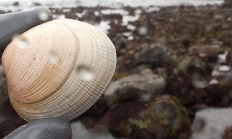
Features: Circular in shape and 1.5-2.5 inches across. Identified by concentric lines and radiating ridges. Longer lived and less abundant than cockles. Habitat: High salinity areas of sand, mud, gravel, or rock. Harvest them in Tillamook, Netarts, Yaquina, and Coos bays. Techniques: These clams can be found in rocky nearshore areas within 6 inches of the surface. Using a rake for these clams is the best harvest method. Learn more here before getting started clamming. See Oregon Sport Fishing Regulations for information on the daily catch limits for bay clams. How to dig for little neck clams (video)