
Search myodfw.com
Showing 241 - 260 of 1302 results
The American bullfrog is a non-native invasive frog that survives and reproduces very successfully in Oregon. Bullfrogs aggressively compete for food and living space with our native frogs. They eat many types of native wildlife including other frogs, young pond turtles, and ducklings. Bullfrogs can lay almost 10 times more eggs than native frogs and can quickly out number them. Photo by Kathy Munsel

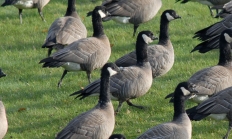
The Bald eagle is one of eight species of sea-eagle worldwide, and the only sea-eagle found throughout North America. It is one of the most studied North American birds. Large size, wingspan of six-and-a-half to eight feet, and the contrast of white head and tail, and yellow eyes, beak, and leg, to dark brown body and wings make the adult Bald eagle one of our most distinctive raptors. Six age-related plumages have been recognized; adult plumage is acquired at four-and-a-half to five years of age. Sexes have similar plumages, but females are larger than males, and the sex of individuals…

The kit fox is the smallest canid that occurs in Oregon. It has the typical canid conformation: the body is slim, the legs are long and thin, and the ears are large and erect. The tail is about 40 percent of the total length and is tipped with black, but has no dark mane on the dorsal surface. The feet and legs are whitish interiorly, light rusty-brown posteriorly. The dorsum is grizzled brownish-gray medially blending to grizzled gray then to light buff laterally and finally to white on the chest and venter. The head and posterior surface of the ears…

Black bears are the largest extant carnivores in Oregon. They are, however, smaller than grizzly bears, and they lack the grizzly's distinctive shoulder hump. A black bear is heavily built with stout legs and large feet. The eyes and ears are relatively small and the tail is extremely short. The claws are recurved but relatively short with those on the forefeet equal to or only slightly longer than those on the hind feet. The characteristic humped shoulders and dished face of the grizzly bear are absent. During spring-autumn seasons, black bears tend to be more active during daylight and crepuscular…
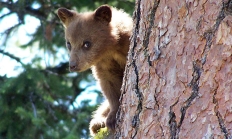
The bighorn sheep is a medium-sized, largely brownish bovid with a white rump patch, muzzle, venter, and rear portion of the legs. The tail is blackish brown on the exposed surface. The hooves are equipped with a rubberlike pad that facilitates negotiating rocky terrain. The ears are relatively small and somewhat pointed. Both sexes are equipped with horns; those of males are massive and spiral outward, whereas those of females are relatively thin, recurved, and mostly directed upward and posteriorly. Horn growth reflects nutritional status. Bighorn sheep are capable of moving with speed and agility through the precipitous terrain in…
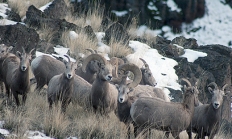
These elegant shorebirds are found as often in dry or damp upland areas as they are on mudflats or beaches. The plain brown immature birds of autumn become spangled with black and gold as breeding approaches. It is an occasional to uncommon migrant in western Oregon (mainly coastal) and locally rare, irregular migrant in eastern Oregon, with most reports at Malheur National Wildlife Refuge, in the Klamath Basin (summer) and in Umatilla County. Hear the call of the American golden-plover Photo by Mark Peck, Flickr
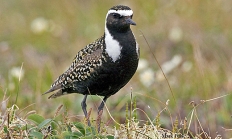

This is a bird of riparian thickets, farmlands, and towns. Since 1980, it has been observed almost annually in Harney County, usually in numbers less than five. A pair successfully fledged young near the Malheur National Wildlife Refuge headquarters in 1994. Most Harney County records occur from early April to late October. Away from Harney county individuals have also been seen in the various eastern and southeastern counties of Oregon. Hear the song of the Great-tailed grackle Photo by Kathy Munsel, ODFW

The Townsend's pocket gopher is a large pocket gopher. The pelage is dark buffy-gray to sooty gray on the dorsum and a rich buff on the venter; the face, nose and auricular patch are black; the feet are dirty gray; and the chin is white. This gopher occurs along the Malheur and Owyhee river valleys in Malheur County and in southern Harney County. Townsend's pocket gophers have been found in alkaline soils along the south shore of Harney Lake and in deep fertile soils near Sod House School near the headquarters of the Malheur National Wildlife Refuge and in Stergen…
Fun facts about our bats Oregon's bats eat only insects. An adult bat eats about 1,000 insects every hour! Bats hang upside down because it gives them an ideal position for take-off. Bats can fly 20 to 30 miles an hour and travel more than 100 miles a night. A baby bat is called a pup. Young bats can fly between two and five weeks of age. Bats are the only flying mammal. ODFW's Living with bats page has tips on protecting at-risk populations, and more. Bat Conservation International Batty for Bats: Facts for kids (pdf) Build a bat house…


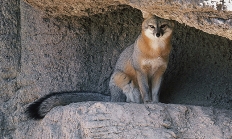
The gray fox is among the smaller canids in Oregon. The basic color of the gray fox is grizzled gray, but the stiff middorsal hairs have long black tips that extend onto the tail as a black mane. Guard hairs are banded white, gray, and black. The throat, venter, and inside of the legs are white; a cinnamon-rufous border to the white throat extends on the flanks and underside of the tail A blackish patch on the side of the face extends onto the lower jaw and a grayish black "exclamation point" extends upward from the interior margin of each…
The Klamath Fish Hatchery was originally constructed in 1929. Many improvements have been made since original construction. The hatchery produces legal and trophy sized rainbow trout, fingerling rainbow trout, brown trout, and cutthroat trout for release throughout the Klamath Basin, Deschutes Basin, Umpqua Basin and the southeast part of the state. The hatchery assist with remote egg takes for wild rainbow and brown trout at Crane Prairie and Wickiup Reservoirs.
The pelage of this mouse is grayish or brownish dorsally, the venter hairs are white with lead-colored bases, and the tail is light colored. In Oregon, it occurs within the area circumscribed by a line connecting Denio Nevada; Fort Rock, Lake County; Powell Butte, Crook County; Malheur National Wildlife headquarters, Harney County; and Burns Junction, Malheur County. On a daily basis, activity begins with an intense burst during the first light to hours after sunset, and declines to almost nil six hours after sunset, then, especially in summer, increases again before sunrise. The Dark Kangaroo Mouse constructs elaborate nests with…

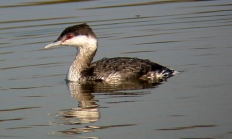
In alternate plumage this striking bird's lower neck, chest, and sides are bright chestnut. Three groups of yellow plumes adorn the sides of the head. Its head and throat are black. This grebe favors areas with much open water surrounded with emergent vegetation. The horned grebe is a rare breeder east of the Cascades. Malheur National Wildlife Reserve averages four to five pairs per summer. It is also rare along the coast in summer and is an uncommon spring and fall transient on lakes, reservoirs, and large rivers west of the Cascades and uncommon to common east of the Cascades…
Western Oregon observers enjoy these large, elegant plovers almost year-round, and as a consequence they are one of the most familiar larger shorebirds. Almost all migrants and winterers visiting Oregon inhabit mudflats and open wet dirt fields. A few can be found on sand beaches and even occasionally on rocks, but the great majority are found feeding and resting on open mud. In Oregon, it is a fairly common to common transient in western interior valleys. East of the Cascades, the Black-bellied plover is an uncommon transient in the Klamath Basin and at Malheur National Wildlife Refuge. In winter it…
