
Search myodfw.com
Showing 301 - 320 of 510 results
SALEM, Ore. – Mussel harvesting is now open from Cape Blanco to the California border the Oregon Department of Agriculture and the Oregon Department of Fish and Wildlife announced today. Marine biotoxin levels in this area tested below the alert level. People should always call the Shellfish Safety Hotline at…
SALEM, Ore – Mussel harvesting is now closed from Tillamook Head (south of Seaside) to the north Jetty of the Siuslaw River (Florence) the Oregon Department of Agriculture and the Oregon Department of Fish and Wildlife announced today. Recent mussel samples indicate levels of Paralytic Shellfish Poisoning (PSP) – a…
SALEM, Ore – Mussel harvesting is now closed from Tillamook Head (south of Seaside) to the north Jetty of the Siuslaw River (Florence) the Oregon Department of Agriculture and the Oregon Department of Fish and Wildlife announced today. Recent mussel samples indicate levels of Paralytic Shellfish Poisoning (PSP) – a…
The original portion of Fall River Hatchery construction was completed in 1929. Many improvements have been made since original construction. In 1952 the ten raceways were completed. The hatchery produces legal and trophy sized rainbow trout, and provides rainbow, brook and cutthroat trout fingerlings for air stocking programs throughout the state. The facility traps and spawns brown trout at a remote site.
Wizard Falls Hatchery was constructed in 1947. Many improvements have been made to the facility since original construction. The hatchery has a rainbow trout broodstock which supply rainbow trout to the Deschutes sub-basin and southeast Oregon. The hatchery is used for incubation and rearing of kokanee salmon and rainbow trout to provide for recreational fishing program objectives, and the incubation and rearing of spring Chinook and summer steelhead as part of a reintroduction program in the upper Deschutes Basin. Brook trout and cutthroat trout fingerlings are reared for the air stocking program on odd years. Kokanee salmon are spawned remotely.
The Bureau of Land Management maintains a series of pastures along Oregon Highway 38 that are a year-round residence for a herd of 60-100 Roosevelt elk. Elk are visible almost every day of the year!
SALEM, Ore – Mussel harvesting is now closed from Tillamook Head (south of Seaside) to the north Jetty of the Siuslaw River (Florence) the Oregon Department of Agriculture and the Oregon Department of Fish and Wildlife announced today. Recent mussel samples indicate levels of Paralytic Shellfish Poisoning (PSP) – a…
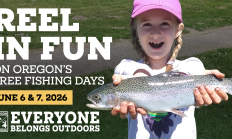
SALEM, Ore..— Everyone can fish, clam and crab for free in Oregon on Saturday and Sunday, June 6-7, 2026. No fishing/shellfish licenses or tags/validations are required on these days (meaning you do not need a Combined Angling Tag, Columbia River Basin Endorsement, Ocean Endorsement or two-rod validation where two rods…
ODFW's legislatively adopted 2025-27 budget did not include funding to continue the operation of Salmon River Hatchery. The hatchery is shifting fish production to other facilities but will remain open for public/fishing access with a volunteer host and occasional staff on site. Learn more.
Irrigon Hatchery began operation in 1984 as part of the Lower Snake River Compensation Program (LSRCP)—a program to mitigate for spring Chinook and summer steelhead losses caused by the four federal dams constructed on the lower Snake River. This facility serves as an egg incubation and rearing facility for summer steelhead destined for the Grande Ronde and Imnaha river systems and egg incubation for 575,000 Umatilla coho eggs for transfer to Cascade Hatchery. Irrigon Hatchery also rears 1.4 million fall Chinook for the Grande Ronde and Snake Rivers and is used as a rearing site for legal-sized and trophy rainbow…
The major portion of Elk River Hatchery construction was completed in 1968. In 1971 the hatchery completed final construction on an intake and ten new ponds. The purpose of the facility is to supplement natural production of fall Chinook in the Elk and Chetco Rivers and winter steelhead in the Chetco River. The facility is used to collect Elk River fall Chinook, to incubate eggs and rear both natural and hatchery fall Chinook and winter steelhead.
Klaskanine Hatchery was first operated in 1911 by the state of Oregon. In 1959 the hatchery was enlarged and renovated under the Columbia River Fisheries Development Program (Mitchell Act)—a program to enhance declining fish runs in the Columbia River Basin. The hatchery is now closely tied to the Select Area Fisheries Enhancement (SAFE) program and works closely with Clatsop County Fisheries (CCF). The facility is currently used primarily for rearing coho for SAFE commercial fisheries, as well as for adult collection and spawning of fall Chinook and as a rearing facility for fall Chinook and winter steelhead.
CORVALLIS, Ore . — The Oregon Hatchery Research Center Board will meet virtually via Zoom on Wednesday, Sept. 3 from 9:00 a.m. to 11:00 a.m. In addition to the regularly scheduled items, the agenda includes a review of a proposal for use of the remaining OHRC Research Fund. The meeting…
The present facility was constructed in 1925, across the North Umpqua River from an earlier trout hatchery built in 1920. The hatchery was closed in 1975 due to low stream flows and high water temperatures, and was reopening in 1979 after extensive reconstruction. In 2012 a state of the art fish passage ladder was completed. It included a fish viewing window for Rock Creek basin fish inventory and a fish trap facility. The hatchery produces fall and spring Chinook, coho, summer and winter steelhead, and rainbow trout. The facility is used for adult collection, spawning, incubation, and rearing of Chinook…
Cole Rivers Hatchery was constructed by the US Army Corps of Engineers (USACE) in 1973 to mitigate for spawning and rearing areas blocked by the construction of Lost Creek, Applegate, and Elk Creek Dams. The hatchery was named in honor of Cole M. Rivers, a biologist on the Rogue River for 20 years. The facility is used for adult collection, spawning, egg incubation and rearing of spring Chinook, coho, summer steelhead, and winter steelhead, and egg incubation and rearing of fall Chinook and rainbow trout. Infrastructure Repair and Renovation Updates
Construction of this facility began in 1924 and production started in 1925 by the state of Oregon. Various renovations have taken place with the most recent being the addition of 4 new fish rearing raceways and improvements to the pollution abatement system which was completed in 2016. Other renovations made throughout the hatchery have utilized the Restoration and Enhancement Program.. The purpose of this facility is to enhance spring Chinook, winter steelhead, summer steelhead, and coho populations for various coastal streams. The facility is used for adult collection, egg incubation and rearing of spring Chinook, fall Chinook, winter steelhead, summer…
The Umatilla Hatchery began operation in 1991. The hatchery is used for egg incubation and rearing of spring Chinook, fall Chinook and summer steelhead.