
Search myodfw.com
Showing 341 - 360 of 665 results
SAUVIE ISLAND WILDIFE AREA, Ore.— To manage ongoing traffic and parking problems at Sauvie Island Wildlife Area's beaches, ODFW is introducing a new limited-entry parking pilot program. Starting July 4, vehicles will need a free Sauvie Island Beaches Pass in addition to the Wildlife Area Parking Permit ($10 daily) to…
The information provided here is intended to help you get an idea of your odds of drawing a reservation in the Eastside and Oak Island hunt areas. First off, the number of permits available in each hunt unit does change throughout the season. See the NUMBER OF RESERVATIONS AVAILABLE FOR EASTSIDE AND OAK ISLAND UNITS link to view the number of permits that are available for each unit and hunt period.
Find maps, boundary descriptions and the percent public land for the Pine Creek Unit.
In 1925 the first fish hatchery on the South Santiam River began operations about 5 miles upstream from today’s present site, rearing annually approximately 100,000 spring Chinook in dirt ponds for release into the South Santiam River. The present site came about with the construction of Foster Dam. In 1968 the facility was dedicated for the rearing of spring Chinook and summer steelhead. This facility was built and annually funded in part by the US Army Corps of Engineers to compensate for the loss of spawning and rearing areas above the dams on the South Santiam River.


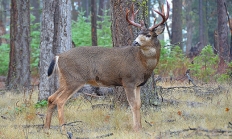
Nearly a dozen subspecies of Odocoileus hemionus are recognized. Of these, two occur in Oregon - the mule deer and Columbian black-tailed deer, often just referred to as "Black-tailed deer." The mule deer is larger, lighter in color, and often associated with more open habitats, whereas the black-tailed deer is smaller and darker, and frequents dense, early seral forest communities. The most distinguishing feature of the black-tailed deer is the tail. Although not as long or wide as that of the white-tail, it is much larger than that of the mule deer. Because of the differences in size, color, marking…
Along coastal shores and islands, the chatter and flight calls of Black turnstones invite an observer to look more closely at the rocky substrates to find these birds busily picking about in their search for food. They primarily use rocky shores, jetties, and offshore islands, but may also be found on shorebird flats and sandy beaches. The Black turnstone is a common transient and winter visitant on the coast. Hear the call of the Black turnstone Phogo by ©Keith Kohl, ODFW

The Costa's hummingbird is a very rare spring and summer visitant to central and southwestern Oregon. Males are sometimes present for the entire year in the Rogue Valley. Males have been observed in canopy-free riparian habitat along Bear Creek and semi-open tall white oaks at the edge of Agate Lake. Many of these birds go undetected in Oregon because of their similarity with other hummingbird species. Hear the call of the Costa's hummingbird Photo by Mick Thompson, Flickr

This winter visitor is a study in gray and tan, with a small dark spot on an otherwise gray breast, dull rufous stripes on the side of the head and crown, and brown wings with distinct white stripes. Tree sparrows visit Oregon only in winter, mainly in lowlands within the Blue Mountains and Owyhee upland regions with a few farther west in some years. They frequent willow clumps in grassy areas and occur occasionally at feeders. Hear the song of the American tree sparrow Photo by Eric Began, Flickr

The original Riverside Tract is adjacent to the Malheur River near the former railroad community of Riverside. It was purchased from the Blaylock family in 1976 and has been administered by ODFW as Riverside Wildlife Area since that time. The purpose of this initial acquisition was to provide public fishing and hunting access to a previously privately held portion of the Malheur River canyon. In addition, this purchase provided the opportunity for the department to emphasize fish and wildlife habitat management in the river canyon. Additional acres were added to this tract in 1977. In 1972, the department purchased a…
Establishment of the Bridge Creek Wildlife Area initially started in 1961 when a parcel of land was purchased from the Frank Hilbert estate. After the initial purchase, several private holdings were acquired to consolidate the land under department ownership. The last parcel was purchased from the Colvin Cattle Company in 1975. The primary purpose of the wildlife area is to maintain and protect a key historic winter range for Rocky Mountain elk ( Cervus elaphus nelsoni).
NEWPORT, Ore – Mussel harvesting is now open coastwide from the Washington border to the California border the Oregon Department of Agriculture and Oregon Department of Fish and Wildlife announced today. Marine biotoxin levels tested below the alert level. People should always call the Shellfish Safety Hotline at 1-800-448-2474 before…
Coquille Valley Wildlife Area was initially established in 2013 with two equally important primary objectives; (1) To protect, enhance, and restore fish and wildlife habitats located on the WA, and (2) to provide a wide variety of wildlife-oriented recreational and educational opportunities to the public.
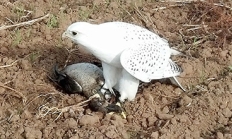
This is a large and power falcon. The majority of Gyrfalcons seen in Oregon are immatures or adults of the "gray" type, but there are several reports of "white" birds. The Gyrfalcon is a regular winter visitant to Oregon. The majority of sightings come from coastal and Willamette Valley lowlands near waterfowl concentrations. Individuals have been seen chasing and feeding on geese, ducks and gulls. Gyrfalcons forage by flying low over the ground and flushing prey, then often giving spectacular tail chases. If a bird refuses to flush the hunt is usually unsuccessful. East of the Cascades it occurs around…
This foreign visitor is regularly found in Oregon among wintering flocks of American widgeon. Drakes are easily distinguished from American wigeon drakes by reddish brown head, gray flank, and lack of green eye stripe. Hens are similar to American Wigeon hens and difficult to distinguish. The call of the male is a shrill whistling, whe'e you; the female's voice a low purr or croak. It is a rare to uncommon visitant east of the Cascades. Hear the call of the eurasian wigeon Photo by ©Greg Gilson

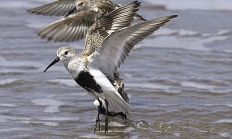
The Dunlin undergoes one of the most dramatic changes in appearance of all shorebirds when it molts from winter to breeding plumage. In winter, these medium sized sandpipers are brownish gray above with white underparts, but in breeding plumage they have a striking rufous-brown back and cap and black belly. Females are larger than males but otherwise similar in appearance. The Dunlin is an abundant transient and winter visitant in estuaries and occasionally on beaches along the coast of Oregon, but significant numbers winter in the Willamette Valley, especially the southern part. Hear the call of the Dunlin Photo by…
In winter plumage, the crisp black head, white neck patch, and gray back are striking, and when combined with a pale bill this species is readily distinguished from small alcids in Oregon. Wing-propelled divers, they are nonbreeding visitors to Oregon's offshore waters. They are the only seabirds whose young are reared entirely at sea. The Ancient murrelet is an uncommon to common fall migrant and winter visitant in shelf waters near shore; rare to uncommon in spring; absent to rare in summer. Hear the call of the Ancient murrelet Photo by Patty Mcgann, Flickr

The Swamp sparrow uses wet areas that have thick vegetation for cover. Several glimpses of this reclusive bird may be required before it can safely be separated from Lincoln's sparrow or the more common Song sparrow, though its distinctive call will give it away to observers familiar with it. Chestnut coloration on the wing coverts helps separate this species from other wintering sparrows. The Swamp swallow is a rare to uncommon spring and fall transient and winter visitant in western Oregon, especially along the coast. Hear the song of the Swamp sparrow Photo from USFWS
