
Search myodfw.com
Showing 381 - 400 of 699 results
Swans, ducks and geese belong to the Anatidae family and occur on all continents. Special oils let their feathers shed water, so they are adapted for swimming and floating, and some are even talented divers. For tips on discouraging geese from overwhelming your yard, check our Living with Wildlife, Birds page.

WILLAMETTE WILDLIFE VIEWING September 17, 2026 Recreating in drought and wildfire season - actions you can take to protect wildlife . For the most current fire closures and restrictions-- KNOW BEFORE YOU GO . Corvallis area EE Wilson Wildlife Area There are lots of deer, shorebirds and waterfowl to see on the wildlife area – look for goose, mallard, hooded merganser and wood ducks. Wildlife viewing remains good for waterfowl and shorebirds. Note: Dogs are required to be on a leash inside the wildlife area boundary. Rifles and pistols are prohibited year-round. Find directions to EE Wilson Wildlife Area. A parking permit is required to park at EE Wilson Wildlife…
Oregon has one species of kingfisher, the raucous Belted kingfisher and 12 woodpecker species. Six woodpeckers are Oregon Conservation Strategy Species of management concern and in need of conservation. Famous for their hammering and hole drilling, woodpeckers might decide your home looks like a good place to set up shop. Learn how to discourage this on our Living with Wildlife, Birds page.

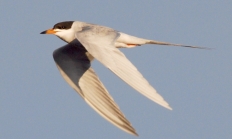
Terns are generally associated with marine environments and salt marshes, but the Forster's tern inhabits freshwater areas. During the breeding season this graceful bird is eastern Oregon's resident small white tern. Typical of terns, the Forster's employs a dramatic hunting method of plunge-diving into shallow waters to capture small fish, the bird sometimes submerging completely. This is an uncommon but highly visible colonial breeder east of the Cascades. Hear the call of the Forster's tern Photo by Dave Budeau, ODFW
World famous for its loud, persistent singing and mimic abilities, the Mockingbird is highly conspicuous. The white flashes in the wings and tail of this grayish bird identify it in flight. It is primarily a southern species that has, by taking advantage of the environmental changes brought about by the ever-increasing human population, expanded its range northward in recent years. In many parts of the country it is a familiar bird of residential neighborhoods. Hear the call of the Northern mockingbird Photo by ©Keith Kohl, ODFW

The Pacific wren makes its home in dense coniferous forests with understory thickets where it often forages for insects. This bird was considered the same species as the winter wren but is now separated as its own distinct species. The Pacific wren is rufous brown above, richly colored below, and barred with a darker brown and dusky. Young birds are distinctly less barred. It’s most easily found by its sharp kep-kep call and ringing, tinkling song. Males defend territory by singing in spring and in hopes of attracting a mate.

The Bohemian waxwing is a nomadic species, invading locations with fruit-bearing trees or shrubs. Referred to as a "roving bands," their name reflects this view of their unpredictable and seemingly carefree lifestyle. Very sociable birds, they exhibit pronounced flocking habits in the winter, and frequently give themselves away with their constant gentle seeping or trilling voice. Their sleek profile and elegant, almost exotic coloration also distinguish these birds. Hear the song of the Bohemian waxwing Photo by Kathy Munsel, ODFW

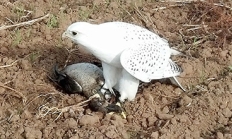
This is a large and power falcon. The majority of Gyrfalcons seen in Oregon are immatures or adults of the "gray" type, but there are several reports of "white" birds. The Gyrfalcon is a regular winter visitant to Oregon. The majority of sightings come from coastal and Willamette Valley lowlands near waterfowl concentrations. Individuals have been seen chasing and feeding on geese, ducks and gulls. Gyrfalcons forage by flying low over the ground and flushing prey, then often giving spectacular tail chases. If a bird refuses to flush the hunt is usually unsuccessful. East of the Cascades it occurs around…
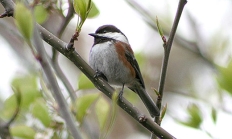
Chestnut-backed chickadees are one of the most common species of bird in conifer forests of western Oregon. They are distinguished from other chickadees by their chestnut-colored back, lack of an eye-line, and their wheezy song. Like other chickadees, they are frequently observed performing acrobatic maneuvers such as hanging from branch tips while foraging high in the canopy. They also frequent bird feeders for suet and sunflower seeds, and will nest in boxes if they are placed near groves of conifers. Hear the call of the Chestnut-backed chickadee Photo by Kathy Munsel, ODFW
This large sparrow is white below and in most plumages has at least some black around the face or throat, more in adults than younger birds. Cheeks are golden-tan in fall and winter and grayish in spring. It is streaked above. It is a winter visitor usually found with other sparrows. A very rare migrant and rare but regular visitor, you can find the Harris's sparrow statewide. Numbers vary considerably from year to year, but a few birds are typically found in the state every year. They are most regular in the Columbia Basin and in valleys within the Blue…

Gray jays are common visitors at mountainous campsites and parks and are commonly known as "camp robbers" for their habit of taking food from humans. Gray jays in the Blue Mountains have the top of their heads white, while birds in the Cascades and Coast ranges have white restricted to the forehead. Coast Range birds are decidedly browner vs grayish overall. In Oregon, the Gray jay resides in conifer forests of the Coast and Cascade ranges, the eastern slope of the Cascades at Ft. Klamath and in the southwestern part of the state. Hear the call of the Gray jay…

One of the most nondescript birds found in Oregon, this sparrow makes up for its drab appearance by its extraordinary song. It is by far the most abundant bird breeding in the vast sagebrush expanses of the Intermountain West. The Brewer's sparrow is an abundant migrant and summer resident east of the Cascades summit, particularly in the southeast quarter of the state among the vast sagebrush communities of the Great Basin Shrub-steppe. In the Columbia Plateau ecoregion, it is an Oregon Conservation Strategy Species. Hear the song of the Brewer's sparrow Photo by Dave Menke, USFWS

One of Oregon's characteristic offshore seabirds, these stocky gull-like birds with steep foreheads come in a broad range of color morphs from white to slate gray, with buffy, bluish-gray, mottled and brown intermediates. The round head and pecking motion of birds feeding on the water is reminiscent of the shape and behavior of pigeons. The heavy hooked bills are divided into colorful plates of green, yellow, and orange, with large tubed nostrils atop. They are irregularly common to abundant in Oregon in winter, especially beyond five miles from shore. Hear the call of the Northern fulmar Photo by Martyne Reesman…

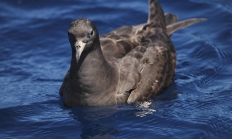
Flesh-footed shearwaters are always exciting birds to find, as they are one of the rarest of the seabirds to occur annually in Oregon. Single birds are sometimes found in flocks of other shearwaters. They are very similar to sooty shearwaters but they are larger with pink or pale whitish feet and dark-tipped pale bills. In addition, their plumage is a deep chocolate-brown, lacking the grayness of the upperpart coloration of sooty shearwaters; and the underwing does not show the sooty's white coverts. It is a rare late fall transient offshore at the western edge and slopes of the continental shelf…
This is a marine gull that breeds on both offshore islands and rocky cliffs along the Oregon Coast. It also uses structures for nesting and, occasionally, will nest on grass-covered headlands. The Western gull's food comes from the marine environment, estuaries, and the immediate shoreline. It eats small fish, clams, mussels, bird eggs, the young of other birds nesting nearby, sea urchins, starfish, squid, crustaceans, marine worms, and carrion. it will scavenge garbage or waste from fishing boats as well. It is present all year along the entire coast of Oregon. Hear the call of the Western gull Photo by…

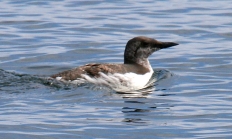
The most common seabirds breeding in Oregon, Common murres are easily recognized by their distinct black and white breeding plumage and their upright stance at colonies. Wing-beats are rapid and like all alcids they can fly underwater. They are often seen over the ocean in long lines of 10-40 or more birds. They nest on rocky islands and cliffs in colonies of tens or hundreds of thousands of birds packed together almost shoulder to shoulder. Major nesting concentrations in Oregon are on the south and north coasts reflecting the availability of suitable nesting habitat. Hear the call of the Common…
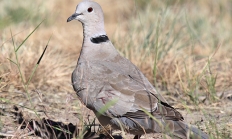
The Eurasian collared-dove is quite similar to the Ringed turtle-dove but is somewhat larger with grayer underparts and darker primaries. It is a bird of agricultural areas and readily visits bird feeding stations in urban and rural neighborhoods. During the 1600s this Indian species began to expand its range until today it occurs in all of Europe and most of Asia. After introductions in the Bahamas in 1974 and Guadeloupe in 1976 it soon expanded throughout the Caribbean and reached Florida by 1980. It is now expanding into other parts of North America, reaching Oregon in 1988. It is expected…
Familiar to anyone from the eastern United States and Canada, this sparrow is much less common in Oregon. Adults show both a white-striped and tan-striped morph, while first year birds resemble tan-striped adults but are typically more heavily streaked underneath. Even the dullest first-year birds have a distinct rectangular white throat patch, often set off with a partial black border. The White-throated sparrow is an uncommon migrant and winter visitor, mainly in western Oregon. Hear the call of the White-throated sparrow Photo by ©Keith Kohl, ODFW

Chukars are ground-loving birds that quickly run uphill or burst from cover with rapid wing-beats and a characteristic whitoo call if alarmed. Introduced by managers wishing to increase hunting opportunities in arid western North America, the chukar is a very successful exotic species that occupies habitats where few other gamebirds exist. It is the most harvested upland bird in Oregon. It is a common permanent resident of eastern Oregon. Populations are distributed in steppe habitats along the breaks of the Columbia, John Day, Snake, Owyhee, Deschutes, Malheur, Burnt and Grand Ronde rivers and lesser watercourses or reservoirs. Hear the call…

Commonly found along beaches and about estuaries, this large, ponderous bird is a conspicuous member of the summer coastal community, easily recognized by its large size, massive bill, and brownish plumage. Highly gregarious, it often forms large flocks; regularly observed foraging over the ocean just offshore. Brown pelicans often join mixed flocks of birds attracted to schools of small fish. They are common spring, summer, and fall visitors along the Oregon coast. Brown pelicans are an Oregon Conservation Strategy Species in the Nearshore ecoregion. Hear the call of the brown pelican Photo by Michael Lazott
