Search myodfw.com
Showing 381 - 400 of 545 results
This thrush-like ground-foraging warbler breeds from southeast Yukon and eastern British Columbia across Canada and through the eastern United States and locally elsewhere east of the Rocky Mountains. It migrates east of the Rocky Mountain to winter in Middle America. It is occasionally found in winter in its breeding range and in California. Small numbers regularly occur in western North America. Most Oregon records are from the southeast part of the state. Spring records range from early-May to mid-June. Fall records are fewer than in spring, and occur between late August and early September. Hear the song of the Ovenbird…

Familiar to anyone from the eastern United States and Canada, this sparrow is much less common in Oregon. Adults show both a white-striped and tan-striped morph, while first year birds resemble tan-striped adults but are typically more heavily streaked underneath. Even the dullest first-year birds have a distinct rectangular white throat patch, often set off with a partial black border. The White-throated sparrow is an uncommon migrant and winter visitor, mainly in western Oregon. Hear the call of the White-throated sparrow Photo by ©Keith Kohl, ODFW

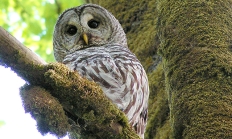
The Barred owl expanded its range from the eastern United States. It was first reported in Oregon in the early 1970s and has since spread to forested areas throughout most of the state. Sometimes confused with the closely related Northern spotted owl, the Barred owl is large with grayish-brown and white feathers and stripes on its chest and throat. It is easily distinguished from the Northern spotted owl by the pronounced horizontal barring across the throat and upper breast, and vertical brown streaks on the lower breast and abdomen. The Barred owl is now a permanent resident in forests of…
The haunting cries of these wanderers evoke a variety of reactions from curiosity to wonder. Highly social, the Pinyon jay epitomizes the dynamics of flock behavior such as colonial nesting, communal feeding of young and non-territoriality. Although Pinyon jays are nomadic and unpredictable, each flock is a tight-knit, integrated unit occupying a home range that does not overlap with other flocks. Flocks may wander widely outside their home range if sufficient food is not available. The Pinyon jay is a permanent resident in juniper and ponderosa pine woodlands of central Oregon. Oregon's known breeding population is confined to the Metolius…

The ring-necked duck, which would have been better named "ring-billed duck" and is called "blackjack" in the southeastern United States, frequents different habits than the scaups with which is is often confused. The black back, white crescent on the side just in front of the wing, and white-ringed bill separate the drake ring-neck from the scaups. The brownish neck ring of the male in alternate plumage is not prominent. The hen is a small dark brown duck with a buff face. Drakes in courtship give a head-throw accompanied by a wow note while hens utter a growling purr. Ring-necks are…

SALEM, Ore.—The Commission approved a revised State Wildlife Action Plan (SWAP) today, a plan that serves as a roadmap for protecting Oregon's at-risk species and their habitats. The Plan incorporates the latest available information on species and presents recommended conservation actions to inform and prioritize conservation work for community members…

CORVALLIS, Ore. — The Oregon Hatchery Research Center Board will meet in Corvallis on Tuesday, December 2 from 11:00 a.m. to 1:00 p.m. at the Oregon Department of Fish and Wildlife South Willamette Watershed District Office (7118 NE Vandenberg Avenue, Corvallis, OR 97330). In addition to the regularly scheduled items…
Canis lupus is the largest canid, not only in Oregon, but in the rest of the world as well. The wolf has relatively long legs, a narrow and deep chest, elbows that turn inward and foot pads that turn outward. These, combined with the digitigrade feet possessed by all canids, make the wolf highly adapted for running. The pelage of gray wolves is long over the body and tail, but relatively short on the legs and face. The predominant color is gray, but the legs, flanks, and venter sometimes are yellowish or light brownish. These colors are overlain by long…

SAUVIE ISLAND WILDIFE AREA, Ore.— To manage ongoing traffic and parking problems at Sauvie Island Wildlife Area's beaches, ODFW is introducing a new limited-entry parking pilot program. Starting July 4, vehicles will need a free Sauvie Island Beaches Pass in addition to the Wildlife Area Parking Permit ($10 daily) to…

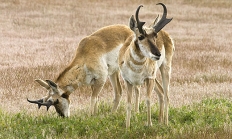
The pronghorn, often called "antelope," is deer-sized with relatively long and thin legs and feet with just two digits on each foot, a relatively small tail, and unique horns consisting of deciduous keratin sheaths set on bony cores arising from the fontal bones. Among males, the laterally flattened sheaths are long, branched and recurved, but in those females that possess horns they are short and simple. The horns and hooves are black. The front feet are larger and carry most of the weight when the pronghorn runs. The pelage is course. The dorsum is a light buff and is separated…
Find the weekly statistics for waterfowl and upland game birds at Summer Lake Wildlife Area. More information about Summer Lake Wildlife Area Bird counts at Summer Lake WA
FOR IMMEDIATE RELEASE Oregon Department of Fish and Wildlife (ODFW) Confederated Tribes of the Umatilla Indian Reservation (CTUIR) Statement on Qapqápa Wildlife Area Acquisition Oregon Department of Fish and Wildlife (ODFW) and the Confederated Tribes of the Umatilla Indian Reservation (CTUIR) regret to announce that the Qapqápa (pronounced cop-COP-a) Wildlife…

NEWPORT, Ore. – ODFW is accepting nominations for a seat on the Pacific Fishery Management Council (Council). The three-year term for this Oregon at-large seat begins Aug. 11, 2026. Anyone interested in being considered, or wishing to nominate someone, must contact Jessica Watson at 541-351-1196 or jessica.l.watson@odfw.oregon.gov . Completed application…
NEWPORT, Ore. – The Oregon Department of Fish and Wildlife is hosting a Feb. 2 public meeting beginning at 6 p.m. to get input on the number and timing of fixed and back-up dates for the central Oregon coast spring all-depth Pacific halibut season. The meeting is in the conference…