
Search myodfw.com
Showing 421 - 440 of 694 results

Protecting and enhancing Oregon’s fish and wildlife, and the habitats they use, for the use and enjoyment of present and future generations is at the heart of what we do.
Returning adult salmon and steelhead enter the fish ladder on the south side of the dam and are held in a 12’ x 40’ trap until they can be processed by ODFW’s South Santiam Hatchery staff. Hatchery employees operate the fish trap one to three times per week depending on the time of year and numbers of adults returning to the system. An average of 4,000 spring Chinook, 4,700 summer steelhead, and 670 winter steelhead are collected annually. All unmarked spring Chinook and winter steelhead are returned to their native habitats in the South Fork of the Santiam above Foster…
NW WILDLIFE VIEWING March 12, 2026 Tillamook County Birds Large numbers of waterfowl are arriving daily, moving back to spring nesting grounds. They will raft up out in the middle of most local estuaries on calm days but will move around with the incoming tide and on windy days. Many species of diving ducks can be seen on area lakes and bays. Likewise, many migrating geese are beginning to arrive and are using area fields, along with many egrets, herons and wintering raptors. Pastures and fields are heavily used by a variety of waterfowl when flooded and by wading birds…
Columbia Fishing March 12, 2026 Current and upcoming fishing opportunities: Columbia River regulation changes for the 2026 spring Chinook fishery are posted. Please see the fishing regulation update page for details. Announcements For the latest regulations, including in-season changes See the fishing regulations update page. Forecasts for 2026 Columbia River Spring Chinook, Summer Chinook and Sockeye are available here. Fish consumption advisories The Oregon Health Authority has issued consumption guidelines for parts of the Columbia River due to high levels of mercury and/or PCBs. Fish with these chemicals look, act, smell and taste like any other fish, so caution is…
While there is a general, statewide season for cougars, there are quotas set by zone. Once a quota in a certain zone is met, that zone will close for cougar hunting. Below are the most recent numbers on cougar harvest by zone.

SE Fishing March 12, 2026 Best bets for weekend fishing A few holdover Rainbow Trout are being caught in Lake of the Woods. Best fishing for wild, native trout in the Klamath Basin will be the Klamath River. The Upper Williamson River above Kirk Road Bridge is now open year-round. Access remains available. Nice holdover trout in the Malheur River below Warmsprings right now. Crappie fishing in Owhyee Reservoir has been good. Bank fishing for rainbow trout has been good at Ana Reservoir. The Cascade Ramp at Hyatt is open. This year at Howard Prairie, the Grizzly, Willow Point and…
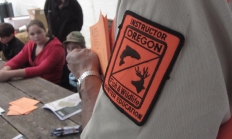
Oregon requires all hunters under the age of 18 to complete a hunter safety education course before hunting in the state. Upon course completion, students will receive a temporary Hunter Safety certification card to be carried while hunting in Oregon until a permanent card is received in the mail to replace it. Hunters over 18 are encouraged to take the online education course, as it may be required for out of state hunts. Note: Youth under the age of 9 may struggle with the course material and may not have the physical strength needed to safely handle a firearm during…
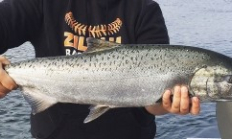
SALEM, Ore. – The Pacific Fishery Management Council (PFMC) met March 4-9 to develop three alternatives for ocean salmon seasons along the coasts of Washington, Oregon, and California. PFMC is hosting a hybrid public meeting March 24 from 7-9 p.m. in Newport to receive input on the proposed salmon management…
The Columbia Basin Wildlife Areas are a composition of four Oregon Department of Fish and Wildlife (department) managed wildlife areas located along the Columbia River, in the Columbia Basin. The four wildlife areas (Power City, Irrigon, Coyote Springs and Willow Creek) are within the Columbia Plateau ecoregion. Management agreements for these areas were initially established between 1971 and 1977 between the department and Federal agencies which own the lands. The Columbia Basin Wildlife Areas, which total approximately 1,885 acres, provide an important landbase for the conservation and recreation of fish and wildlife within a highly privatized and altered landscape and…
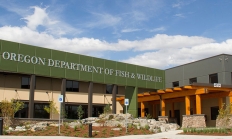
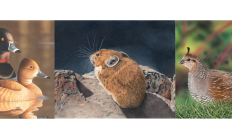
SALEM, Ore. – ODFW invites the public to view artwork entered in the annual stamp art contest on Tuesday, Nov. 4 from 12:30-5:00 p.m. at ODFW Headquarters in Salem. The event is free and open to the public. Located at 4034 Fairview Industrial Dr SE, Salem, ODFW Headquarters will host…
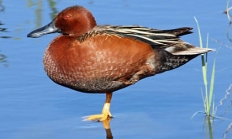
The bright rusty plumage of the male cinnamon teal, a bird of western North America, is a visual delight. In flight, both males and females show powder blue in the wings as they fly fast and low, timed at nearly 60 miles per hour. They weigh only about one pound. They are a common breeder throughout the state except in western Oregon and the high Cascades. They are most common east of the Cascades. Hear the call of the cinnamon teal Photo by Maxine Wyatt
This Eurasian diving duck regularly occurs in the Aleutian Islands and with increasing regularity in North America, especially along the West Coast. It is now reported annually in Oregon, between mid-October and early May, with most during January and February. All were from the coastal lowlands or the Willamette Valley, except for one on a small pond in Josephine County. They are closely related to the scaups and often associated with them. Hear the call of the tufted duck Photo by Tom Benson, Flickr

The Northern shoveler's specialized bill earned it in the nickname "spoonbill" among waterfowl hunters. The drake is strikingly handsome with a dark head, white breast, reddish belly, blue wing coverts and an iridescent green speculum. Brown hens also have blue wing patches similar to that of the cinnamon and blue-wing teal. This duck is locally common in summer in eastern Oregon and uncommon in western Oregon. It is a common spring and fall migrant statewide. Hear the call of the Northern shoveler Photo by Kathy Munsel, ODFW

The green-winged teal is the smallest North American dabbling duck. In alternate plumage, green-wing drakes have a cinnamon-colored head with a green eye-stripe, gray back, flanks, and wing with a iridescent green speculum. Hens are brown with a green speculum. This duck is mainly a migrant and winter visitor. It is an uncommon summer resident and breeder in northeastern Oregon and a rare summer resident west of the Cascades. Hear the call of the green-winged teal Photo by Kathy Munsel, ODFW

FOR IMMEDIATE RELEASE Oregon Department of Fish and Wildlife (ODFW) Confederated Tribes of the Umatilla Indian Reservation (CTUIR) Statement on Qapqápa Wildlife Area Acquisition Oregon Department of Fish and Wildlife (ODFW) and the Confederated Tribes of the Umatilla Indian Reservation (CTUIR) regret to announce that the Qapqápa (pronounced cop-COP-a) Wildlife…