
Search myodfw.com
Showing 421 - 440 of 849 results
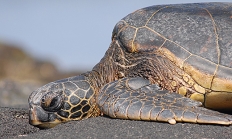
The largest of hard-shelled sea turtles, the green turtle weighs 300 to 350 pounds as an adult, and feeds primarily on sea grasses and algae. Strictly herbivores, green sea turtles are named for their greenish-colored fat. Photo by Dave Budeau, ODFW
The Western whiptail is found in eastern Oregon deserts and semi-arid shrublands. It is most common in flat, sandy areas and along dry washes. These lizards are primarily insectivorous. In a food habits study in southeastern Oregon, they ate caterpillars, crickets, grasshoppers, and beetles. They also eat spiders, scorpions, and other lizards. Photo by Keith Kohl, ODFW


Hunter's Guide Hunter's Resources Hunter's Technique Hunter's Bounty
Various seasons
Online Learning
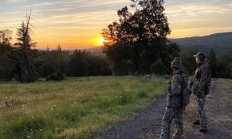

Milton-Freewater, Ore. – Representatives from the Oregon Department of Fish and Wildlife, the Confederated Tribes of the Umatilla Indian Reservation, and the Walla Walla Basin Watershed Council gathered on Sept. 1 for a field visit to one of the region's most significant ongoing restoration efforts: the North Fork Walla Walla…
The snowshoe hare is the smallest member of the genus in Oregon. Individuals in populations east of the Cascade Range, and some individuals in the Cascade Range, become white in winter and are brown in summer. This hare is associated with dense thickets of young conifers, especially those with lower branches touching the ground and especially firs and western larch interspersed with small clearings vegetated by grasses and forbs. Photo from ODFW

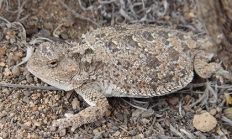
The pygmy short-horned lizard occurs in sagebrush deserts, juniper woodlands, and open coniferous forests. It prefers open areas with sandy soils, but is also found on rocky soil. Ants make up a large part of the diet, but beetles, caterpillars, spiders, and sowbugs are also eaten. This lizard burrows into the soil when inactive. Photo by Dave Budeau, ODFW
The gopher snake occurs in a wide variety of habitats, from deserts and grasslands to woodlands and open forests. It frequents agricultural regions, especially where there is brushy cover such as fence rows. Diet varies according to size, with young eating insects, lizards, rodents, and birds and their eggs. Adults can take larger prey, occasionally as large as rabbits. Photo by Simon Wray, ODFW
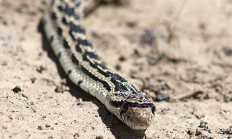
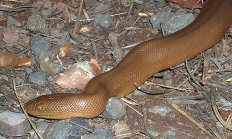
The rubber boa occurs in a variety of habitats, from desert scrub, foothill woodlands, and grasslands through deciduous and coniferous forests. In the Coast Range, it is found commonly in forest clearings that contain rotting stumps and logs. It is absent from the immediate vicinity of the coast north of Coos Bay. Rubber boas are constrictors and eat small mammals, especially young mice and shrews. Photo by Simon Wray, ODFW
The Western fence lizard occupies a wide range of habitats, from desert canyons and grasslands to coniferous forests. It requires vertical structure in its habitat, such as rock piles or logs. It is absent from dense, humid forests and flat desert valleys. This lizard is insectivorous, and feeds on crickets, grasshoppers, beetles, ants , wasps, leafhoppers, and aphids. Some spiders are taken as well. Photo from ODFW

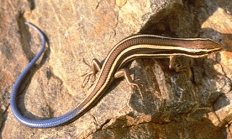
The Western skink is found in moist places such as under rocks or logs in a variety of habitats from grassland and chaparral to desert scrub, juniper woodlands, and coniferous woodlands and forests. Rocky areas with some moisture, such as riparian zones, are favored. This skink feeds on a wide variety of invertebrates, including beetles, grasshoppers, moths, flies, spiders, and earthworms. Photo by Simon Wray, ODFW
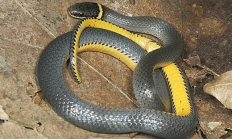
The ringneck snake requires moist micro-habitats such as downed logs, rocks, or stumps. It is found in a variety of vegetation types, but is most closely associated with pine-oak woodlands and moist canyon bottoms. It also can be abundant in Willamette Valley grasslands. These snakes feed mainly on small lizards, snakes and salamanders and also slugs, earthworms, frogs, and insects. Photo by Simon Wray, ODFW

Shellfish regulations only apply to Columbia River downstream of Tongue Point/Rocky Point line at the mouth of the Columbia River.
The mountain cottontail is intermediate in size and light grayish-brown in color. Its tail is white and ears relatively broad and rounded. It is usually associated with rocky outcrops with nearby dominant vegetation consisting of big sagebrush, bitter-brush, rabbit-brush, western juniper and mountain-mahogany. In Oregon, it occurs throughout the state east of the Cascade Range with a western extension into Josephine County. Photo by ©Keith Kohl, ODFW

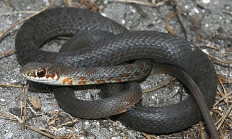
The racer is found in a variety of open habitats, including sagebrush flats, juniper woodlands, chaparral, and meadows. It avoids dense forests, high mountains, and very dry areas, and seeks cover under rocks, logs, or dense shrubs This species feeds on lizards, smaller snakes, frogs, toads, small mammals, birds and their eggs, and some insects. Young racers eat crickets, grasshoppers, and other insects. Photo by Simon Wray, ODFW
CLACKAMAS, Ore.—Oregon and Washington fishery managers have finalized preseason planning for 2026 Columbia River summer and fall recreational salmon and steelhead fisheries. Forecasts for summer steelhead, sockeye, fall Chinook, and coho returns will allow opportunity for anglers to target these fish. The planned 2026 fall-season fisheries are primarily limited by…
These delicate and truly golden plovers that pass through Oregon in fall are always a delight to find on an open beach or grassy coastal plain. The Pacific golden-plover feeds mainly in the open. A rare to uncommon migrant; most birds occur in fall on the outer coast. They are very rare to rare in winter on the coast and in the Willamette Valley. Hear the call of the Pacific golden-plover Photo by Dave Budeau, ODFW
