
Search myodfw.com
Showing 441 - 460 of 925 results
Find maps, boundary descriptions and the percent public land for the Fort Rock Unit.

The European starling is considered an invasive species in Oregon. It was introduced from Europe. They most closely resemble blackbirds, with which they often flock in fall and winter. While both have iridescent plumage, starlings can be told from blackbirds by their two-toned wing pattern - dark upperwing, pale underwing - and during the breeding season by the bright yellow bill. Starlings adapt readily and quickly to human habitation and are highly efficient and successful breeders. However, the abundance of the bird, the rapidity with which it has spread across North America, and its propensity to cause damage to crops…

Protecting and enhancing Oregon’s fish and wildlife, and the habitats they use, for the use and enjoyment of present and future generations is at the heart of what we do.
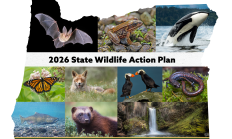
SALEM, Ore.—ODFW is excited to announce that Oregon's State Wildlife Action Plan (SWAP) has been officially approved by the U.S. Fish and Wildlife Service. This milestone marks the final step in adopting the 2026 SWAP, a science‑based roadmap to maintain healthy fish and wildlife populations, prevent further declines of at‑risk…
CENTRAL POINT, Ore. – Learn how to spot and identify animal tracks, splash around in a stream to check out aquatic bugs, and play "survival of the fish-est." Join the Oregon Department of Fish and Wildlife, Jackson County Parks, and Rogue River Watershed Council for Wildlife Wisdom every Saturday from…

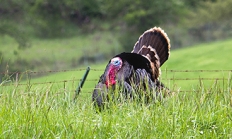
The wild turkey is the largest game bird in North American with mature males weighing upwards of 20 pounds and standing 40 inches tall. These large terrestrial birds are generally dark brown to black in appearance but iridescent color in feathers ranging from gold and copper to green and black gives a metallic appearance, particularly in full sunlight. Males and about 10 percent of females sport a unique beard of keratinous filament that protrudes from the junction of the breast and neck. Beards grow continuously but rarely exceed 10 inches in length. Females are smaller and duller in appearance. Densities…
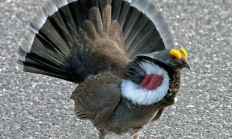
This popular upland game bird is the largest of Oregon's three forest grouse. It is well known for the distinctive hooting call emitted by courting males in the spring. This call is accompanied by an extravagant courtship display involving exposure of blood-engorged, featherless shoulder spots and eye combs, which are reddish to orange. It is a common resident in coniferous forests. Hear the call of the dusky grouse Photo by Jim Dollar, Flickr
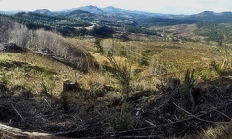
Oregon's diverse habitats and terrain offers something for every hunter. From the densely forested Coast Range to the expansive sage steppe of the Great Basin, hunting opportunities are practically unlimited. Visit e-regulations
Teach, restore, study, host, build, communicate When you sign up to be an ODFW volunteer, you are helping to protect Oregon's fish and wildlife, manage ODFW properties and spark a passion in others to hunt, fish and appreciate the outdoors building and enhancing fish, wildlife and their habitats for current and future generations. Donating even one day a year is all it takes to be helpful. We can be as flexible as possible to find the right opportunity to fit your schedule. Join thousands of volunteers by sharing your time and talents with ODFW.
Ruffed grouse are named for a series of black iridescent feathers on the sides of the neck called the ruff, which is erected by males to form an ring around the neck during courtship displays. This forest-dwelling species, favored by upland game-bird hunters, is well known for the drumming of the males during courtship displays in the spring. It is a common resident throughout most forested regions of the state. It occupies most forests at low to moderate elevations east of the Cascade crest, primarily the east slope of the Cascades from Ft. Klamath and upper Klamath Lake and Blue…

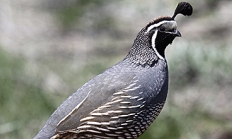
California quail are the most widely distributed upland game birds in Oregon. Most easily recognized by the comma-shaped, black, plume, or "topknot," which bends forward and is larger on the male. It has been a resident statewide since the early 1900s, except for most forests of the north Coast Range and west Cascades; it is generally absent along the coast north of Coos Bay. California quail is also absent from high-elevation areas of the east Cascade range. They are common residents in rural and even some suburban areas, particularly in eastern Oregon where many coveys gather at feeding stations during…
Vireos and shrikes are predatory song birds. Their bills are strong and hooked to kill and dismember prey including insects and small birds, mammals and reptiles. These birds hunt from fences, wires and treetops and sometimes hang captured prey on thorns to eat them later.

Need to figure out controlled hunts, find a place to clam, learn how to fish or get directions to a wildlife area? We've got information on all that and more, straight from ODFW biologists and other accomplished hunters, anglers and wildlife watchers. Header image by Dave Budeau

