
Search myodfw.com
Showing 441 - 460 of 897 results
CORVALLIS, Ore. – The shotgun range at E.E. Wilson Wildlife Area near Corvallis will be closed for renovation from July 14 through the end of October. Renovations on the range will include expanding the shooting bays and implementing ADA complaint access to the site. ODFW expects work to be complete…
Features: Green sunfish have more of a bass-shaped body and a larger mouth than the other sunfishes, other than the warmouth. Also, unlike other sunfish except the warmouth, the pectoral fin is rounded, rather than pointed. Green sunfish are olive green on the back and sides with a yellowish-copper or brassy hue on the lower sides of the belly. Dusky, vertical bars are often present. Turquoise mottling, often in the form of bars, radiates backward from the snout and eye. They have a dark spot at the base of the rear lobe of the dorsal fin. Habitat: Green sunfish are…

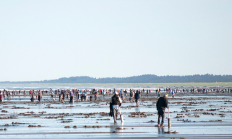
ASTORIA, Ore. – Clatsop beaches reopen for razor clam harvesting Oct. 1 following the annual conservation closure that began July 15. Before harvesting razor clams or any shellfish, always call the Shellfish Safety Hotline at 1-800-448-2474 or visit the ODA Recreational Shellfish Biotoxin Webpage. During the closure, Oregon Department of…
Returning adult salmon and steelhead enter the fish ladder on the south side of the dam and are held in a 12’ x 40’ trap until they can be processed by ODFW’s South Santiam Hatchery staff. Hatchery employees operate the fish trap one to three times per week depending on the time of year and numbers of adults returning to the system. An average of 4,000 spring Chinook, 4,700 summer steelhead, and 670 winter steelhead are collected annually. All unmarked spring Chinook and winter steelhead are returned to their native habitats in the South Fork of the Santiam above Foster…
This seabird, the most abundant in Oregon, has recently suffered severe declines or significant population shift in the eastern North Pacific. Similar in shape to thin, long-winged gulls, sooty shearwaters are dark sooty gray with limited amounts of white on the underwing coverts. They glide on wind currents along wave troughs on stiff wings. Gregarious, they form huge loose flocks in migration, often passing for hours within site of land-based observers. In Oregon, it is an abundant summer visitor and transient offshore on the inner shelf and is most numerous three to six miles offshore. Hear the call of the…

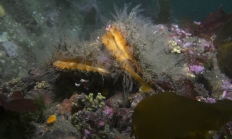
The rock scallop ( Crassadoma gigantea) lives in the swift current shallows of Oregon's nearshore rocky reefs. Due to the coloration at its hinge, it is also known as the purple hinged scallop. These highly specialized scallops cement themselves to rocks, primarily at depths from 10 to 150 feet. They feed on microscopic plankton they filter from the water and reproduce via broadcast spawning. In order for spawning to be successful, they need to be close to one another. For this reason, it is best to harvest solitary rock scallops and minimize harvest pressure on dense aggregations which are more…
Marion Forks Hatchery began operation in 1951. The U.S. Army Corps of Engineers (COE) funds the majority of operational costs as mitigation for the development of Detroit and Big Cliff dams. The hatchery is used for egg incubation and rearing of spring Chinook.
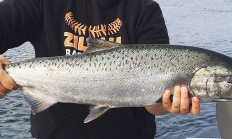
Features: While in the ocean, Chinook salmon often have a purple hue to their backs with silvery sides and bellies, large oblong black spots on the back, and round black spots on both lobes of the tail (note that tail spotting may be obscured in ocean fish by “silver” in the tail). Upon returning to freshwater to spawn, Chinook darken in color and develop red on their bellies and fins. A key identifier is the black gum line on the lower jaw with dark colors both inside and outside of the gum line. Spawning generally occurs from August to early…
NE Fishing June 25, 2026 Best bets for weekend fishing: Kokanee fishing has been good on Wallowa Lake. Perch fishing has been good at Phillips Reservoir with some large fish caught. Try Willow Creek Reservoir for trout, bass, and crappie. Smallmouth bass fishing on the John Day is currently very good Trout stocking May 25- June 12: Aldrich Pond, Anson Wright Pond, Bull Prairie Res, Cutsforth Pond, Roulet Pond, Wallowa Wildlife Pond (Weavers Pond), Hog Creek Pond, Holliday Park Pond, Honeymoon Pond, Hunter Pond (Starkey Forest Ponds), McNary Channels Ponds, Morgan Lake, Kinney Lake, Luger Pond, Marr Pond, Seventh St…
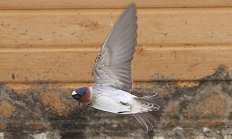
This chunky swallow is readily recognized by its square tail and orangish rump patch. It nests colonially and has taken to human-made structures so well that it has greatly expanded its range into many areas otherwise not suitable for it. It does not do well in urban settings, however, and quickly disappears when areas become densely settled. The unique gourd-shaped mud nest is often usurped by other species for nesting and is often used for protective roosting sites by rosy-finches and other wintering species. It is a locally common to abundant breeding bird near water throughout most of Oregon. Its…
Worldwide, frogs and toads are in trouble because of habitat loss, pollution, pesticides, climate change, diseases, the pet trade and competition from invasive species. Many of Oregon's 12 native species of frogs and toads are listed as Oregon Conservation Strategy Species of concern. Frogs and toads belong to the same animal group but are very different. Toads have dry, rough and bumpy skin covering a wide body while frogs are slender with smooth, moist skin. Frog eyes are higher on the head than toads and are rounder and bulging. And there's a reason we play "leap frog" - frogs take…

This medium-sized shorebird is the most common dowitcher in eastern Oregon and inland locations, where it sometimes gathers in large flocks feeding in shallow water. It is also the only dowitcher in the state that regularly winters. Although breeding plumage adults are reddish below and heavily patterned above, most birds seen in Oregon are duller postbreeding adults or browner immatures. During winter, when shorebirds are hard to find, a small flock of chattering dowitchers, even in plain gray basic plumage, often brightens a day in western Oregon. In migration, it can be found at almost any shallow water site in…

Rich, warm, unpatterned brown above and dull white below with a dusky throat and breast, the Rough-winged swallow is inconspicuous and often overlooked when flying with other, more brightly colored swallows. It is often confused with the similarly plumaged Bank and immature Tree swallows. It is most often observed flying low over rivers and lakes, rarely high overhead. It is a locally common summer resident statewide, most abundant at low to moderate elevations, usually near water. It usually nests singly, but sometimes in small loose colonies, rarely more than three pairs. Distribution is limited in many areas by lack of…

This moderately small wren maintains the frenetic energy that is so obviously typical of this family of birds. It is a summer inhabitant in many parts of Oregon, generally in open woodlands, thickets, and occasionally in residential gardens. The House wren occurs over the widest latitudinal range of any New World passerine. The House wren nests in a wide variety of native and human-influenced habitats. Nest sites are primarily located within preformed cavities in snags. It is a very uncommon to common transient and summer resident in semi-open woodland habitats throughout the state. In southwest Oregon, it is most common…

The red fox has a beautiful orange-red coat, black feet, and black-tipped ears. The belly is usually white or light grey, the muzzle is narrow and pointed, and the ears are pointed. It is an opportunistic carnivore, eating what is available including small mammals, birds and their eggs, reptiles, amphibians, fruit and some insects. The red fox is territorial and mates for life Red foxes occur throughout much of Oregon.

Cascade Hatchery was authorized under the Mitchell Act and began operating in 1959 as part of the Columbia River Fisheries Development Program – a program to enhance declining fish runs in the Columbia River Basin. The facility is used for egg incubation and rearing of coho.
Roaring River Hatchery was constructed in 1924. Many improvements have been made to the hatchery since the original construction. In 1987 and 1996 new raceway ponds were constructed to replace the original raceways. The hatchery is a mixed-stock facility, producing both anadromous fish and resident trout. The hatchery is used for rearing summer and winter steelhead from fingerling to smolt. The rainbow trout program involves broodstock maintenance, spawning, egg incubation and rearing.
Clackamas Hatchery began operation in 1979 and is used for adult collection, egg incubation and rearing of spring Chinook and winter steelhead, rearing of coho and acclimation of summer steelhead.
Newport, Ore. – Oregon's commercial Dungeness crab season opens Dec. 16 from Cape Falcon to the California border, the Oregon Department of Fish and Wildlife announced today. Crab will be available in time for the holiday season. Oregon will open the north coast to align with Washington once Long Beach…