
Search myodfw.com
Showing 461 - 480 of 849 results
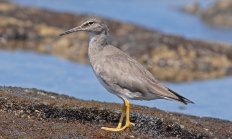
The presence of this medium-sized shorebird often is announced by its high-pitched ringing call as it forages along rocky coastlines amid crashing waves. Unlike most shorebirds, Wandering tattler is a loner and is rarely encountered in flocks. Loose aggregations may sometimes be found together strung out along jetties in migration. The Wandering tattler is a fairly common migrant during spring and fall along the entire Oregon Coast. Hear the call of the Wandering tattler Photo by Dave Budeau, ODFW
This small, remarkably delicate long-legged wader can be found in migration across most of Oregon. It is speckled gray and white with some variation by season and is typically noticed mincing about in shallow pools and in the water adjacent to mudflats or on seasonally flooded fields, as well as in small isolated ponds. It is an uncommon to common migrant, most birds in fall. In the eastern one-third of Oregon, it usually outnumbers Greater yellowlegs in fall. Hear the call of the Lesser yellowlegs Photo by Dave Budeau, ODFW

The Bohemian waxwing is a nomadic species, invading locations with fruit-bearing trees or shrubs. Referred to as a "roving bands," their name reflects this view of their unpredictable and seemingly carefree lifestyle. Very sociable birds, they exhibit pronounced flocking habits in the winter, and frequently give themselves away with their constant gentle seeping or trilling voice. Their sleek profile and elegant, almost exotic coloration also distinguish these birds. Hear the song of the Bohemian waxwing Photo by Kathy Munsel, ODFW

This large brown sparrow with its handsome black-and-white head pattern is a common breeder in brushy semi-open country throughout much of the state. In winter, it is frequently found in large flocks, often in the company of Golden-crowned sparrows and other seed eaters. White-crowns are easily seen as they feed on the ground, repeatedly dashing back into the cover of dense shrubs before emerging for another foraging bout. Hear the song of the White-crowned sparrow Photo by Kathy Munsel, ODFW

The Mink is a semiaquatic species. The body is elongate and cylindrical, the legs are short and stout, the tail is bushy and about half as long as the head and body. The head is flattened, the ears small and rounded, and the nose is pointed. The pelage consists of dense grayish underfur and long lustrous guard hairs. Dorsally, it is dark brown to blackish but somewhat lighter on the venter. In Oregon, the mink is found throughout the state and is associated with river, lake, pond, or marsh environments. They forage along overhanging banks, and in holes and crevices…

As their common name implies, these lizards are found in sagebrush habitats, but also occur in chaparral, juniper woodlands, and coniferous forests. They require well-illuminated open ground near cover and are primarily ground dwellers. They eat a variety of small invertebrates, including crickets, beetles, flies, ants, wasps, bees, mites, ticks, and spiders. Also called the Northern sagebrush lizard, it is an Oregon Conservation Strategy Species in the Columbia Plateau ecoregion. Photo by ©Keith Kohl, ODFW

Much variability in coloration exists in the common garter snake but the best identifying characteristic is a stripe down the middle of the snake's back. While the common garter snake frequents wet meadows and forest edges, it occurs in a variety of habitats far from water, including open valleys and moist coniferous forest. Smaller snakes eat earthworms, but adults feed on a variety of vertebrate prey, including frogs, toads, salamanders, birds, fish, reptiles, and small mammals. Invertebrates, including slugs and leeches, are also eaten. Photo by Dave Budeau, ODFW

This large brown shorebird is the most wide-ranging of the curlew species. It is distinctive, having contrasting light-brown and dark-brown head stripes and a long decurved bill that it uses to probe for food on coastal mud flats and beaches. It is a common spring and fall migrant in coastal areas although it is also found, rarely, in small numbers inland as well. It is a rare spring migrant in the Willamette Valley with generally about one record annually, typically in late April or early May. Hear the call of the Whimbrel Photo by ©Keith Kohl, ODFW

This active and often unwary woodpecker, the smallest in North America, is generally the most often seen black and white woodpecker in human-settled areas. A preference is shown for decayed wood for nesting, though sound wood is also utilized. Nest sites are usually 10 to 12 feet off of the ground. It is found mostly at low to moderate elevations in deciduous and mixed deciduous-coniferous forests throughout much of the state, and less often in coniferous forests. Hear the call of the Downy woodpecker Photo by ©Keith Kohl, ODFW

Noted for its familiar call, chick-a-dee-dee-dee, the Black-capped chickadee is widely heralded as one of Oregon's friendliest and cheeriest residents. Even in the midst of winter, this bird "fairly overflows with good spirits." The Black-capped chickadee is resident at low to moderate elevations in western Oregon from the Willamette Valley and coastal counties to Douglas County and in most of eastern Oregon with the exception of the southeastern corner of the state. Hear the song of the Black-capped chickadee Photo by Dave Budeau, ODFW

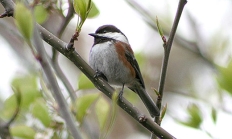
Chestnut-backed chickadees are one of the most common species of bird in conifer forests of western Oregon. They are distinguished from other chickadees by their chestnut-colored back, lack of an eye-line, and their wheezy song. Like other chickadees, they are frequently observed performing acrobatic maneuvers such as hanging from branch tips while foraging high in the canopy. They also frequent bird feeders for suet and sunflower seeds, and will nest in boxes if they are placed near groves of conifers. Hear the call of the Chestnut-backed chickadee Photo by Kathy Munsel, ODFW
This is a bird of riparian thickets, farmlands, and towns. Since 1980, it has been observed almost annually in Harney County, usually in numbers less than five. A pair successfully fledged young near the Malheur National Wildlife Refuge headquarters in 1994. Most Harney County records occur from early April to late October. Away from Harney county individuals have also been seen in the various eastern and southeastern counties of Oregon. Hear the song of the Great-tailed grackle Photo by Kathy Munsel, ODFW

Western pond turtles prefer marshes, streams, rivers, ponds and lakes. They need sparse vegetation nearby for digging nests and like to bask on logs. Population declines are due to habitat loss, degradation of nesting areas by invasive plants, competition from non-native turtles and disease. Predators include raccoons and invasive bullfrogs and fish. Western pond turtles are Oregon Conservation Strategy Species in the Coast Range, East and West Cascades, Klamath Mountains and Willamette Valley ecoregions. Photo by Simon Wray, ODFW

This species is found in a variety of habitats. To make matters more confusing, four subspecies are found in Oregon, each of which has somewhat different habitat preferences. All can be found in moist areas such as marshes and lake or stream margins, but two may occur some distance from water. The diet varies among subspecies; the more aquatic forms feed on fish, frogs, tadpoles, and leeches, which are eaten in the water. Terrestrial forms take frogs and toads, but also lizards, small mammals, salamanders and slugs. Photo by David Bronson, ODFW

Although they occur in a wide variety of habitat types, from deserts and chaparral to open forests across Oregon, Western rattlesnakes usually occur near rocks, cliffs, or downed logs. They overwinter in dens typically located on south-facing rocky hillsides exposed to sunshine. Western rattlesnakes feed mainly on small mammals, including mice, gophers, squirrels and rabbits, but will also take birds lizards, and amphibians. The Western rattlesnake is an Oregon Conservation Strategy Species in the Willamette Valley. Photo by Simon Wray, ODFW

CORVALLIS, Ore. – The shotgun range at E.E. Wilson Wildlife Area near Corvallis will be closed for renovation from July 14 through the end of October. Renovations on the range will include expanding the shooting bays and implementing ADA complaint access to the site. ODFW expects work to be complete…
Coquille Valley Wildlife Area was initially established in 2013 with two equally important primary objectives; (1) To protect, enhance, and restore fish and wildlife habitats located on the WA, and (2) to provide a wide variety of wildlife-oriented recreational and educational opportunities to the public.
CLACKAMAS, Ore.—Fishery managers from Oregon and Washington took joint state action today to add another three days of recreational spring Chinook salmon fishing in the mainstem Columbia River downstream of Bonneville Dam. This fishery had closed on Wednesday, April 8 per the preseason schedule adopted in February. With the additional…
NEWPORT, Ore – Mussel harvesting is now open coastwide from the Washington border to the California border the Oregon Department of Agriculture and Oregon Department of Fish and Wildlife announced today. Marine biotoxin levels tested below the alert level. People should always call the Shellfish Safety Hotline at 1-800-448-2474 before…
Smaller than a robin, this shy skulker is difficult to see, even though it is present during the nesting season in marshes throughout the state. The Sora is mostly brown with a black face and a stout yellow bill. Its chicks are small black balls of fluff with a bit of orange feathering under their chins. In the breeding season, Soras use wet meadows, including sedge, rush, and hair grass types but also wet areas with emergent vegetation, particularly cattails and tulles. They eat invertebrates, seeds, plant leaves, and stems. Hear the call of the Sora Photo by Kathy Munsel…
