
Search myodfw.com
Showing 481 - 500 of 897 results
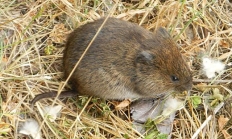
The creeping vole is the smallest vole in Oregon. It has an exceedingly short tail and tiny eyes. The short, dense fur on the dorsum ranges from sooty gray to dark brown or black, with scattered yellowish hairs. Hair on the venter is dusky washed with buff or white; the tail is blackish, slightly darker above that below; and the fur on the ears is black. In Oregon, it ranges from Brooks Meadows and Crater Lake west to the Pacific Ocean. The species has been seen at some localities in the Willamette Valley. However, hiatuses in the distribution occur in…
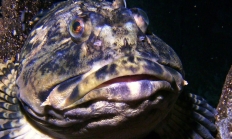
Features: Quillback rockfish are slate-brown and mottled with yellow and orange towards the head, while the rear half of their body is gray to dark brown or black. They have dark brown or black "freckles" on their head and gill cover. They have deeply incised membranes on their very long, spinous dorsal fins. Quillback rockfish can grow to be 24-inches long. Habitat: They prefer rocky bottoms from the intertidal zone out to 800 feet. Technique: Quillback rockfish are currently prohibited. Anglers are required to immediately descend back to depth any quillback rockfish encountered outside of the 30-fathom regulatory line and…

Features: Males' plumage is entirely black except for a small white teardrop around each eye, and white secondaries that form a conspicuous square wing patch during flight. A black knob graces the males' swollen, white-ridged, orange bills. Females and immatures are dark brown above and pale below with diffuse white patches in front of and behind the eyes. Their bills are dark. Habitat: Abundant along the coast from fall through spring. Techniques: Rarely taken as part of a mixed duck bag, their habit of resting and feeding on open ocean waters makes them inaccessible to most hunters.


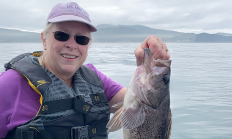
Cara Rupp with her 5 lb. 11 oz. Black rockfish near Beverly Beach State Park. Photo provided by Dennis J Rupp. NEWPORT, Ore. – The General Marine Species daily bag limit is reduced to three fish beginning Sept. 18 to lower the risk of an early season closure. The one-fish…
NEWPORT, Ore. – The General Marine Species bag limit returns to a four-fish bag limit beginning Monday, Aug. 18. The one-fish sub-bag limit for cabezon and the one-fish sub-bag limit for canary rockfish remain in place, and retention of quillback rockfish and yelloweye rockfish is prohibited. Great weather in mid-July…
Although common within its range, this handsome sparrow can easily be overlooked. The gray head, black malar stripe, white eyebrow, and prominent black spot set in the middle of a white breast identify the bird. It is widespread throughout the extensive shrub-steppe of central and eastern Oregon. The principal breeding range of Sagebursh sparrow is southeast and central Oregon. It is found throughout the arid expanses of the Great Basin and usually associated with big sage. Although considered by some authors to be a sagebrush obligate, Sagebrush sparrows have been found in other plant communities exclusive of sagebrush. Hear the…

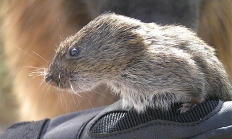
The montane vole is a medium-sized vole. The pelage is ashy gray mixed with brown and black on the dorsum shading to light gray or whitish on the venter. The feet are lead colored and the tail is bi-colored black or dark gray above and light gray to whitish below. Splotches of different shades of yellow on the nose, venter, and dorsal surfaces of the feet and tail occur on some adult Montane voles. This vole is distributed throughout most montane and intermontane areas of the west occurring throughout that portion of Oregon east of the crest of the Cascade…
Features: These fish are dark blue or black with a light belly, a blotchy pattern on the sides, and no spots in the dorsal fin. The easiest way to distinguish a blue rockfish from a deacon rockfish is that the blues have jaws that meet together when closed. Habitat: Like all rockfish, these fish use rocky reefs as habitat. They are common down to 500 feet or more, but also come in to shallow areas. Blue rockfish will often suspend in large schools well off the bottom over rocky areas. Technique: They readily take both bait and lures. Blue rockfish…

Features: These fish are dark blue or black with a light belly. In fact, they are closely related to blue rockfish, which are similar in appearance. The easiest way to identify a deacon rockfish is by the lower jaw that extends forward creating a significant underbite. Habitat: Like all rockfish, these fish use rocky reefs as habitat, but commonly suspend well up off the bottom. They are common down to 300 feet or more. Technique: They readily take both bait and lures. Deacon rockfish have smaller mouths than the black rockfish and are more likely to take smaller jigs and…

Features: Female pheasants are brown on top and paler underneath. They have black spots on their sides and black bars throughout their tails. The males are much more conspicuous with bright red on their head, a white band around their necks, and an iridescent copper color on their sides and backs. Their tails are long and pointed with barring. Habitat: The ringneck is a farmland species, heavily dependent on cereal grains and other seeds. They also like taller vegetation for cover. Technique: Because pheasants are tied so closely to agriculture, the majority of hunting opportunity occurs on private lands. State…

Salamanders are a group of tailed amphibians with long bodies and short limbs. They often prefer habitats with damp conditions, which allows them to “breathe” better through their skin. Wet and rainy days (typically late fall through spring in Oregon) are the best time to look for salamanders, as the additional moisture from fog and rain allow for increased surface activity. To find salamanders, look in cracks or search under bark, rocks or logs. If you move any debris during your search, remember to put it back where you found it when you’re done—salamanders are sensitive to disturbance and many…

The major portion of Elk River Hatchery construction was completed in 1968. In 1971 the hatchery completed final construction on an intake and ten new ponds. The purpose of the facility is to supplement natural production of fall Chinook in the Elk and Chetco Rivers and winter steelhead in the Chetco River. The facility is used to collect Elk River fall Chinook, to incubate eggs and rear both natural and hatchery fall Chinook and winter steelhead.
The North Nehalem Fish Hatchery was originally constructed in 1966. The hatchery replaced the Foley Creek Hatchery which was constructed in 1926. The facility is used for adult collection, spawning, egg incubation and rearing of fall Chinook, coho, winter steelhead and rainbow trout.
Sandy Hatchery began operation in 1951 as a state-funded facility. In 1959, the hatchery became part of the Columbia River Fisheries Development Program (Mitchell Act) – a program to enhance declining fish runs in the Columbia River Basin. The facility is currently used for the adult collection of spring Chinook, winter and summer steelhead, and coho salmon. Coho and winter steelhead eggs are taken, hatched, ponded and reared to release on station.
LA GRANDE, Ore. – Effective Aug. 1 through Sep. 30, minimum and maximum size limits as well as the daily and possession bag limits for rainbow trout and bass are suspended for Thief Valley Reservoir (Southeast Zone) located in Union County. Harvest will be allowed by hand, dip net, or…
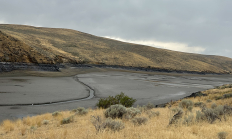
This 141-acre property along both sides of the Yachats River was first purchased in the early 1980s to provide forage for elk and help alleviate elk damage to surrounding agricultural land. It also provides public access to the Siuslaw National Forest along the Yachats River Highway, where there are few public access points.
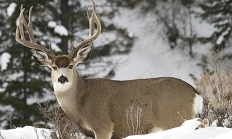
The mule deer is the larger member of the genus in Oregon. The ears are long, the metatarsal gland is surrounded by hairs similar in color but considerably longer than those on the remainder of the metatarsus, and the tail is short and constricted basally. Among adult males, the antlers are dichotomously branched with tines of approximately equal length. In winter, the basic pelage color is cinnamon buff. The chest is nearly black at the midline grading to grayish on the sides. The nose, sides of face, chin, and throat are whitish to pale buff. Spots of black occur immediately…
During the breeding season Pigeon guillemots are easily seen flying low over the water along rocky coastlines or in estuaries. They have striking red feet, legs, and mouth linings and their large white wing patches contrast markedly with the rest of their black plumage. When standing on land they have a distinctive upright posture and often emit a high-pitched squeal. In the non breeding season they move offshore and look entirely different when their black plumage becomes mottled with white. The Pigeon guillemot occurs during the breeding season all along the Oregon coast wherever offshore islands or rocky cliffs are…
