
Search myodfw.com
Showing 481 - 500 of 795 results
Lower Deschutes Wildlife Area was established in 1983, with the initial donation of land by the Oregon Wildlife Foundation (OWF) of 2,758 acres. In 1986 OWHF donated an additional 5,158 acres of land to the department. The Lower Deschutes Wildlife Area was initially established to provide permanent public angler access. However, especially with the 1986 acquisition, the wildlife area has grown to provide enhanced wildlife and fish habitat (i.e. through removal of livestock, riparian vegetation improvements, etc.) and more wildlife-oriented recreational activities such as hunting, boating, hiking and biking. In 2015, ODFW partnered with the Trust for Public Land to…
The song of this wren is often mistaken for the Song sparrow in the thickets and open woodlands where it resides. When in view, however, its long tail, thin bill, and white line above its eye are distinctive. Found in a variety of habitats, it readily takes advantage of cleared forest grown to large shrubs, especially blackberries. It is a permanent resident west of the Cascades, in Klamath and Warner basins, and along the upper Columbia River and tributaries. Hear the song of the Bewick's wren Photo by David Hoffman, Flickr

The Pacific wren makes its home in dense coniferous forests with understory thickets where it often forages for insects. This bird was considered the same species as the winter wren but is now separated as its own distinct species. The Pacific wren is rufous brown above, richly colored below, and barred with a darker brown and dusky. Young birds are distinctly less barred. It’s most easily found by its sharp kep-kep call and ringing, tinkling song. Males defend territory by singing in spring and in hopes of attracting a mate.

Merriam's ground squirrel is one of the two small gray ground squirrels in Oregon without stripes or spots. Most of the geographic range of this squirrel is in Oregon, where it occurs south and east of a line connecting Huntington, North Powder, Maupin, Warm Springs, Bend, and Fort Rock, Summer Lake, and Plush. This species does not occur south of the North Fork Owyhee River in Malheur County. These ground squirrels emerge in early March, breed, rear their young, become exceedingly fat and go into their hibernacula by early August. Photo by ©John Rakestraw

Cassin's auklet uses a few offshore lands for breeding in Oregon. It forages in the marine environment and nests in a chamber under rocks or digs its own burrow, two to six feet long, in the soil. This species spends its day at sea and only comes to the burrow at night, perhaps to reduce discovery by predacious Western gulls. Although few Cassin's auklets nest in Oregon, nesting sites are found along the entire coast where offshore rocks provide appropriate habitat. During the non-breeding season this is the most abundant alcid seen at sea in Oregon. They are present offshore…

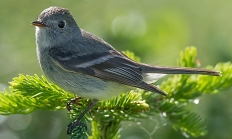
The Hammond's flycatcher spends much of its time in tall conifer canopies, where its subdued plumage and quiet, monotonous chant let it be easily overlooked. A diligent observer may be able to locate this aerial insectivore on a dead limb just beneath the live crowns of mature conifers from which it sallies into a canopy gap to capture insect prey on the wing. It is a common summer resident of montane coniferous forests through the state, on both sides of the Cascades. Hear the song of the Hammond's flycatcher Photo by Keith Williams, Flickr
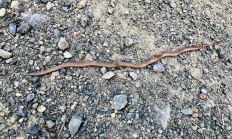
The Forest Sharp-tailed Snake was recognized as a separate species from the Common Sharp-tailed Snake ( Contia tenuis) in 2010. While these two species closely resemble one another, Forest Sharp-tailed Snakes can be identified by their long tails which have 43-58 subcaudal scales. This secretive species limits most of their activity to the rainy season, preferring to stay underground during dry conditions. Forest Sharp-tailed Snakes occur in southwest portion of the Oregon, where they select mesic environments and can be found in shaded forest habitats and mixed woodlands. Photo by russnamitz, iNaturalist
CANYON CITY, Ore.- A poacher investigated for more than 50 crimes committed in Grant County between 2023 and 2024 was sentenced to 95 days behind bars and more than $22,000 in restitution and fines, according to wildlife officials. In what wildlife enforcement officers refer to as a serial poaching case…
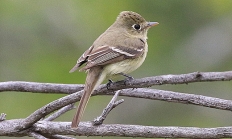
This small greenish flycatcher is easily overlooked in the moist, shady forests where it makes its summer home. It is a common to abundant breeder in forests of the Coast Range and west Cascades below about 4,000 feet and a common transient in western Oregon. The Pacific-slope flycatcher is most easily detected and identified by voice, but there is incongruence between published descriptions of vocalizations and some birds heard in the field lessens the certainty of identification to species, especially those in eastern Oregon. Hear the sounds of the Pacific-slope flycatcher Photo by Trish Gussler, Flickr
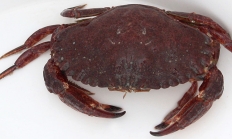
Features: These crab can be identified by their black-tipped claws, wide fan-shaped carapace (body cover) and deep, brick-red color. Habitat: As the name implies, red rock crab prefer the harder substrate habitats such as rocks, pilings, and other structure. Red rock crab prefer higher salinities than Dungeness crab and therefore are usually found in larger estuaries, close to the ocean. They are most common in Coos, Yaquina, and Tillamook bays where there are plentiful rocky substrates. Red rock crabs are native to Oregon. Techniques: Usually caught in combination with Dungeness crab, using the same techniques.
One of the characteristic birds of woodlands and city streets is this loud, colorful jay. Its bright blue-and-white-plumage and shrill calls are quite distinctive. It is closely related to the Steller's jay and hybrid individuals have been noted where their ranges overlap. It is an opportunistic forager of small animals and invertebrates, but is predominantly a vegetarian. It is a rare to regular visitor to eastern and western Oregon from late September to late April. The Blue jay prefers open mixed forests or deciduous groves and is often found in orchards and parks and along wooded city streets. Hear the…

A large and colorful member of the sparrow family, the Green-tailed towhee is perhaps more recognizable by its eye-catching chestnut crown than by its less intense green-gray back and olive tail. As a ground forager, it spends most of its time on the ground or in thick cover, scratching about industriously in the leaf litter, and it may go unnoticed. But its catlike mewing call, which it often gives from a brushy perch, is one of the quintessential sounds of the shrublands of the east slope of the Cascades and the Great Basin. It is locally fairly common east of…

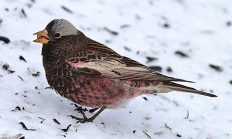
This dark, medium-sized finch with gray and pink highlights is the darkest of the rosy-finches and one of Oregon's rarest breeding birds. It is found in summer in montane areas above timberline, where loose swarms of these birds seem to blow like leaves among isolated cirques, cliffs, and hanging snowfields. In Oregon it breeds on Steens Mountain and may breed occasionally in the Wallowa Mountains. Winter distribution is poorly known, but birds have been found on the lower east side of Steens Mountain and in the Alvord Desert in winter and rarely in central Wallowa County. Hear the song of…
SALEM, Ore.—ODFW is accepting public comments on the proposed 2027 Big Game Regulations and other agenda items the Commission will consider at their September meeting in La Grande. Comment using the links embedded with each agenda item provided on the September meeting agenda page. The deadline to submit written comments…
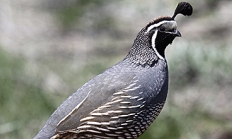
California quail are the most widely distributed upland game birds in Oregon. Most easily recognized by the comma-shaped, black, plume, or "topknot," which bends forward and is larger on the male. It has been a resident statewide since the early 1900s, except for most forests of the north Coast Range and west Cascades; it is generally absent along the coast north of Coos Bay. California quail is also absent from high-elevation areas of the east Cascade range. They are common residents in rural and even some suburban areas, particularly in eastern Oregon where many coveys gather at feeding stations during…
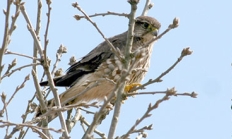
One of the most impressive sights in the unforested regions east of the Cascades is a Prairie falcon strafing a Belding's ground squirrel colony repeatedly at full speed in hopes of catching one emerging from its burrow at just the wrong moment. Prairie falcons are most common in rimrock country where they nest, but may travel great distances in search of prey. Prairie falcons are large, sandy brown above and off-white with variable amounts of streaking below. The face has a vertical stripe below the eye, as do many falcons. In flight, the long, pointed wings and long tail identify…
The Black oystercatcher is easily recognized with its black plumage, long, strait, laterally compressed, orange-red bill with a yellow tip, orange-red eye ring, yellow iris, and pale pink legs. These birds are restricted to rocky coastal shorelines where they feed in the intertidal zone. They are an uncommon to fairly common resident on rocky shores and sand/gravel beaches along the entire coast. Along the sandy central coast, they are present only as an occasional dispersing or wandering individual, typically on jetties. Black oystercatchers are Oregon Conservation Strategy Species in the Nearshore ecoregion. Hear the call of the Black oystercatcher Photo…

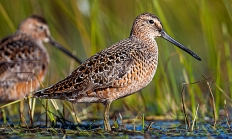
These chunky medium-small shorebirds are quite colorful in oranges and browns during most of their time in Oregon, where they are found mainly along the coast and locally in muddy areas inland. Their feeding motion has been likened to a sewing machine as flocks move slowly through shallow water and wet mud, probing with long straight bills. They are occasionally seen in marginal areas such as flooded pastures, but less likely than Long-billed to use such upland locations. They are a common to locally abundant coastal migrant, less common and more local in western interior valleys, and rare bur regular…
This medium-sized owl is easily recognized by its conspicuous "ear" tufts, yellow eyes set in a round facial disk, size, and mottled plumage of black, brown, gray, buff, and white. Legs and toes are densely feathered. Females are larger and darker in coloration than males. It is strictly nocturnal and secretive during nesting. The Long-eared owl is a fairly common breeder in open country east of the Cascades in wooded riparian areas and junipers. It is a common breeder on Boardman Bombing Range, Morrow County and widespread in Malheur County. It is a rare breeder in the foothills of the…
