Search myodfw.com
Showing 501 - 520 of 705 results
Veterans invited to grand reopening event set for Nov. 15 MONMOUTH, Ore.—ODFW Hunter Education Coordinator Jered Goodwin used to see a group of disabled Veterans regularly visiting the shotgun shooting range at E.E. Wilson Wildlife Area, a former military base turned wildlife area and popular outdoor destination in the Willamette…
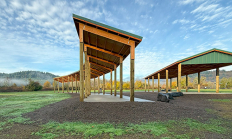
The original Riverside Tract is adjacent to the Malheur River near the former railroad community of Riverside. It was purchased from the Blaylock family in 1976 and has been administered by ODFW as Riverside Wildlife Area since that time. The purpose of this initial acquisition was to provide public fishing and hunting access to a previously privately held portion of the Malheur River canyon. In addition, this purchase provided the opportunity for the department to emphasize fish and wildlife habitat management in the river canyon. Additional acres were added to this tract in 1977. In 1972, the department purchased a…
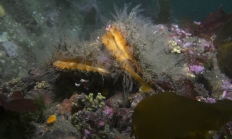
The rock scallop ( Crassadoma gigantea) lives in the swift current shallows of Oregon's nearshore rocky reefs. Due to the coloration at its hinge, it is also known as the purple hinged scallop. These highly specialized scallops cement themselves to rocks, primarily at depths from 10 to 150 feet. They feed on microscopic plankton they filter from the water and reproduce via broadcast spawning. In order for spawning to be successful, they need to be close to one another. For this reason, it is best to harvest solitary rock scallops and minimize harvest pressure on dense aggregations which are more…
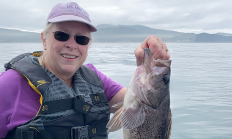
Cara Rupp with her 5 lb. 11 oz. Black rockfish near Beverly Beach State Park. Photo provided by Dennis J Rupp. NEWPORT, Ore. – The General Marine Species daily bag limit is reduced to three fish beginning Sept. 18 to lower the risk of an early season closure. The one-fish…
Need to figure out controlled hunts, find a place to clam, learn how to fish or get directions to a wildlife area? We've got information on all that and more, straight from ODFW biologists and other accomplished hunters, anglers and wildlife watchers. Header image by Dave Budeau

SALEM, Ore. – ODFW invites the public to view artwork entered in the annual stamp art contest on Tuesday, Nov. 4 from 12:30-5:00 p.m. at ODFW Headquarters in Salem. The event is free and open to the public. Located at 4034 Fairview Industrial Dr SE, Salem, ODFW Headquarters will host…
ODFW's Living with beavers page has more information on beavers role in Oregon's ecosystems, and more. Receive Beaver Action Plan Partnership Updates by E-mail Resources ODFW Living with Wildlife: American Beaver (Information) (pdf) ODFW Living with Wildlife: American Beaver (flier) (pdf) ODFW's 3-Year Action Plan for Beaver-Modified Landscapes (pdf) ODFW Beaver Emphasis Area primary contacts map (pdf) Beaver bibliography (pdf): An annotated bibliography of published literature on beaver (2008) Oregon State Animal: (pdf) American Beaver Fact Sheet ODFW Requirements for Relocation of Beaver in Oregon (pdf)

The gray partridge was released in North America as early as 1790 from its native range in Europe and Asia, but it was not until the 1900s that this stocky gamebird became well established in many states. It is also called the Hungarian partridge (or Hun) by hunters. The gray partridge currently thrives mainly in the valleys of the northeast and Columbia Basin counties of Oregon. Photo by Dave Miller, Flickr

Willamette Fishing September 10, 2026 Best bets for weekend fishing: Last week's rain gave several valley waterways a cooling refresh to kickstart fall fishing. Two-rod validation has been extended through Dec. 31 upstream of Willamette Falls. ODFW stocked Blue Lake, St. Louis Ponds, Adair Pond, and Bond Butte Pond in July with channel catfish. These fish, sourced from an approved facility, averaged approximately one pound each and are expected to provide excellent summertime fishing opportunities in these valley ponds. Try warmwater fishing for smallmouth bass and yellow perch near underwater structures and drop-offs in Foster Reservoir. Fishing for walleye and…
Image: The circles show monitoring stations in the basin and the green shows detection of a tagged salmon. KLAMATH FALLS, Ore. — Salmon are making exciting progress in their return to the upper Klamath Basin, with fisheries biologists from ODFW and The Klamath Tribes celebrating a series of firsts as…
SNAKE FISHING September 10, 2026 Best bets for weekend fishing Bass and trout can be caught downstream of Hells Canyon Dam. Fall Chinook salmon reopened on August 18 on Snake River downstream of Hells Canyon Dam, harvest limits have been adjusted due to low return numbers. See the regulation updates page for more information. Announcements: Fishing in drought and wildfire season - actions you can take to protect wildlife and yourself. For the most current fire closures and restrictions-- KNOW BEFORE YOU GO . If your favorite fishing spot is no longer listed It's probably because that river, lake or…

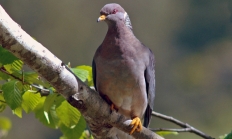
About the size of the domestic pigeon, this swift-flying species is popular among sport hunters. An arboreal bird, it is often observed perched alone on top of a tall tree or in flocks when flying about feeding areas and mineral sites. This is a common summer resident in forested areas west of the Cascade crest. It typically nests in forested mountain areas in the west Cascades. Hear the call of the Band-tailed pigeon Photo by Dave Budeau, ODFW
The mountain cottontail is intermediate in size and light grayish-brown in color. Its tail is white and ears relatively broad and rounded. It is usually associated with rocky outcrops with nearby dominant vegetation consisting of big sagebrush, bitter-brush, rabbit-brush, western juniper and mountain-mahogany. In Oregon, it occurs throughout the state east of the Cascade Range with a western extension into Josephine County. Photo by ©Keith Kohl, ODFW

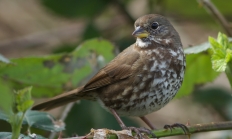
These big, medium-brown sparrows with variable grayish faces and heavily streaked or blotch undersides can be found in summer at higher elevations across much of the state except the Coast Range. Darker brown birds from more northerly breeding populations are common in western Oregon in winter, often coming to feeders, where they scratch like towhees for seed on the ground. Hear the song of the Fox sparrow Photo by Robin Horn, Flickr

Oregon's recreational fisheries for Pacific halibut and bottomfish are constrained by bycatch of yelloweye rockfish, an overfished species. Many of the regulations on these fisheries exist to keep bycatch of yelloweye rockfish within sustainable limits, in order to help the stock recover (for example, depth restrictions in the bottomfish fishery, and no lingcod during offshore long-leader trips). ODFW encourages anglers to reduce impacts by using descending devices to release yelloweye rockfish, and better yet, to avoid areas where they might be caught.
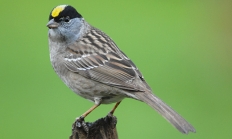
Flocks of these big, brown, plain sparrows are a common sight in winter in western Oregon. By early spring their faded head markings become a beautiful gold, black and white, and their plaintive descending songs become frequently heard from almost any large brush pile. They are an abundant migrant in western Oregon, less common farther east, and abundant in winter throughout the Willamette Valley. Hear the song of the Golden-crowned sparrow Photo by Dave Budeau, ODFW