Search myodfw.com
Showing 521 - 540 of 694 results
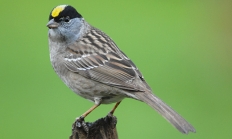
Flocks of these big, brown, plain sparrows are a common sight in winter in western Oregon. By early spring their faded head markings become a beautiful gold, black and white, and their plaintive descending songs become frequently heard from almost any large brush pile. They are an abundant migrant in western Oregon, less common farther east, and abundant in winter throughout the Willamette Valley. Hear the song of the Golden-crowned sparrow Photo by Dave Budeau, ODFW
In Oregon, the opossum is considered an invasive species. The Virginia opossum is a cat-sized mammal with a pointed nose, unfurred, black, leathery ears with white edges; beady eyes; a hind foot with an opposable hallux (big toe); and a naked scaly tail. It was introduced in Oregon between 1910 and 1921. Populations were established in northwestern Oregon apparently from releases of animals brought to the state as pets or novelties. Small streams, forest communities, and agricultural lands planted to a variety of crops are typical of many habitats occupied by Virginia opossums in Oregon. They are active nocturnally and…

The ears of the pygmy rabbit are short, rounded, and covered with long silky hairs inside and out; the tail is small and covered with hairs possessing wide buffy bands with narrow blackish tips above and below; and the feet are short, densely furred below, and colored a light orangy-buff. In Oregon, pygmy rabbits have been found east and south of a line connecting Klamath Falls, Fremont, Redmond, and Baker City. This rabbit is closely tied to habitats dominated by big sagebrush. The Pygmy rabbit is an Oregon Conservation Strategy Species in the Northern Basin and Range ecoregion. Photo from…

Although common within its range, this handsome sparrow can easily be overlooked. The gray head, black malar stripe, white eyebrow, and prominent black spot set in the middle of a white breast identify the bird. It is widespread throughout the extensive shrub-steppe of central and eastern Oregon. The principal breeding range of Sagebursh sparrow is southeast and central Oregon. It is found throughout the arid expanses of the Great Basin and usually associated with big sage. Although considered by some authors to be a sagebrush obligate, Sagebrush sparrows have been found in other plant communities exclusive of sagebrush. Hear the…

A big, well-mannered bird of friendly, even playful disposition, with an abundant curiosity as to human presence and activities within the realm of open ocean over which he presides. Long-winged, to seven feet, and dark sooty-brown; adults have a white rump and feathering, which juveniles lack, around the base of a large bill. Every sighting of these gentle giants gliding up to the boat evokes delight. The black-footed albatross is a regular visitant spring through fall offshore, but is irregular in winter. They glean squid, fish and fish eggs from the ocean surface and also eat galley scraps. Hear the…

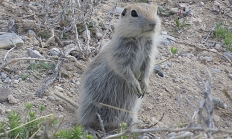
The Piute ground squirrel is the other of the two small gray ground squirrels without stripes or spots. In Oregon, it occurs south of Sheepshead and Cedar mountains in Malheur County. It is a species of the High Desert and commonly occurs in habitats in which the dominant shrub is big sagebrush, saltbush, or greasewood. It is commonly associated with rocky outcrops, levees, railroad embankments, ditchbanks, and sand dunes. Some occur in fencerows and edges of alfalfa and small-grain fields. These ground squirrels are usually active for three to five months each year. They emerge from their hibernacula in February…
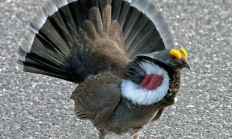
This popular upland game bird is the largest of Oregon's three forest grouse. It is well known for the distinctive hooting call emitted by courting males in the spring. This call is accompanied by an extravagant courtship display involving exposure of blood-engorged, featherless shoulder spots and eye combs, which are reddish to orange. It is a common resident in coniferous forests. Hear the call of the dusky grouse Photo by Jim Dollar, Flickr
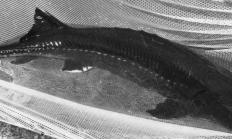
Features: The name “cutthroat” is derived from the two red slash marks or streaks on the underside of the lower jaw. Lahontans don't develop the intense crimson or gold coloration that other subspecies do, but the males can develop some red on their sides. Spots on the head can help distinguish this subspecies from other inland cutthroat subspecies. Habitat: This variety has adapted to the dry, highly alkaline waters and was once widespread throughout the Lahontan Basin of California, Nevada and southeast Oregon. Today, native populations can be found in the Whitehorse and Willow creek basins in the far southeastern…

NW Fishing March 12, 2026 Best bets for weekend fishing Winter steelhead fishing remains fair on the North Coast. The Nestucca River, Wilson, and North Fork Nehalem Rivers will provide the best opportunity to catch hatchery steelhead. The rain is coming down, and North Coast Rivers are on the rise as of this writing; many rivers may be high for the weekend but should be dropping into shape early next week. Other basins (including the Little Nestucca, Trask, Kilchis, Nehalem, and Necanicum Rivers) all have catch and release opportunities for wild steelhead. Coffenbury Lake, Vernonia Pond, Lost Lake, and Sunset…
Ruffed grouse are named for a series of black iridescent feathers on the sides of the neck called the ruff, which is erected by males to form an ring around the neck during courtship displays. This forest-dwelling species, favored by upland game-bird hunters, is well known for the drumming of the males during courtship displays in the spring. It is a common resident throughout most forested regions of the state. It occupies most forests at low to moderate elevations east of the Cascade crest, primarily the east slope of the Cascades from Ft. Klamath and upper Klamath Lake and Blue…

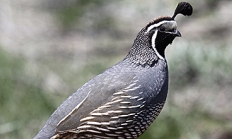
California quail are the most widely distributed upland game birds in Oregon. Most easily recognized by the comma-shaped, black, plume, or "topknot," which bends forward and is larger on the male. It has been a resident statewide since the early 1900s, except for most forests of the north Coast Range and west Cascades; it is generally absent along the coast north of Coos Bay. California quail is also absent from high-elevation areas of the east Cascade range. They are common residents in rural and even some suburban areas, particularly in eastern Oregon where many coveys gather at feeding stations during…
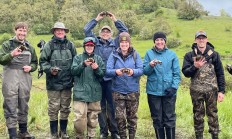
Teach, restore, study, host, build, communicate When you sign up to be an ODFW volunteer, you are helping to protect Oregon's fish and wildlife, manage ODFW properties and spark a passion in others to hunt, fish and appreciate the outdoors building and enhancing fish, wildlife and their habitats for current and future generations. Donating even one day a year is all it takes to be helpful. We can be as flexible as possible to find the right opportunity to fit your schedule. Join thousands of volunteers by sharing your time and talents with ODFW. Current volunteer opportunities

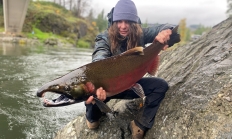
Features: The color of all trout varies with environment. In general, the rainbow is bluish-green on the back, silvery on the sides and belly, and has a white edge to the dorsal, anal, and pelvic fins. A generous sprinkling of black spots appear along the back, and on the dorsal, adipose and caudal fins. A pinkish band usually extends along the sides. Habitat: Rainbow trout are the most widely stocked and distributed trout in Oregon. They occur naturally in many rivers and streams, and each year ODFW stocks millions more in ponds, lakes and streams. Prime trout waters are clear…

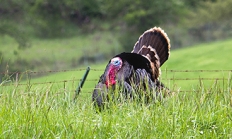
The wild turkey is the largest game bird in North American with mature males weighing upwards of 20 pounds and standing 40 inches tall. These large terrestrial birds are generally dark brown to black in appearance but iridescent color in feathers ranging from gold and copper to green and black gives a metallic appearance, particularly in full sunlight. Males and about 10 percent of females sport a unique beard of keratinous filament that protrudes from the junction of the breast and neck. Beards grow continuously but rarely exceed 10 inches in length. Females are smaller and duller in appearance. Densities…