
Search myodfw.com
Showing 521 - 540 of 849 results
With its long, forked tail and long wings, it is the most graceful of all land birds and reminds one of the smaller terns not only in shape but in behavior. The Barn swallow has taken so completely to nesting on human-made structures that one forgets they were once restricted to caves and rock crevices. Almost every farm in the state has a pair or two nesting in an outbuilding, and very few bridges do not have a pair or two. It is the best known of the swallows. It is a fairly common to locally abundant summer resident and…

An acrobatic flier with a dashing white eye-stripe, the Mountain chickadee is a common year-round resident of Oregon's high-elevation coniferous and mixed forests. This species is distinguished from other North American chickadees by its white eyebrow, gray flanks, and gray undertail coverts and by its drawling, hoarse-sounding chick-a-dee-dee-de call. It is resident in all types of forests from two to 10 miles west of the Cascades summit and east, in the Blue, Siskiyou, Wallowa and Warner mountains and on Hart, Steens and other isolated mountains east of the Cascades. Hear the song of the Mountain chickadee Photo by Simon Wray…

A group of twittering, tiny gray birds streaming through bushes and trees and across openings surely are Bushtits. Females' eyes are pale, males' dark. They are highly gregarious except when nesting. The intricately made sock-like nest is unusually large for the size of the bird. Bushtits show a distinct indifference to humans and regularly nest within residential neighborhoods and establish foraging routs throughout many cities. They regularly take suet at bird feeding stations and visit backyard birdbaths. The Bushtit is a fairly common resident throughout Oregon except in Umatilla, Union, and Wallowa counties and at higher elevations of mountain ranges…

Few birds are as astonishing as the American dipper. This nondescript, dark brown to gray bird is seldom seen more than a few feet from the water's edge. Its elaborate song, which can come forth even on cold winter days, is readily heard above the noise of rushing streams. This bird's ability to dive into a rushing stream to forage on aquatic invertebrates and reappear in the same location has elicited wonder and excitement from ornithologists, naturalists, and birders as well as envy and adoration from fly-fishers. It is an uncommon year-round resident in montane streams and rivers throughout Oregon…

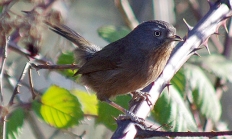
This is a mouse-like bird, only occasionally musters the courage to dart from its shadowy domain. The male and female are generally indistinguishable by external characters. Both sexes are small and brown, with dim streaks on a paler, often pinkish breast; generally paler and grayer in drier regions. Both sexes sing; the female's repeated single note is easily distinguishable from the male's fast trill introduced by several individual notes. The Wrentit is a resident along the coastal slope; in the Columbia River Lowlands and in the south inland to the west Klamath Mountains. It uses a wide range of habitats…
The Chipping sparrow is a small and slender sparrow that has a distinctive sharp chip note and simple, trilling song. Breeding adults display a chestnut crown, a black eye-stripe, and crisp white eyebrow. After nesting season, both male and female lose their distinctive bright cap for a streaky dull brown head pattern that is similar to other winter sparrows. It is a common summer resident in open forests and drier woodland edges throughout Oregon and is especially abundant in the Blue Mountains. The Chipping sparrow is an Oregon Conservation Strategy Species in the Willamette Valley ecoregion. Hear the song of…

The song of this bird is one of the characteristic sounds of spring evenings in much of the high desert country of eastern Oregon. This temperate migrant is a ground-nesting, ground-foraging bird of most of the grassland, agricultural land, and shrubs steppe habitats of Oregon. The streaked brownish plumage of the Vesper sparrow is similar to that of several small to medium-sized sparrows, except for white outer tail feathers, shown most conspicuously in flight. The Oregon vesper sparrow is an Oregon Conservation Strategy Species in the Klamath Mountains and Willamette Valley ecoregions. Hear the song of the Vesper sparrow Photo…

Although not brilliantly plumaged, the conspicuous Song Sparrow is one of the more regularly seen birds in Oregon. Defensive and curious, when approached it readily announces its presence with loud chips and often excitedly rises to a conspicuous perch to confront the interloper. The Song sparrow is well named as both male and female have a variety of songs that may be heard at any time of year, and juvenile birds begin to sing full songs within two months of hatching. The Song sparrow is a common and widespread resident of western Oregon. Hear the song of the Song sparrow…

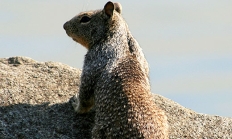
The California ground squirrel is a large, long-tailed gray squirrel with a large, nearly-black, triangular patch between light-gray shoulder patches. The gray dorsal pelage is speckled with buffy white spots. The tail is bushy, but not so full and spreading as those of tree squirrels. In Oregon, it occurs throughout the area west of the Cascade Range and throughout much of Central Oregon. It is considered among the most generalized of the ground squirrels as it inhabits a variety of habitats. Although it is a ground-dwelling squirrel, it has a strong propensity to climb. It is commonly observed sitting on…
The Western red-backed vole is among the smaller of the voles in Oregon. The pelage consists of a vaguely demarked reddish-brown or chestnut-brown stripe on the dorsum grading to buffy gray to dark gray on the sides and venter; the tail is indistinctly bi-colored, light grayish-brown above and whitish below. This vole occurs from the Columbia River south through the Coast Range. It does not occur in the Willamette Valley or other interior valleys west of the Cascade Mountains. It is a denizen of forest habitats, but tends to be most abundant in closed canopy old-growth forests containing an abundance…

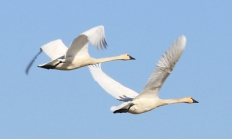
Of several swans found in Oregon, the tundra swan is by far the most common during the non-breeding season. It is most readily distinguished from the similar-appearing trumpeter swan by voice, although subtle differences in physical appearance and behavior can separate the two with difficulty. It is a fairly common transient throughout the state but most abundant at large bodies of water and wetland complexes east of the Cascades including the Malheur National Wildlife Refuge and the surrounding Harney Basin, Summer Lake Wildlife Area and the Klamath Basin. Hear the call of the tundra swan Photo by Kathy Munsel, ODFW
NEWPORT, Ore – Mussel harvesting is now open from Cascade Head to the California border the Oregon Department of Agriculture and Oregon Department of Fish and Wildlife announced today. Marine biotoxin levels in this area tested below the alert level. People should always call the Shellfish Safety Hotline at 1-800-448-2474…



NW BIG GAME HUNTING September 17, 2026 Currently open Archery deer and elk, bear, cougar ( check current harvest numbers), coyote, youth only controlled series hunts, general season antlerless elk damage, premium, auction and raffle hunts and western gray squirrel. *Check Big Game regulations for hunt details and purchase your license and required tag before hunting. Announcements and resources Gear up for this year's Big Game Hunting Forecast and get ahead of the game! Big game statistics - You'll find links to population, harvest and maps that can help you decide where to hunt this season. Check the Leftover Tag…
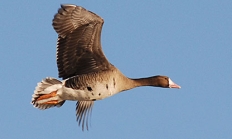
While not as abundant or conspicuous as the more familiar Canada and snow geese, the great white-fronted goose represents one of the first signs of fall. The greater white-fronted goose is gray-brown in body color and has orange feet. Adults have the namesake white forehead, pinkish-orange bill, and black speckled/barred breast and belly. Laugh-like calls from small skeins of these birds are heard high overhead in August through September in the north Willamette Valley and across the Cascades to south central Oregon and northeast California. Hear the call of the greater white-fronted goose Photo by Dave Budeau, ODFW
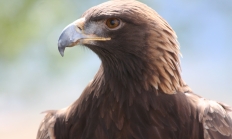
The Golden eagle is the largest soaring raptor inhabiting open country and mountainous terrain in eastern Oregon. A powerful and skillful hunter, the Golden eagle has become the National icon of the American West. A very large, dark raptor, the nape golden in all plumages, the females are slightly larger. Juvenile birds show white patches at the base of the primaries and a white tail with a broad dark terminal band. They are common residents in all Oregon counties east of the Cascade range. The Golden eagle inhabits shrub-steppe, grassland, juniper, and open ponderosa pine and mixed conifer/deciduous habitats. It…
The enigmatic Solitary sandpiper may be one of the least understood of Oregon's regularly occurring shorebirds. As its name implies, the species is most often found singly, and it rarely occurs in groups of more than two individuals. The Solitary sandpiper frequents habitats not often utilized by other migrant shorebirds, such as smaller and often partly wooded patches of water, and high-altitude bogs and wet meadows. It is an uncommon to rare migrant in fresh water or brackish habitats throughout Oregon; rarest along outer coast and in alkali habitats. Spring adults more common in the western interior valleys; fall juveniles…
