
Search myodfw.com
Showing 521 - 540 of 1410 results
Inconspicuous and master of stealth, the Least bittern inhabits densely vegetated deep-water marshes, making observations rare and difficult; its call is often the only way to detect this secretive species. The smallest of herons, its long neck and legs make it appear larger. The crown, back and tail of male birds is greenish black; purple-chestnut on female. Neck, flanks, and underparts are brown and white and the wings buff. It is a rare spring and summer resident in larger freshwater marshes of eastern Oregon and a very rare spring through fall visitor in the Rogue and Willamette valleys. At Upper…

One of Oregon's rarest breeders, this distinctive "shorebird" is known for its courtship display flight and loud curlew-like call. it often perches in pine trees or on fence posts adjacent to nesting areas. A small plover-like head and short, strait bill seem out of proportion to its body, which is reminiscent of a small curlew. The Upland sandpiper is a rare breeder in large montane meadows within forests of eastern Oregon. They are almost never observed away form the breeding grounds in Oregon. The Upland sandpiper is an Oregon Conservation Strategy Species in the Blue Mountains ecoregion. Hear the call…

Canvasbacks are large; adults in good condition are as heavy as mallards and second in size only to the white-winged scoter among common Oregon ducks. Drakes have a reddish head and neck; black breast, lower back and tail coverts; nearly white back, flank, and belly, and dark gray tail. The hen is grayish brown with a darker brown head, neck, breast and tailcoverts. It is an occasional summer resident in northeast Oregon, nesting locally only at Ladd Marsh in Union County. It is an uncommon spring and fall migrant in northeastern Oregon and regular in winter and spring on the…

Three Mile Falls Dam is located at river mile three on the Umatilla River. The dam was constructed in the early 1900s and serves as an irrigation dam that is a complete barrier to fish migrating upstream. In order to successfully migrate past the dam, all adult salmon and steelhead must use the fish passage facility located on the east side of the dam. The fish facility consists of a fish ladder, viewing window, fish trap and holding pond. Every adult salmon and steelhead heading upstream is counted at this facility using a combination of trapping and video tape enumeration…
Known as "bluebill" to most hunters, this species is one of the most abundant and widespread of North American ducks. The lesser scaup is similar to the greater scaup in appearance and habits, but is smaller and lacks the white on the primaries. In the field, however, the black-and-white drakes and brown hens are very similar to greater scaups. The common vocalization is the purr call of the female; drakes are usually silent, but utter a low single-note whistle in courtship. In general, the lesser scaup is more apt to be found in interior or freshwater habitats while the greater…


Alsea Hatchery was constructed in 1936 and is operated with state funds. Many improvements have been made to the hatchery since original construction. The hatchery produces both winter steelhead and rainbow trout. The facility is used for adult collection, spawning, egg incubation and rearing of winter steelhead, and egg incubation and rearing of rainbow trout.
The present facility was constructed in 1925, across the North Umpqua River from an earlier trout hatchery built in 1920. The hatchery was closed in 1975 due to low stream flows and high water temperatures, and was reopening in 1979 after extensive reconstruction. In 2012 a state of the art fish passage ladder was completed. It included a fish viewing window for Rock Creek basin fish inventory and a fish trap facility. The hatchery produces fall and spring Chinook, coho, summer and winter steelhead, and rainbow trout. The facility is used for adult collection, spawning, incubation, and rearing of Chinook…
Construction of this facility began in 1924 and production started in 1925 by the state of Oregon. Various renovations have taken place with the most recent being the addition of 4 new fish rearing raceways and improvements to the pollution abatement system which was completed in 2016. Other renovations made throughout the hatchery have utilized the Restoration and Enhancement Program.. The purpose of this facility is to enhance spring Chinook, winter steelhead, summer steelhead, and coho populations for various coastal streams. The facility is used for adult collection, egg incubation and rearing of spring Chinook, fall Chinook, winter steelhead, summer…
SALEM, Ore.—Oregon's Fish and Wildlife Commission today made changes to the formula used to allocate mule deer Landowner Preference (LOP) tags, which was needed due to the new harvest and population management system for mule deer approved in 2024. In a 6-0 vote (one abstention), the Commission approved shifting to…
This medium-sized, shy grebe has bright white cheeks that contrast sharply against a dark crown and rust red neck during the breeding season. An aquatic bird, it breeds in lakes and ponds, usually in forested areas. In Oregon, it is found in waters with hardstem bulrush intermixed with open water over five feet deep. Five to 20 birds at Rocky Point in the Upper Klamath Lake National Wildlife Reserve form the only consistent breeding population in Oregon. The red-necked grebe reaches its greatest numbers during winter along the coast. The red-necked grebe is an Oregon Conservation Strategy Species in the…

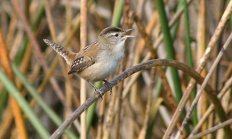
This pugnacious little wren, formerly known as the Long-billed marsh wren, inhabits cattail, bulrush, and other marsh plants. As the only Oregon species of wren that nests over water, it is easy to identify when seen, but sexes are difficult to differentiate in the absence of song due to similar coloration. This species has long been of interest to behavioral and evolutionary ecologists due to its polygyneous mating system, widespread construction of dummy nests, and the male's complex singing behavior. The Marsh wren nests statewide in appropriate wetland habitats. It is particularly common during breeding season around Malheur National Wildlife…
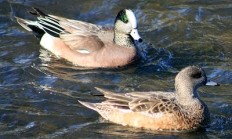
Wigeon drakes are beautifully marked with white pate, green eye stripe, purplish breast and flanks, white belly and wing covert patch, and iridescent black/green speculum. The grayish hen shows white on the wing covert patch. Drakes give a three-note whistle and get progressively noisier as spring approaches and courting flights begin. Medium sized flocks are common in fall and winter, and like geese, will be found grazing pastures, park lawns, and golf courses. It is a rare to locally common breeder in eastern Oregon and rare in summer in western Oregon. It is a common to abundant migrant and wintering…
These small, fast flying seabirds are unique among alcids in North America in their use of coastal coniferous forests, primarily old-growth trees, as nesting habitat. Their solitary nests are usually concealed within the forest canopy, and breeding birds are cryptic and primarily crepuscular at nest sites. Because of their secretive behavior and elusive nests, Marbled murrelets were considered the "enigma of the Pacific" and were one of the last ornithological mysteries in North America, as the first nest was not discovered until 1974. Distribution at inland nesting sites is fragmented, as birds occur only in areas where suitable habitat remains…

Bobolinks summer in Oregon's eastern grasslands and meadows, singing what has been described as a bubbling delirium of ecstatic music that flows from the throat of the bird like sparkling champagne. The yellow-brown female, juvenile or non-breeding male may at first appear to be a sparrow, but the breeding male has an astonishing and diagnostic backwards tuxedo pattern of buff on the nape and white rump and scapulars on an otherwise black body. The Bobolink is a regular, locally common breeder at the Malheur National Wildlife Refuge and a few scattered pairs occur in northeast Oregon. West of the Cascades…

CENTRAL POINT, Ore. – The Rogue-Siskiyou National Forest is temporarily closing the Huckleberry Mountain area in the High Cascades Ranger District Aug. 22-31 for Tribal ceremonial purposes. Rogue Unit general archery hunters should be aware of the closure over the archery opening weekend, Aug. 30-31. For more information on the…

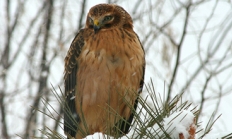
The Northern harrier is a slender, medium-sized hawk characterized by a noticeably long tail, bold white rump patch, and owl-like face. Commonly encountered in large expanses of open country, its main hunting technique is through use of a distinctive buoyant, gliding flight low over the ground that relies heavily on visual as well as auditory cues to detect prey. The larger females have rich brown upperparts while adult males are mostly light to medium gray, sometimes appearing almost ghostly silvery-white. Males are noted for their high-spirited and acrobatic courtship displays, in particular a series of dives and barrel rolls in…
The coyote is a typical canid intermediate in size between the foxes and the gray wolf. The pelage of the coyote is grayish, buff, pinkish cinnamon, or brownish, or a combination of those colors, often overlain by blackish tipped hairs on the ears, muzzle feet, and dorsum. The lips and eyelids are black, accentuated by contrasting borders of white fur. The underparts are paler than the remainder of the body. Considerable variation in color and markings of coyotes is evident among individuals and regionally east and west of the Cascade Range. True albinos with pink eyes and pink foot pads…

The majestic trumpeter swan is the largest of our native waterfowl and one of the heaviest flying birds in the world with males sometimes exceeding 30 pounds. Historically hunted to the brink of extinction, it was recognized as an endangered species long before there was an Endangered Species Act, and its recovery is a conservation success story. The adult's snow-white plumage with contrasting black bill and feet and 8-foot wingspan define this magnificent bird. Their neck is as long as their body and is used to reach food at the marsh bottom. In spring, the trumpeter swan is a locally…
