Search myodfw.com
Showing 541 - 560 of 825 results
This medium-sized shorebird is the most common dowitcher in eastern Oregon and inland locations, where it sometimes gathers in large flocks feeding in shallow water. It is also the only dowitcher in the state that regularly winters. Although breeding plumage adults are reddish below and heavily patterned above, most birds seen in Oregon are duller postbreeding adults or browner immatures. During winter, when shorebirds are hard to find, a small flock of chattering dowitchers, even in plain gray basic plumage, often brightens a day in western Oregon. In migration, it can be found at almost any shallow water site in…

The nasal meow of the Franklin's gull can be heard as it soars above wetlands and meadows, and colonies of this species are reported to be the loudest of all the gulls. In breeding plumage, the black hood contrasts sharply with the white breast and bright red bill. This species depends much more on insects and other invertebrates than do other gulls, and is therefore considered economically beneficial and favored by farmers. The Franklin's gull occurs in the southeast portion of the state in spring and summer, especially Harney Basin. It is rare west of the Cascades. It nests locally…

This diminutive owl is one of the smallest in North America, with a body mass of about 1.9 ounces. It has dark eyes, brown plumage with darker and reddish variegations, and small ear tufts. The Flammulated owl is unique among owls in the Pacific Northwest in that it preys almost exclusively on insects and is a neotropical migrant. Additionally, the pitch of its rather ventriloquial hoot is among the lowest of all North American owls. The Flammulated owl breeds on the eastern slope of the Cascades, in the Blue and Wallowa mountains, and in small numbers in the mountains of…
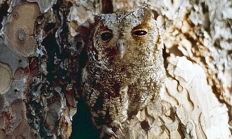
Almost strictly nocturnal, the Western screech-owl hunts discreetly at night and roosts during the day in dense woodlands, its perfectly streaked plumage allows it to pass as tree bark. These habits make it difficult to see, and it is more common than many are aware. It is a small owl with yellow eyes and feathered ear tufts. It exhibits geographic variation in plumage color and pattern: both gray morphs and brown morphs occur in the Pacific Northwest. Sexes are alike. The Western screech-owl is a fairly common year-round resident in lower-elevation woodlands throughout Oregon. It is usually found below 3,000…
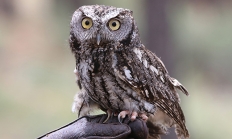
This tiny owl has a reputation as an aggressive predator on everything from mice and voles to birds and mammals over twice its size. Coloration is highly variable with brown and gray morphs. In Oregon, color varies from dark brown in coastal mountains to gray in eastern Oregon, with an intermediate pale grayish-brown form in the Cascade mountains. About the length of a White-crowned sparrow, it has striking yellow eyes, dark vertical streaks on the breast and abdomen, and dark "eyespots" on the back of the head. It is primarily diurnal and can often be approached quite closely when it…

Because of its association with old forests, this inconspicuous, dark brown owl has become one of the most controversial birds in the Pacific Northwest. The dark eyes and creamy white mottling on the breast and abdomen are distinctive, as is the lack of fear of humans. Both adults and young will typically allow humans to approach within a few feet, and it is not unusual for curious juveniles to follow hikers through the woods. The Northern spotted owl is a permanent resident in forested regions of western Oregon, from the coastal mountains to the eastern foothills of the Cascade Range…

The Common nighthawk is a migrant to Oregon with one of the longest migration distances of any North American bird. It is also one of the last to arrive in Oregon. Long, slender wings are marked by a white patch on the "hand" visible in flight from great distances. When perched on the ground, the cryptic brown, gray, and black mottling makes the bird almost invisible. This bird breeds and migrates at all elevations through the state. Its nesting habitat is characterized by open landscapes with little ground cover and is most abundant in sagebrush and rocky scablands and rimrock…

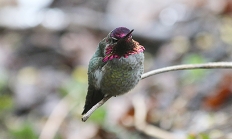
Anna's hummingbird is the largest hummingbird common to our region. It is the only hummingbird regularly found in Oregon in winter, during which time it is exposed to short day lengths, limited sources of food and periods of intense cold. It is more vocal than most hummingbirds with males uttering a dry, scratchy buzz of a song that can be heard throughout the year. It is a rare to locally uncommon summer resident west of the Cascades in interior valleys and along the coast; also along the Columbia River east to The Dalles. It occurs and probably breeds into the…
The haunting cries of these wanderers evoke a variety of reactions from curiosity to wonder. Highly social, the Pinyon jay epitomizes the dynamics of flock behavior such as colonial nesting, communal feeding of young and non-territoriality. Although Pinyon jays are nomadic and unpredictable, each flock is a tight-knit, integrated unit occupying a home range that does not overlap with other flocks. Flocks may wander widely outside their home range if sufficient food is not available. The Pinyon jay is a permanent resident in juniper and ponderosa pine woodlands of central Oregon. Oregon's known breeding population is confined to the Metolius…

On his historic expedition with Meriwether Lewis, Captain William Clark, the bird's namesake, first mistook this species for a woodpecker undoubtedly because of its long, sharp beak. However, this most specialized member of the North American Crow family uses this apparatus to pry loose its favored seeds from unrelenting cones of several pines with which the nutcracker has a symbiotic relationship. The whitebark pine, in particular, is totally reliant on Clark's nutcrackers for seed dispersal and germination. In Oregon the Clark's nutcracker is a resident along the crest of the Cascades, usually above 4,000 feet, lower on the east slope…

A constant chatter of high-pitched staccato tidi tidi tidi or tideet tideet calls coming from the canopy of ponderosa pine forests east of the Cascade Range is a sure sign of the presence of this tiny, highly active, social nuthatch. Measuring only 3.75-4 inches long, this stubby mite is the smallest and plainest of the three western U.S. nuthatches. This is a tree-bark clinger that has a woodpecker-like bill for probing bark, opening seeds, and cavity excavation. The Pygmy nuthatch forages all the tree surfaces from the trunks to the outer- and top-most needles and cones. The Pygmy nuthatch is…

Even in the most barren and desolate reaches of the Great Basin, the cheerful song of the hardy Rock wren will contradict any notion that the desert is devoid of life. This specialist of cracks and crevices can be found almost anywhere there is exposed rock. One of its most unique features is the mysterious pebble path is constructs from its stone-cave nest to the outside entrance. Drab and pale overall, the gray head and back, white to tawny underparts, and gray tail with buff-tipped corners distinguish this species from other wrens. The Rock wren is a common breeder in…

This moderately small wren maintains the frenetic energy that is so obviously typical of this family of birds. It is a summer inhabitant in many parts of Oregon, generally in open woodlands, thickets, and occasionally in residential gardens. The House wren occurs over the widest latitudinal range of any New World passerine. The House wren nests in a wide variety of native and human-influenced habitats. Nest sites are primarily located within preformed cavities in snags. It is a very uncommon to common transient and summer resident in semi-open woodland habitats throughout the state. In southwest Oregon, it is most common…

This small, dark-headed sparrow flashing white outer tail feathers is one of the state's most abundant species and one of the easiest to identify. When not nesting, the Dark-eyed junco might be seen nearly anywhere in the state. It is a regular visitor to city parks and neighborhood bird feeders. Most juncos occurring in Oregon show dark hoods, dull rusty-brown backs, and pinkish brown below the wings. Some are grayish, lacking much of the brown tones. They are most often observed in single-species flocks but individuals and small groups often join mixed wintering sparrow flocks. It is resident from the…

The House sparrow is an invasive species introduced from Europe. No other North American wild bird is so associated with human settlement as this introduced House sparrow. Its foods are nearly all imports, and its nesting and cover requirements are also human-derived. The House sparrow and European starling are the only introduced passerine birds that are thriving in Oregon. These birds can dominate bird feeders and utilize nest boxes that were intended for native species. The House sparrow can be found statewide around buildings at human developments of adequate size ranging from scattered farmsteads in remote and rural areas to…

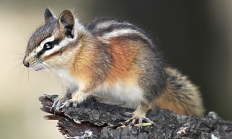
The yellow-pine chipmunk is one of the smallest in Oregon, only slightly larger than the least chipmunk. Its face is marked with a dark stripe, followed laterally by two alternate light and dark stripes. The outermost light strip is nearly white. It occurs on the east slope of the Western Cascades and eastward through most of the remainder of Oregon, except it is absent from most of the Columbia Basin and much of southern Harney, eastern Malheur, and southern Baker counties. Its range also extends westward in the Siskiyou Mountains in southern Jackson and Josephine counties. Ponderosa pine seems to…
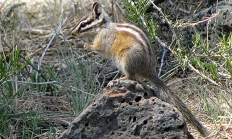
The least chipmunk is the smallest chipmunk in Oregon, but it is only slightly smaller than the yellow-pine chipmunk. As in all chipmunks, the face is marked with a dark stripe through the eye bordered on each side with a light- and a dark-colored stripe. The middorsum is marked with a dark-colored stripe followed on each side by two alternating light- and dark-colored stripes. The least chipmunk has the largest geographic range of any chipmunk. In Oregon, it occurs east of the Cascade Range except in the Columbia Basin and most of the Blue Mountains. In general, it is a…
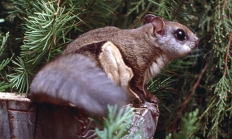
The Northern flying squirrel is the smallest arboreal squirrel in Oregon. It is typically squirrel-like except that the fore- and hind legs are connected by a furred patagium that extends from the ankle to the wrist. It is lead colored with buffy brown to brown tips. It occurs in forested areas west of the Cascade Range and eastward to near Lakeview, Lake County and Paulina Lake, Deschutes County. The species also occurs in the Blue, Ochoco, and Wallowa mountains. Northern flying squirrels are mostly nocturnal although individuals may be observed abroad during light hours on rare occasions. They are usually…
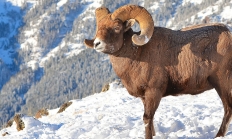
Features: Rocky Mountain bighorn sheep are the largest-bodied bighorn in North America and one of two subspecies of wild sheep in Oregon. Bighorn sheep were extirpated from the state in the 1800s so current populations are the result of a reintroduction effort by ODFW and sportsman groups. Habitat: Oregon’s estimated 800 Rocky Mountain bighorn sheep are found in the northeast corner of the state, in canyons of the Snake River and its tributaries and in alpine areas of the Wallowa Mountains. Techniques: Bighorn sheep are one of the rarest game species hunted in Oregon today, with about 100 tags available…
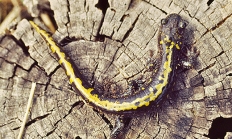
Appropriately named, adult long-toed salamanders have extremely long toes on their hind feet. Adults have black or brown skin that is smooth and moist with a yellow ragged-edged stripe running from its head to the tip of its tail. It is speckled with white or silver dots along its sides and underside. Adults may grow up to more than six inches in total length. Adult long-toed salamanders are seen infrequently, as they spend most of the year in the ground. They find cover in a variety of habitats including grasslands, dry shrub-steppe, pastures, lowland forests, high elevation lakes and ponds…