Search myodfw.com
Showing 581 - 600 of 1416 results

Oregon has a variety of raptors, from the diminutive Sharp-shinned hawk to our nation's symbol, the Bald eagle. Some of these birds of prey are migratory, while many live here year-round and can be seen hunting along rivers, roadside posts and fields.

Oregon's owls are mostly nocturnal, hunting for insects, fish, frogs, birds, mice and other small mammals in the night. Their hoots, screeches and calls can be heard after dark or early in the morning. Owls don't build nests, but instead use tree cavities, nests created by other species, naturally occurring structures or human-made nest platforms. The Western burrowing owl nests underground in abandoned dens dug by squirrels, prairie dogs and badgers. Learn more about Oregon's owls.

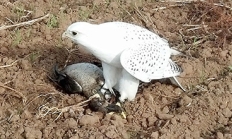
This is a large and power falcon. The majority of Gyrfalcons seen in Oregon are immatures or adults of the "gray" type, but there are several reports of "white" birds. The Gyrfalcon is a regular winter visitant to Oregon. The majority of sightings come from coastal and Willamette Valley lowlands near waterfowl concentrations. Individuals have been seen chasing and feeding on geese, ducks and gulls. Gyrfalcons forage by flying low over the ground and flushing prey, then often giving spectacular tail chases. If a bird refuses to flush the hunt is usually unsuccessful. East of the Cascades it occurs around…
Large and primarily white, the American white pelican has the longest wingspan of any bird in Oregon. It also has an enormous orange bill, and flies with neck withdrawn. During the breeding season the top of the bird's head becomes dusted with black and a horn grows on the upper mandible; this projection serves as a target for aggressive encounters to avoid injury to the essential bill pouch, but is shed after the eggs are laid. This pelican makes unusually long flights for feeding and migration, and at great distances, soaring flocks have been reported as UFOs. In Oregon, it…

This thrush-like ground-foraging warbler breeds from southeast Yukon and eastern British Columbia across Canada and through the eastern United States and locally elsewhere east of the Rocky Mountains. It migrates east of the Rocky Mountain to winter in Middle America. It is occasionally found in winter in its breeding range and in California. Small numbers regularly occur in western North America. Most Oregon records are from the southeast part of the state. Spring records range from early-May to mid-June. Fall records are fewer than in spring, and occur between late August and early September. Hear the song of the Ovenbird…

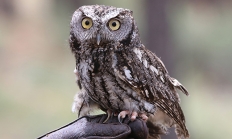
Almost strictly nocturnal, the Western screech-owl hunts discreetly at night and roosts during the day in dense woodlands, its perfectly streaked plumage allows it to pass as tree bark. These habits make it difficult to see, and it is more common than many are aware. It is a small owl with yellow eyes and feathered ear tufts. It exhibits geographic variation in plumage color and pattern: both gray morphs and brown morphs occur in the Pacific Northwest. Sexes are alike. The Western screech-owl is a fairly common year-round resident in lower-elevation woodlands throughout Oregon. It is usually found below 3,000…
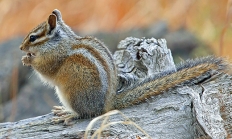
The pelage of this chipmunk is marked with five dark and four light stripes on the dorsum; the middorsal stripe is usually black and nearly always darker than the other four dark stripes. The sides of the face are marked with three brown and two light gray stripes, a patch behind the ear is light gray. The tail is blackish frosted with ochre dorsally and rusty brown ventrally. Allen's chipmunk produces a call of a rapid series of three or four to as many as 10 syllables. In Oregon, it occurs in forested areas along the eastern part of the…
A quiet, modest, unobtrusive little bird that must be sought to be seen in its shady retreats, this little-studied species can easily be overlooked. It is typically associated with oaks and mixed woodlands, where it hops along the foliage hunting for insects. In winter it forages with flocks of chickadees, kinglets, and nuthatches. This is Oregon's only resident vireo. Although it is sometimes referred to as non-migratory, some seasonal movement has been observed. Similar in appearance and behavior to the more common and widespread Ruby-crowned kinglet. Hear the song of the Hutton's vireo Photo by Greg Gilson

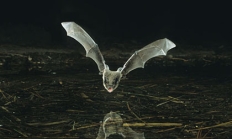
The long-legged myotis lives in forests and comes out early in the evening to hunt. It is a fast flier and will chase insects for a long distance. One baby is born in the summer, and the species hibernates in winter. In general, the long-legged myotis is a species associated with montane coniferous forests, but it also occurs in some desert and riparian habitats. The long-legged myotis is an Oregon Conservation Strategy Species in these ecoregions: Blue Mountains, Coast Range, East and West Cascades, Klamath Mountains, and Northern Basin and Range. Photo by ©Michael Durham

The foothills of interior southwestern Oregon come alive in late April with the bold song of this bright yellow warbler. Here it seems every brushy area or mixed conifer/hardwood forest with dense undergrowth has at least one male singing just beyond the reach of binoculars. Although it can be found in many other places in the state and in a variety of habitats, nowhere else is it as common. Nashville's are one of the few warblers in the West to nest on the ground. They occupy diverse shrub communities, often including or adjacent to a relatively short or open tree…

SALEM, Ore. – The Fish and Wildlife Commission meets Friday, July 11 at 10 a.m., at The Dalles Civic Auditorium (323 East 4th St., The Dalles). See the agenda here. The meeting will also be livestreamed from the Commission page. At Friday's meeting, the Commission will be asked to consider…

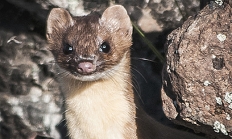
The Long-tailed weasel is the larger of the two weasels in Oregon, but smaller than the other member of the genus, the mink. Males are considerably larger than females. The head is flattened and somewhat triangular; the body and neck are elongate and almost cylindrical; the legs are short, and the tail is long. The summer pelage is brown dorsally; the venter is yellowish to orangish except for a white chin and sometimes one or more scattered brown spots. The tip of the tail is black. The pelage is molted twice annually. In the Cascade Range and eastward through the…
The kit fox is the smallest canid that occurs in Oregon. It has the typical canid conformation: the body is slim, the legs are long and thin, and the ears are large and erect. The tail is about 40 percent of the total length and is tipped with black, but has no dark mane on the dorsal surface. The feet and legs are whitish interiorly, light rusty-brown posteriorly. The dorsum is grizzled brownish-gray medially blending to grizzled gray then to light buff laterally and finally to white on the chest and venter. The head and posterior surface of the ears…


CLACKAMAS, Ore.—Oregon and Washington fishery managers have finalized preseason planning for 2026 Columbia River summer and fall recreational salmon and steelhead fisheries. Forecasts for summer steelhead, sockeye, fall Chinook, and coho returns will allow opportunity for anglers to target these fish. The planned 2026 fall-season fisheries are primarily limited by…
An Oregon native, sooty grouse occupy the coniferous forests of western Oregon, the eastern slopes of the Cascades, the Blue Mountains of northeastern Oregon, and the Klamath Basin and South Warner Mountains. Preferred habitat includes timber edges, open timbered slopes and mountain meadows, often adjacent to springs or other sources of water. They are often associated with berry producing areas such as chokecherry thickets. Hear the call of the sooty grouse Photo by ©Keith Kohl, ODFW

The Western whiptail is found in eastern Oregon deserts and semi-arid shrublands. It is most common in flat, sandy areas and along dry washes. These lizards are primarily insectivorous. In a food habits study in southeastern Oregon, they ate caterpillars, crickets, grasshoppers, and beetles. They also eat spiders, scorpions, and other lizards. Photo by Keith Kohl, ODFW

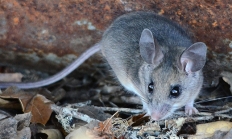
The piñon mouse is the largest member of the genus in Oregon. It is characterized by its enormous ears. Hair color varies geographically; overall, in central and eastern Oregon it is a pale-buff color with a wash of black on the dorsum, whereas mice from southwestern Oregon are bright ocherous on the shoulders and flanks and a dirty brown on the dorsum. In Oregon, the piñon mouse has been found in Josephine, Jackson, Klamath, Lake, Deschutes, Jefferson, Grant, Crook, and Harney counties. East of the Cascade Range it is almost always associated with western juniper in rimrocks. In southwestern Oregon…