Search myodfw.com
Showing 601 - 620 of 897 results
Oregon requires all hunters under the age of 18 to complete a hunter safety education course before hunting in the state. Upon course completion, students will receive a temporary Hunter Safety certification card to be carried while hunting in Oregon until a permanent card is received in the mail to replace it. Hunters over 18 are encouraged to take the online education course, as it may be required for out of state hunts. Note: Youth under the age of 9 may struggle with the course material and may not have the physical strength needed to safely handle a firearm during…
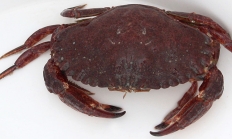
Features: These crab can be identified by their black-tipped claws, wide fan-shaped carapace (body cover) and deep, brick-red color. Habitat: As the name implies, red rock crab prefer the harder substrate habitats such as rocks, pilings, and other structure. Red rock crab prefer higher salinities than Dungeness crab and therefore are usually found in larger estuaries, close to the ocean. They are most common in Coos, Yaquina, and Tillamook bays where there are plentiful rocky substrates. Red rock crabs are native to Oregon. Techniques: Usually caught in combination with Dungeness crab, using the same techniques.
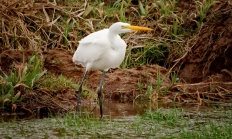
The Great egret is much larger than Snowy or Cattle egrets, and has a unique combination of yellow bill, black legs, and a cape of feathers draping beyond the tail in the breeding season. As a breeder, the Great egret is most abundant east of the Cascades, but it is present year-round in the Klamath Basin. It is more common April through November. It is also fairly common to abundant on the south coast except during summer months. In summer, it is rare west of the Cascades, but is a regular local breeder around Coos Bay. In fall, it occurs…
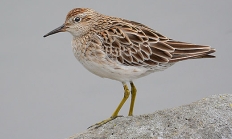
This is a portly, brightly colored shorebird, typically found in coastal salt marshes, mud flats, and sandy margins of freshwater ponds. Migrant juveniles rather than adults appear in Oregon. They have a flattish, dark rufous-colored crown with fine black streaking. The crown gives the appearance of a jaunty "cap" sitting forward on the head and abruptly ending at the rear. The breast is rich orange-buff shading into the white lower breast and belly. The well-defined creamy-white supercilium broadens behind the eye and is visible at a considerable distance. This is one of the most distinctive field marks on juveniles. They…
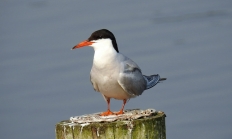
This is a small tern most often seen along the coast flying along the beaches or hovering and diving over a school of fish just offshore. Breeding-plumage adults have sharp black caps, reddish bills, and forked tails, and are pale grayish above and white to pale gray below. They are a common to abundant spring and fall transient over the ocean, usually within 15 miles, irregularly along the coast and in the estuaries. Nearshore and inland flocks are often observed resting in compact flocks on nearby shores or on floating objects, or flying about over the water in search of…
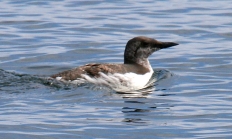
The most common seabirds breeding in Oregon, Common murres are easily recognized by their distinct black and white breeding plumage and their upright stance at colonies. Wing-beats are rapid and like all alcids they can fly underwater. They are often seen over the ocean in long lines of 10-40 or more birds. They nest on rocky islands and cliffs in colonies of tens or hundreds of thousands of birds packed together almost shoulder to shoulder. Major nesting concentrations in Oregon are on the south and north coasts reflecting the availability of suitable nesting habitat. Hear the call of the Common…
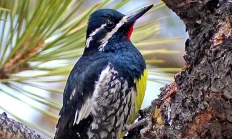
Male and female Williamson's sapsuckers look so different that until 1873, ornithologists thought they represented two distinct species. The mostly black male has a bright yellow belly and red chin. The female is pale brown with barred back and wings and dull yellow belly. It is a summer resident of forests in the Blue Mountains, on the east slope of the Cascades and east to Warner Mountains in the south. It breeds in mid - to high-elevation mature or old-growth conifer forests with fairly open canopy cover, and large dead trees suitable for nest cavities. Hear the call of the…
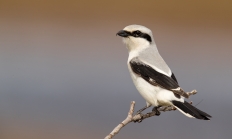
This is the larger of Oregon's two shrikes, and the more likely to be seen in winter. Most of those seen in Oregon are hatch-year birds wearing brownish plumage in the fall and graying as winter passes. Adults stand out from young of the year with more crisp gray, black, and white plumage. Shrikes inhabit open landscapes. They resemble and act like small raptors, however, they capture and kill prey with a hooked bill rather than with talons. The Northern shrike is an uncommon to locally common visitor in open habitats statewide. It is absent some years along the southern…
Ravens are clever, innovative, and entertaining. They quickly exploit human-created opportunities for food and shelter. Their spectacular aerial acrobatics conducted under windy or thermal conditions appear to be an act of fun. The Common raven's plumage is entirely shiny black like the American crow, but the ravens appear 25 percent larger, have a wedge-shaped tail and have deeper croaks and other calls than the American crow. In Oregon, the Common raven is a fairly common, widespread resident in many habitats throughout the state; population densities are highest east of the Cascades. Hear the call of the Common raven Photo by…

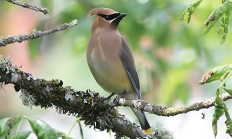
One of Oregon's most efficient fruit-eaters and a perennial irritant to cherry, blueberry, and grape growers, the Cedar waxwing is a sleek, social resident of mixed forests and urban areas throughout the state. Smooth, tan-brown plumage, a black mask with a mall head crest, red waxy wingtips, and a yellow tipped tail give Cedar waxwings a distinctive appearance. The breeding range of the Cedar waxwing covers most of Oregon, except for the extensive conifer forests and expansive treeless areas with greater breeding populations reported in lowlands. Hear the call of the Cedar waxwing Photo by Kathy Munsel, ODFW
Familiar to anyone from the eastern United States and Canada, this sparrow is much less common in Oregon. Adults show both a white-striped and tan-striped morph, while first year birds resemble tan-striped adults but are typically more heavily streaked underneath. Even the dullest first-year birds have a distinct rectangular white throat patch, often set off with a partial black border. The White-throated sparrow is an uncommon migrant and winter visitor, mainly in western Oregon. Hear the call of the White-throated sparrow Photo by ©Keith Kohl, ODFW

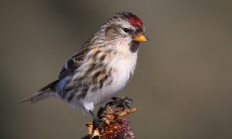
These tiny finches brighten the winter landscape of northeastern Oregon in some years. Their tan and ivory streaked with brown is plain enough, but the red forehead, black chin, and breast suffused in pink add a spot of color to snow-covered trees and shrubs. The Common redpoll is an uncommon to rare, irregular winter visitor, mainly in lowlands of the eastern Blue Mountain ecoregion. In peak years, this species can be locally common in Union, Wallowa, and Baker counties but in other years, it is essentially absent. It is an irregular visitant to Umatilla and Grant counties and in all…
In Oregon, the opossum is considered an invasive species. The Virginia opossum is a cat-sized mammal with a pointed nose, unfurred, black, leathery ears with white edges; beady eyes; a hind foot with an opposable hallux (big toe); and a naked scaly tail. It was introduced in Oregon between 1910 and 1921. Populations were established in northwestern Oregon apparently from releases of animals brought to the state as pets or novelties. Small streams, forest communities, and agricultural lands planted to a variety of crops are typical of many habitats occupied by Virginia opossums in Oregon. They are active nocturnally and…

The hoary bat has a wingspan of nearly 16 inches. It has dark fur tipped with white, a dark mask on its face, a yellow-orange throat and round ears edged in black. This bat roosts in branches of trees and likes to feed around outdoor lights. Hoary bats migrate south in winter, returning to Oregon in the spring. This bat usually bears twins. Hoary bats are found at scattered localities over most of the region west of the Cascade Range and in montane regions east of the Cascade Range. They are an Oregon Conservation Strategy Species in all ecoregions except…

The Great Basin pocket mouse is the largest member of the genus in Oregon. The dorsal pelage of this mouse is pinkish buff or ocherous buff overlain with black hairs; the venter is white to buffy. A lateral line, usually somewhat olive colored, separates the dorsal and ventral pelages. The tail is distinctly bicolored. In Oregon, it occurs thought east of the Cascade Range, except it does not occur in the Wallowa and Blue mountains. The Great Basin pocket mouse constructs burrows below the surface that contain granaries for storage of food, a nest cavity, and several entrances. They spend…

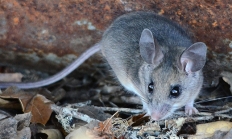
The piñon mouse is the largest member of the genus in Oregon. It is characterized by its enormous ears. Hair color varies geographically; overall, in central and eastern Oregon it is a pale-buff color with a wash of black on the dorsum, whereas mice from southwestern Oregon are bright ocherous on the shoulders and flanks and a dirty brown on the dorsum. In Oregon, the piñon mouse has been found in Josephine, Jackson, Klamath, Lake, Deschutes, Jefferson, Grant, Crook, and Harney counties. East of the Cascade Range it is almost always associated with western juniper in rimrocks. In southwestern Oregon…
Features: The winter males' body is mostly white except for a black breast and central back; the wings are dark, scapulars long and gray, and the dark central tail feathers are long and slender. Winter females are darker above with a light head; scapulars and tail feathers are short and dark. Dark areas mark females' heads and males' necks. Habitat: Long-tailed ducks can show up almost anywhere from the coast (they usually winter off shore) to inland on the Columbia River and on lakes throughout the state. Techniques: Some long-tailed ducks are taken in Oregon, but not enough to show…

KLAMATH FALLS, Ore. – ODFW is taking steps to protect native redband trout by requiring catch-and-release fishing for them and flies and artificial lures only (no bait) for all species from June 15 to Oct. 31 on Upper Klamath Lake and spring-fed creeks that feed into it. The waterbodies impacted…
CENTRAL BIG GAME HUNTING June 25, 2026 Currently open Cougar ( check current harvest numbers), Coyote Announcements and resources Check the Leftover Tag List for an opportunity to hunt this year. View the Big Game raffle and auction hunt results along with the 2026 seed number drawing results. Big game harvest statistics - You'll find links to population, harvest and point summary reports that can help you decide what hunts to apply for this season. Please report elk with hoof disease - If you see elk showing signs of elk hoof disease, including lame or limping elk or elk with…