
Search myodfw.com
Showing 601 - 620 of 1410 results
The gray partridge was released in North America as early as 1790 from its native range in Europe and Asia, but it was not until the 1900s that this stocky gamebird became well established in many states. It is also called the Hungarian partridge (or Hun) by hunters. The gray partridge currently thrives mainly in the valleys of the northeast and Columbia Basin counties of Oregon. Photo by Dave Miller, Flickr

Yuma myotis emerges when it is almost dark and forages for insects over streams and ponds. This bat is gray, tan or brown; it lives in a variety of habitats. Large numbers of female bats gather together in May or June to have their young. In autumn, they migrate. Yuma myotis is found throughout the state and is associated more closely with water than any other North American species of bat. Photo by ©Michael Durham

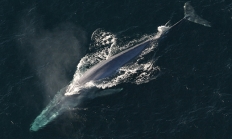
Blue whales are occasionally spotted off Oregon, but usually no closer than 10 miles offshore. These whales are part of the Eastern North Pacific population that range from Alaska to Costa Rica. They migrate between feeding areas along the west coast of the United States and Canada and breeding and calving grounds off Mexico and Central America. They are thought to be among the most endangered of the great whales. Photo by NOAA
The mountain cottontail is intermediate in size and light grayish-brown in color. Its tail is white and ears relatively broad and rounded. It is usually associated with rocky outcrops with nearby dominant vegetation consisting of big sagebrush, bitter-brush, rabbit-brush, western juniper and mountain-mahogany. In Oregon, it occurs throughout the state east of the Cascade Range with a western extension into Josephine County. Photo by ©Keith Kohl, ODFW

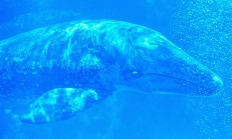
The most common whale off the Oregon coast is the gray whale. In addition to the approximately 200 resident gray whales that live nearly year-round off Oregon, a winter and spring migration brings about 18,000 more past our coast. Gray whales are baleen whales (mysticetes). They grow to 50 feet in length and will weigh up to 80,000 pounds; adult females are larger than males, which is common in all baleen whales. They do not have a dorsal fin on their back but instead have a series of knuckles. These whales are mottled gray and are covered with barnacles and…
This species breeds in upland deciduous and mixed forests with dense understory from southeastern Canada south to Georgia. It winters in the Caribbean and Middle America and casually in the United States. It migrates primarily along the east coast and regularly in small numbers along the west coast. It is rare but regular in Oregon during the fall from early September to mid-November. Hear the song of the Black-throated warbler Photo by Kenneth Schneider, Flickr

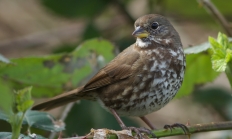
These big, medium-brown sparrows with variable grayish faces and heavily streaked or blotch undersides can be found in summer at higher elevations across much of the state except the Coast Range. Darker brown birds from more northerly breeding populations are common in western Oregon in winter, often coming to feeders, where they scratch like towhees for seed on the ground. Hear the song of the Fox sparrow Photo by Robin Horn, Flickr
California myotis is an acrobatic flyer. It is dark brown to blond with dark ears, and feeds on moths and flies. Early in the summer, a female joins a maternity or nursery colony where she gives birth to one offspring. In winter, these bats roost in mines, caves and buildings. The California myotis is an Oregon Conservation Strategy Species found throughout the state except for the Columbia Basin. Photo by ©Michael Durham

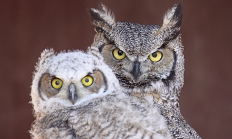
The Great horned owl is the most commonly encountered owl in Oregon. It is a large, stocky, powerful owl with large yellow eyes and distinctive feather tufts or "ears" above the eyes. Plumage color varies from dark brown in western Oregon to pale grayish brown in southeastern Oregon. The throat is white. It is a fairly common permanent resident throughout the state, but generally absent in areas above the timberline. Hear the call of the Great horned owl Photo by Charlotte Ganskopp
Bringing its cheerful song to streamside thickets throughout the state each breeding season, the bright and active Yellow warbler seems to be the incarnation of summer. Notable for its vivid color, it has been described as a "rich yellow flame among the opening leaves." It was once the most conspicuous breeding warbler in Oregon and was formerly common in shade trees of urban areas, including western Oregon, but has declined precipitously. Hear the song of the Yellow warbler Photo by ©Keith Kohl, ODFW

This delicate warbler rewards a diligent observer with a stunning black-and-orange vision hidden among the leaves (adult males) or a more subtle gray-and-gold (females and immatures) in riparian areas within the open forests of northeastern Oregon. A spars, unpredictable and probably declining breeder in the state, it is sometimes seen at "vagrant traps" such as desert oases and isolated coastal copses during migration. Hear the song of the American redstart Photo by Dan Pacamo, Flickr

The Common yellowthroat is one of North America's most widespread warbler species and its witchity-witchity-witchity song is also among the most easily recognized. This skulker may breed in any suitably damp brushy or weedy habitat throughout the state, and can be abundant in extensive marshy habitat. They are rare in winter in western Oregon in interior valleys and along the coast. Hear the song of the Common yellowthroat Photo by Kathy Munsel, ODFW

This is a medium-sized bat with large, long ears. It is gray, brown, or black and generally active only after full darkness. Townsend's big-eared bat is very vulnerable to human disturbance, and its numbers are declining. In Oregon, it is classified as a State Sensitive Species. It's also an Oregon Conservation Strategy Species in all ecoregions except Nearshore. Never disturb this bat if you are in a cave. Photo by ©Michael Durham

The granite peaks of Oregon’s Blue and Wallowa Mountains form the backdrop for many of this zone’s glacier-carved lakes and crystalline streams. Bull trout thrive in this zone’s cold, clear rivers, which also sustain whitefish and rainbow trout, and welcome returning runs of hatchery-reared steelhead. Chinook salmon travel over 300 miles up the Columbia to spawn in rivers such as the Imnaha and Wallowa. Warmwater fisheries are few, but the John Day River offers world-class fishing for smallmouth bass.
Abundant rainfall feeds the massive Willamette River watershed, tamed by a system of reservoirs that are stocked annually with hundreds of thousands of rainbow trout. Some of these reservoirs also grow trophy-size largemouth and smallmouth bass, as well as bluegill, brown bullhead and crappies. Smaller lakes and ponds nearer the valley floor provide springtime trout fishing close to home. Salmon and steelhead navigate the Willamette River and its tributaries, many of which are also home to rainbow and cutthroat trout.

This large brown sparrow with its handsome black-and-white head pattern is a common breeder in brushy semi-open country throughout much of the state. In winter, it is frequently found in large flocks, often in the company of Golden-crowned sparrows and other seed eaters. White-crowns are easily seen as they feed on the ground, repeatedly dashing back into the cover of dense shrubs before emerging for another foraging bout. Hear the song of the White-crowned sparrow Photo by Kathy Munsel, ODFW

This bat is brown to reddish brown and has relatively long forearms. It gets its name from the fringe of hairs along the bottom of its tail. It roosts in trees, snags, buildings, caves, rocks, cliffs and bridges. It likes beetles and moths but will eat spiders and crickets. The fringed myotis occurs in the Coast Range from Jackson County to Clatsop County and in the northeastern corner of the state. It's an Oregon Conservation Strategy Species in seven of the nine ecoregions. Photo by ©Michael Durham

The Mink is a semiaquatic species. The body is elongate and cylindrical, the legs are short and stout, the tail is bushy and about half as long as the head and body. The head is flattened, the ears small and rounded, and the nose is pointed. The pelage consists of dense grayish underfur and long lustrous guard hairs. Dorsally, it is dark brown to blackish but somewhat lighter on the venter. In Oregon, the mink is found throughout the state and is associated with river, lake, pond, or marsh environments. They forage along overhanging banks, and in holes and crevices…

This active and often unwary woodpecker, the smallest in North America, is generally the most often seen black and white woodpecker in human-settled areas. A preference is shown for decayed wood for nesting, though sound wood is also utilized. Nest sites are usually 10 to 12 feet off of the ground. It is found mostly at low to moderate elevations in deciduous and mixed deciduous-coniferous forests throughout much of the state, and less often in coniferous forests. Hear the call of the Downy woodpecker Photo by ©Keith Kohl, ODFW
