
Search myodfw.com
Showing 641 - 660 of 1410 results
In Oregon, the opossum is considered an invasive species. The Virginia opossum is a cat-sized mammal with a pointed nose, unfurred, black, leathery ears with white edges; beady eyes; a hind foot with an opposable hallux (big toe); and a naked scaly tail. It was introduced in Oregon between 1910 and 1921. Populations were established in northwestern Oregon apparently from releases of animals brought to the state as pets or novelties. Small streams, forest communities, and agricultural lands planted to a variety of crops are typical of many habitats occupied by Virginia opossums in Oregon. They are active nocturnally and…

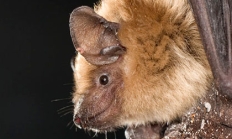
The big brown bat is a relatively large bat with a wingspan of 13 to 14 inches. Its dark color and slow flight help with identification. They are more likely to be active in cold weather than other bats and prefer human structures for roosting. The big brown bat occurs throughout the state. In eastern Oregon it forages over the forest canopy, along roads through the trees, along the forest edge, over forest clearings, and along cliffs and canyon streams. In western Oregon, the species is usually associated with coniferous and deciduous forests. Photo by ©Michael Durham
Ruffed grouse are named for a series of black iridescent feathers on the sides of the neck called the ruff, which is erected by males to form an ring around the neck during courtship displays. This forest-dwelling species, favored by upland game-bird hunters, is well known for the drumming of the males during courtship displays in the spring. It is a common resident throughout most forested regions of the state. It occupies most forests at low to moderate elevations east of the Cascade crest, primarily the east slope of the Cascades from Ft. Klamath and upper Klamath Lake and Blue…

Columbian sharp-tailed grouse, commonly called "prairie chickens" by early Oregon residents, were abundant in the grasslands and foothills of Oregon east of the Cascade Mountains prior to the late 1800s but were considered extirpated from the state by the 1970s. Recent reintroduction programs give a glimmer of hope that sharp-tails may once again hold their own in northeast Oregon. Males congregate on leks or dancing grounds in the spring and perform elaborate social displays. The Columbian sharp-tailed grouse is an Oregon Conservation Strategy Species in the Blue Mountains ecoregion. Hear the call of the Columbian sharp-tailed grouse Photo by Mike…

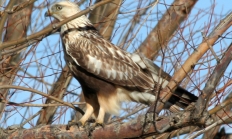
Characteristic of open country and cold weather, the Rough-legged hawk can be found soaring over exposed terrain or perched on utility poles across much of the state in winter. The rough appearance of its legs comes from the feathers covering their length, an adaptation that provides extra warmth in frigid weather. In flight, dark wrist patches and belly help identify this large buteo, though like other hawks it is subject to much variation in plumage. From a distance it frequently appears to have a frosty upper half. It often hovers over fields while hunting, a behavior that is rare among…
A slender, orange bill, pearl gray upperparts, and fringed black crest adjoining a white face and neck indeed render this graceful hunter from the south elegant. The foreheads of adults turn white in post-breeding plumage, their usual state in Oregon. These terns frequent quiet waters or lagoons when diving for fish, but also dive in calm ocean waters. They roost with flocks of gulls and other terns on coastal spits, estuarine sandbars, and on mudflats close to bay mouths. Virtually all records of the Elegant tern in Oregon are coastal or within half a mile of shore. None have been…

Insects swept up in a rising air mass are favorite prey of this species nicknamed the "cloud swift." It prefers to nest near or even behind the curtain of a waterfall. This dark swift glides for long distances, often very high in the sky, with its wings held somewhat downward. It is larger and darker than the more common Vaux's swift, and has a slightly forked tail. The Black swift is a rare to uncommon spring and fall transient and summer visitant throughout the state. It's an Oregon Conservation Strategy Species in the West Cascades ecoregion. Hear the call of…

With its long, forked tail and long wings, it is the most graceful of all land birds and reminds one of the smaller terns not only in shape but in behavior. The Barn swallow has taken so completely to nesting on human-made structures that one forgets they were once restricted to caves and rock crevices. Almost every farm in the state has a pair or two nesting in an outbuilding, and very few bridges do not have a pair or two. It is the best known of the swallows. It is a fairly common to locally abundant summer resident and…

The Brown-headed cowbird was referred to in early literature as the "buffalo bird" presumably because it commonly foraged on insects flushed under the feet of ungulates. It is a brood parasite, laying its eggs in nests of other species and leaving the rearing of young to surrogate parents. This has had serious consequences for many host species within the cowbirds' range. In Oregon, the Brown-headed cowbird is a common migrant and breeder in open habitats and woodland edges in all parts of the state. It is most abundant in agricultural land, sagebrush and juniper steppe, coastal scrub, riparian zones, and…

SE Fishing June 18, 2026 Best bets for weekend fishing Catch and Release for Redband Rainbow Trout with no bait will be required starting June 15 on Upper Klamath Lake including Pelican Bay, Crystal Creek, Recreation Creek, Harriman Creek, Odessa Creek, Short Creek, Pelican Bay, Fourmile Creek, Thomason Creek, Fourmile Canal, and mouth of Williamson River. Willow Valley Reservoir is good for largemouth bass Black drake mayflies will be hatching in various rivers in the Klamath Basin. Lake of the Woods, Miller Lake and Fourmile Lake will be good for hatchery rainbow trout The Wood River below Weed Road is…
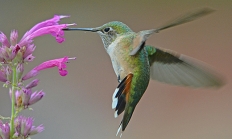
Perhaps the most enigmatic hummingbird found regularly in Oregon, the Broad-tailed hummingbird has so far eluded documentation of its breeding in the state, likely due to identification uncertainties and the remoteness of its preferred habitat. Primarily a Rocky Mountain species, its hard-to-define breeding range seems to reach its limit at Oregon's eastern edges where reports of this beautiful and rare species arise each summer. The relatively large adult male has a rose-red gorget and green plumage with no dorsal Rufous coloration. Females and immatures are nearly indistinguishable in the field from those of the more common Rufous hummingbird. Hear the…
A colorful harbinger of spring, the hardy Tree swallow arrives from the south during February each year. It is a highly social species that is usually observed in large flocks often with Violet-green and other swallow species. It is not colonial but several pairs may nest together if available cavities are clustered. The Tree swallow is a bird of open places near water and is seldom seen in residential neighborhoods or built-up urban areas. It is the only swallow that eats berries and small seeds as well as insects. In Oregon, it is a locally abundant summer resident and breeding…

Arguably the most widely recognized of Oregon's birds, the American robin is the largest, most abundant, and most widespread thrush in the state. Ranging from sea level to treeline, the robin's loud, musical voice and conspicuous brick-red chest make it unmistakable to even the most casual of observers. The robin thrives in both human-dominated and natural landscapes and is considered to be a habitat generalist throughout its range. Considering the robin's natural history, we know most about its diet, which comprises primarily of soft invertebrates in the spring and summer and fruit in the fall and winter. It is most…

Although a common breeding bird throughout Oregon's mountains, the Pine siskin retains an air of mystery due to its highly nomadic and unpredictable movements and its fondness for the inaccessible conifer canopy. It is most familiar in winter through early spring when flocks descend to foothills and valleys to feed on alder catkin seeds and many mingle with goldfinches in weed patches and at feeders. It is readily identified by its heavily streaked plumage and by the yellow wing and tail bars that are especially prominent in flight. The Pine siskin is a generally common resident in conifer forests throughout…

The flight of Pacific loons by the thousands along the coast each spring and fall is one of Oregon's most dramatic bird migrations. Stunning plumage often clothes these fast-flying travelers. The straight bill, distinguishing Pacific from red-throated and yellow-billed, is less robust than that of common loons. The Pacific's head is larger and its neck thicker than those of the red-throated. In flight, Pacific's wing-beats are faster than those of common, loons the feet appear larger, the forecrown is rounder, and the hindcrown more sloped than those of red-throated loons. This is the most abundant loon off the Oregon coast…

Skulking through wetlands, the American bittern is rarely seen - it has an extremely slow and stealthy walk, and when a threat approaches it freezes and mimics marshland plants with upright posture and beak pointed skyward. These behaviors combined with its cryptic plumage effectively camouflage the bird. However, it is occasionally seen in flight, and its low, gurgling song can be heard over long distances. An uncommon to fairly common breeder east of the Cascades and a rare migrant in Malheur county it has also been noted at mountain lakes east of the Cascades in Lake County. In western Oregon…

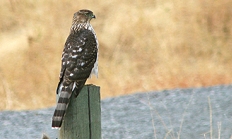
Cooper's hawks are smallish "bird hawks" (slightly smaller than American Crows) with rounded wings, a long rounded tail, and long yellow legs. This is the mid-sized accipiter nesting in Oregon and is larger than the Sharp-shinned hawk, but smaller than the Northern goshawk. The usual mode of flight consists of several rapid wing-beats alternating with brief periods of sailing. Juveniles are dark above with underparts streaked vertically while adults tend to have a bluish cast to their gray upperparts. The long tail is barred dark and light with narrow whitish band at the tip. It is an uncommon breeder in…
The Common nighthawk is a migrant to Oregon with one of the longest migration distances of any North American bird. It is also one of the last to arrive in Oregon. Long, slender wings are marked by a white patch on the "hand" visible in flight from great distances. When perched on the ground, the cryptic brown, gray, and black mottling makes the bird almost invisible. This bird breeds and migrates at all elevations through the state. Its nesting habitat is characterized by open landscapes with little ground cover and is most abundant in sagebrush and rocky scablands and rimrock…
