Search myodfw.com
Showing 661 - 680 of 1416 results
SALEM, Ore. – ODFW is accepting public comments on potential rule changes to commercial Dungeness crab fishing and trap check times for bear and cougar. Comment using the links provided on ODFW's rulemaking page. The deadline to comment is July 24 at 8 a.m. These policy proposals will be considered…

One of the characteristic birds of woodlands and city streets is this loud, colorful jay. Its bright blue-and-white-plumage and shrill calls are quite distinctive. It is closely related to the Steller's jay and hybrid individuals have been noted where their ranges overlap. It is an opportunistic forager of small animals and invertebrates, but is predominantly a vegetarian. It is a rare to regular visitor to eastern and western Oregon from late September to late April. The Blue jay prefers open mixed forests or deciduous groves and is often found in orchards and parks and along wooded city streets. Hear the…

This distinctive warbler breeds in deciduous and mixed forests from southeast Yukon, east British Columbia, across Canada and through the eastern United States. It migrates east of the Rocky Mountains to winter from northern South America north to the southern United States. It is a regular transient west of the Rocky Mountains with many more spring records than fall. Oregon spring records range from early April to mid-June. Fall records occur from mid-August to late-November. Hear the song of the Black-and-white warbler Photo by Howard Patterson, Flickr

The bobcat is the smallest wild felid in Oregon, with females being considerably smaller than males. The bobcat is about twice the size of a domestic cat, but its legs are longer, its tail is shorter, and its body is more muscular and compact. The feet are relatively small and the bobcat is not well adapted to negotiate deep snow. In general, the variously spotted pelage is yellowish with grayish overtones in winter and with reddish overtones in summer, reflecting the two annual molts. The ears are black with a large white spot and are equipped with short black tufts…

This is the largest native quail in North America and one of the least understood. Males and females have identical plumage characterized by distinctive white flank barring and prominent vertical head plumes. Their eastern Oregon range appears reduced from historical accounts. Mountain quail are considered occasional in Union and Wallowa counties. They have also been observed along many of the tributaries of the John Day River in Wheeler and Grant counties and some in Wasco, Jefferson, Deschutes and Crook counties. In western Oregon, they are found in most forested mountainous areas generally above 1,640 feet, but may move to valley…


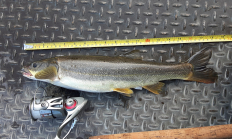
CENTRAL POINT, Ore. – The seventh annual Rogue River Pikeminnow Roundup is set for Sept. 26 - Sept. 28, offering anglers the chance to win prizes while helping protect native fish. Participants can win fishing gear, apparel, gift cards, and more by catching non-native Umpqua pikeminnow in the Rogue River…
One of the first migrants to brighten Oregon woodlands with song is the Black-throated gray warbler. As early as the first week in April, the distinctive buzzy song announces the male's arrival in habitats from riparian forests to juniper woodlands, chaparral to Douglas-fir forests. It sings even as it darts through the canopy and understory in search of insects. Except for the small yellow spot in front of the eyes, the male is an essay in black, gray and white. The cap and throat are black, as is the cheek which is outlined in white. The back is gray, striped…

CLACKAMAS, Ore.—Fishery managers are delaying the sockeye retention opener on the Columbia River until at least June 27 as the run is returning lower than forecasted. The season is now scheduled for June 27-July 5, but anglers should keep a close eye on action notices and the in-season regulations updates…

Inconspicuous and master of stealth, the Least bittern inhabits densely vegetated deep-water marshes, making observations rare and difficult; its call is often the only way to detect this secretive species. The smallest of herons, its long neck and legs make it appear larger. The crown, back and tail of male birds is greenish black; purple-chestnut on female. Neck, flanks, and underparts are brown and white and the wings buff. It is a rare spring and summer resident in larger freshwater marshes of eastern Oregon and a very rare spring through fall visitor in the Rogue and Willamette valleys. At Upper…

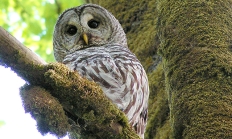
The Barred owl expanded its range from the eastern United States. It was first reported in Oregon in the early 1970s and has since spread to forested areas throughout most of the state. Sometimes confused with the closely related Northern spotted owl, the Barred owl is large with grayish-brown and white feathers and stripes on its chest and throat. It is easily distinguished from the Northern spotted owl by the pronounced horizontal barring across the throat and upper breast, and vertical brown streaks on the lower breast and abdomen. The Barred owl is now a permanent resident in forests of…
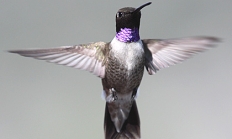
Noteworthy as a generalist, the Black-chinned hummingbird appears in a wide variety of habitats, including lush river bottoms, urban settings and desert canyons. Below the male's velvety black gorget is an iridescent purple band that can also look black in poor light. At rest, the wingtips are relatively broad and curved, unlike any other North American hummingbird. A rare to locally common resident east of the Cascades, it is least common in Klamath and Lake counties. Summer habitat in eastern Oregon includes canyons, juniper woodlands, and desert riparian zones. In the foothills of the Blue and Wallowa Mountains, it's found…
The male Red-winged blackbird, sentry of the marsh during the breeding season, continually announces its territory to all present with its oak-a-tee song, and tenaciously defends against flyby predators. The male is territorial, polygynous, larger than the female, and glossy black with a broad bar of red-orange, bordered with yellow, on wing writs. Females are less conspicuous in behavior, light brown, with a heavily streaked breast, and buffy supercilium. This is one of the most abundant and studied birds in North America. The Red-winged blackbird occurs west of the Cascades in Oregon from coastal and valley locations, and east of…

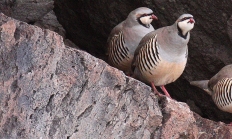
Pheasants, grouse, quail and turkey are all upland game birds that are chicken-like and ground-dwelling. Wild turkeys are the largest upland game bird in Oregon.
With a widespread distribution and affinity for open habitats, the Killdeer is one of the most common and recognized birds through much of North America. Killdeer are large for a plover and easily distinguished from other North American plovers by their characteristic two black or brownish-black breast bands. Killdeer are well known for their loud and persistent call of "kill-dee, kill-dee," heard at all times of day or night on both the breeding and wintering grounds. Killdeer often nest close to human activities. Adults perform an elaborate and exaggerated broken-wing display to lure humans and potential predators away from their…

Bats are important pollinators and the only flying mammals; they use sound to locate their prey, and they live a long time. Oregon has 15 species of bats, and eight of those are Oregon Conservation Strategy Species. Strategy Species are those having small or declining populations, are at-risk, and/or of management concern. Some of Oregon's species migrate south in winter while some remain here and hibernate. Bats have echolocation which allows them to make high-pitched sounds then listen to the echo of those sounds to locate where objects are. Echolocation helps them find even the smallest insect.

The American badger is a medium-sized, powerfully built carnivore strongly adapted for digging. The body is flattened and the legs are short but stout; the toes of the forefeet are partly webbed and equipped with long, curved claws; the hind feet are shaped like miniature shovels; and each eye is equipped with a membrane that can be extended to cover it. The ears are rounded and densely covered with fur but seem large in comparison with those of many digging mammals. The tail is short and brushlike. Dorsally, the long, shaggy pelage is mottled grayish blending on the venter to…

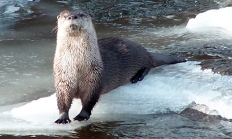
The River otter is adapted for both terrestrial and aquatic environments. The heavily muscled, somewhat cylindrical body is thickest at the thorax and tapers posteriorly to a thick, flattened tail. The body tapers to a blunt and slightly flattened head. The legs are short and powerful; and the toes are webbed. The eyes are small, forwardly directed and set high on the head. The underfur is grayish, short, and dense, and overlain by longer, stiff and shiny guard hairs. The dorsum is brown and the venter a lighter brown or tan; the lower jaw and throat are whitish. In Oregon…