Search myodfw.com
Showing 681 - 700 of 785 results
The ears of the pygmy rabbit are short, rounded, and covered with long silky hairs inside and out; the tail is small and covered with hairs possessing wide buffy bands with narrow blackish tips above and below; and the feet are short, densely furred below, and colored a light orangy-buff. In Oregon, pygmy rabbits have been found east and south of a line connecting Klamath Falls, Fremont, Redmond, and Baker City. This rabbit is closely tied to habitats dominated by big sagebrush. The Pygmy rabbit is an Oregon Conservation Strategy Species in the Northern Basin and Range ecoregion. Photo from…

Commonly found along beaches and about estuaries, this large, ponderous bird is a conspicuous member of the summer coastal community, easily recognized by its large size, massive bill, and brownish plumage. Highly gregarious, it often forms large flocks; regularly observed foraging over the ocean just offshore. Brown pelicans often join mixed flocks of birds attracted to schools of small fish. They are common spring, summer, and fall visitors along the Oregon coast. Brown pelicans are an Oregon Conservation Strategy Species in the Nearshore ecoregion. Hear the call of the brown pelican Photo by Michael Lazott

Heermann's gulls, the warm-water gulls of summer and fall, accompany Brown pelicans as they fly north each summer. Although most feed along the shore or in the ocean, some feed on tide flats. They often steal food from Brown pelicans. They may take fish directly from the pelicans' bills immediately after a dive or claim food that pelicans have located, discarded, or disturbed. This gull is common on the outer seacoasts, beaches, bays and estuaries. They are strongly associated with outer coasts and adjacent ocean waters, usually within a few miles of shore. A few wander inland during the fall…

A slender, orange bill, pearl gray upperparts, and fringed black crest adjoining a white face and neck indeed render this graceful hunter from the south elegant. The foreheads of adults turn white in post-breeding plumage, their usual state in Oregon. These terns frequent quiet waters or lagoons when diving for fish, but also dive in calm ocean waters. They roost with flocks of gulls and other terns on coastal spits, estuarine sandbars, and on mudflats close to bay mouths. Virtually all records of the Elegant tern in Oregon are coastal or within half a mile of shore. None have been…

Though less conspicuous than Great blue herons, Green herons are well-established residents of western Oregon. They are distinguished by small size, glossy greenish-black cap and back, yellow legs, blackish-green wings, gray underparts, and dark red neck. One of the few tool-using birds, Green herons are experts at making and using baits and lures, such as bread crusts, mayflies, earthworms, sticks, and feathers to catch fish. The Green heron is an uncommon but regular migrant and summer resident throughout west and south central Oregon. Detection of nests is difficult and breeding status uncertain in some areas due to its secretive habits…

One of Oregon's rarest breeders, this distinctive "shorebird" is known for its courtship display flight and loud curlew-like call. it often perches in pine trees or on fence posts adjacent to nesting areas. A small plover-like head and short, strait bill seem out of proportion to its body, which is reminiscent of a small curlew. The Upland sandpiper is a rare breeder in large montane meadows within forests of eastern Oregon. They are almost never observed away form the breeding grounds in Oregon. The Upland sandpiper is an Oregon Conservation Strategy Species in the Blue Mountains ecoregion. Hear the call…

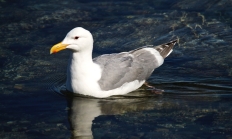
This mid-sized, pink-legged gull has caused much of the confusion in west coast gull classification and identification. Its plumage characteristics are similar to Herring, Iceland, and some Glaucous-winged hybrids, and great care is needed for correct identification. It differs from the Herring gull in having a much smaller bill, a darker eye, less black in the wing-tips and, often, a more rounded head. Opportunistic feeders, Thayer's gulls regularly concentrate about landfills, food-processing plants, and over fish runs. It is a common migrant and fairly common winter visitor along the coast. The largest wintering numbers are found in the Portland metropolitan…
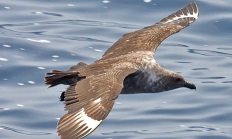
Skuas are the size of a Western gull, dark with a pale nape and large white patches on the bases of the primaries on both the upper and lower surfaces. This is a solitary bird. Its flight is low and direct with heavy flapping and little gliding. It steals food from other seabirds, and is aggressive, bordering on predatory. It may grab a shearwater's head, wing, or tail and shake and kick the bird until it regurgitates its food. Chances of detection are best around flocks of shearwaters feeding behind fishing boats. It is a rare to uncommon fall transient…
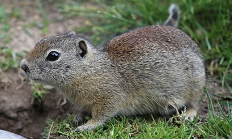
Belding's ground squirrel is a medium-sized ground squirrel without spots, stripes, or splotches. The pelage is smoky gray with some pinkish on the face, feet, and venter, and with a more or less well-defined reddish or brownish band in the middorsal region. The tail is cinnamon on the ventral surface. This squirrel occurs south and east of a line connecting Enterprise, Heppner, Maupin, Wasco Sisters, Diamond Lake, and south to Fish Lake. It may occur in steppe and shrub-steppe area, particularly in meadows; sagebrush flats; and small-grain pasture , and hay-crop fields, and sometimes in openings in woodlands. The Belding's…
Adult tiger salamanders are relatively large with olive-colored blotches outlined in black. They have gray undersides and can grow to 13 inches in total length. As adults, tiger salamanders live almost entirely on land, returning to the water to breed. Terrestrial adults spend a lot of time in burrows that they or other animals have dug. Tiger salamanders are found in grassland and shrub-steppe habitats. It is unknown whether tiger salamanders occurs naturally in Oregon, or whether they were introduced by people after larval salamanders used for bait colonized fishing lakes and ponds. Photo by Matt Reinbold, Flickr

NEWPORT, Ore. – The Oregon Department of Fish and Wildlife recommends people avoid harvesting and consuming softshell and bay clams from Alsea Bay estuary after the Oregon Health Authority issued a recreational use advisory for Eckman Lake in Lincoln County. The OHA issued an August 28 advisory due to the…
SALEM, Ore. — The Oregon Department of Fish and Wildlife is hosting a public meeting to review the agency's draft Endangered Species Management Plan for Southern Resident Orcas (SRO). The online-only meeting is July 9 from 6:30 p.m. – 8 p.m. ODFW staff will give a brief presentation of SRO…
SALEM, Ore.—The Oregon Fish and Wildlife Commission will meet Thursday and Friday, Aug. 13-14 in Salem. See the meeting agenda at https://myodfw.com/articles/commission-agenda-august-13-14-2026 On Thursday, Commissioners will visit projects showcasing work underway with partners to recover salmon/steelhead and lamprey in the Willamette Basin. To join the Tour, be at ODFW Headquarters…
A white form on the distant water may be the sides and breast of an adult male, whose deep green head and dark back are less visable when far away. The pearl gray bodies and white breasts of females, subadults, and eclipse males are starkly delineated from their full-crested chestnut heads. Long, slender, saw-tooth bills are held horizontally during surface swimming and grip squirming prey after an underwater chase. From coastal bays to the high Cascades, in all corners of Oregon and far beyond, common mergansers ply the rivers and peer into still waters in their efficient pursuit of fish…

In quiet backwaters and wooded wetlands, these stunning ducks can occasionally be seen skulking near the shoreline as they search for fish. The male with a striking black head and extensible white crest, white breast, black back, and chestnut sides is truly a sight to behold. Females and immatures are quite plain by comparison: dull grayish-brown except for a reddish brown crest. Hooded mergansers are surprisingly secretive and local during the breeding season. They breed locally throughout the Willamette Valley west to the coast and south to Coos County. They are casual from April to early October in the Umpqua…

These small, fast flying seabirds are unique among alcids in North America in their use of coastal coniferous forests, primarily old-growth trees, as nesting habitat. Their solitary nests are usually concealed within the forest canopy, and breeding birds are cryptic and primarily crepuscular at nest sites. Because of their secretive behavior and elusive nests, Marbled murrelets were considered the "enigma of the Pacific" and were one of the last ornithological mysteries in North America, as the first nest was not discovered until 1974. Distribution at inland nesting sites is fragmented, as birds occur only in areas where suitable habitat remains…

SW BIG GAME HUNTING September 3, 2026 Currently open Archery deer and elk, bear, cougar ( check current harvest numbers), coyote, youth only controlled series hunts, general season antlerless elk damage, premium, auction and raffle hunts. Season openings beginning in September Western gray squirrel *Check Big Game regulations for hunt details and purchase your license and required tag before hunting. Announcements and resources Gear up for this year's Big Game Hunting Forecast and get ahead of the game! Big game statistics - You'll find links to population, harvest and maps that can help you decide where to hunt this season…
The Rocky Mountain tailed frog’s coloring often matches the color of local rocks ranging from brown or reddish-brown to gray. They have grainy textured skin that further enhances their camouflage. Males have a short tail, the signature for tailed frogs. Adult males are slightly smaller than adult females that grow to two inches in length. Rocky Mountain tailed frogs are found in the water or close by it. They live in very shallow and heavily shaded water of fast-flowing, small, permanent streams in older mountain forests with cold and clear water, rocky substrates and little silt. These streams are often…

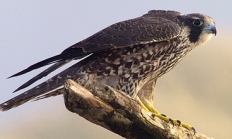
Peregrine falcons are among the most charismatic and noted of the world's birds. They are described as the fastest animal on the planet, and have been recorded reaching speeds in excess of 240 miles an hour in dives after prey. They are one of Oregon's boldest raptors, and have been observed usurping active Golden eagle nest sites, stealing fish from Ospreys and ground squirrels from adult Bald eagles who stray into their territory. It has, for perhaps 4,000 years, been used by falconers because of its skill in capturing game birds in tandem hunts with humans. Peregrines are medium-sized raptors…