
Search myodfw.com
Showing 681 - 700 of 1416 results
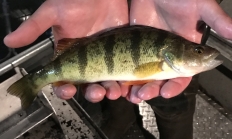
Features: Yellow perch are golden, with six to nine dark vertical bars. They have two well-separated dorsal fins; the second fin has two or three spines. Lower fins are yellowish-orange and, unlike walleye, yellow perch do not have canine teeth. Maximum size in Oregon exceeds 3 pounds and 18-inches long. They are prolific spawners, often resulting in an overpopulation of stunted fish. Habitat: Yellow perch prefer lakes, reservoirs and slower moving streams that have cool, clean water and ample vegetation. Perch bite readily and are therefore popular with young and novice anglers. Technique: In the spring and fall, find yellow…
ODFW's Living with beavers page has more information on beavers role in Oregon's ecosystems, and more. Receive Beaver Action Plan Partnership Updates by E-mail Resources ODFW Living with Wildlife: American Beaver (Information) (pdf) ODFW Living with Wildlife: American Beaver (flier) (pdf) ODFW's 3-Year Action Plan for Beaver-Modified Landscapes (pdf) ODFW Beaver Emphasis Area primary contacts map (pdf) Beaver bibliography (pdf): An annotated bibliography of published literature on beaver (2008) Oregon State Animal: (pdf) American Beaver Fact Sheet ODFW Requirements for Relocation of Beaver in Oregon (pdf)

Wizard Falls Hatchery was constructed in 1947. Many improvements have been made to the facility since original construction. The hatchery has a rainbow trout broodstock which supply rainbow trout to the Deschutes sub-basin and southeast Oregon. The hatchery is used for incubation and rearing of kokanee salmon and rainbow trout to provide for recreational fishing program objectives, and the incubation and rearing of spring Chinook and summer steelhead as part of a reintroduction program in the upper Deschutes Basin. Brook trout and cutthroat trout fingerlings are reared for the air stocking program on odd years. Kokanee salmon are spawned remotely.
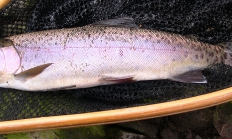
Features: As the name suggests, these fish have rosy red strip along their sides. Other identification clues include large, profuse black spots on the body and orange and yellow tints along the belly. Habitat: Redband trout are a subspecies of native rainbow trout that have adapted to the arid, desert conditions of eastern Oregon. During drought years distribution constricts as streams dry and become uninhabitable. Trout re-colonize these streams during wet cycles, expanding the distribution. Prime trout waters are clear, clean and cold. Good trout stream habitat is complex, consisting of an array of riffles and pools, submerged wood, boulders…
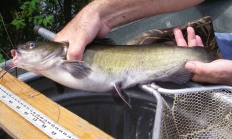
Features: Channel catfish are pale bluish-olive above and bluish-white below with a deeply forked tail, dorsal and pectoral spines, and an adipose fin. Like all other catfish, channel catfish have “whiskers” or barbels extending from the chin and upper jaw. Young fish have a varying number of small black spots over much of the body, while older fish may be partially or entirely without spots. Maximum size in Oregon approaches 40 pounds, but most are less than 10 pounds. Habitat: Channel catfish in western Oregon are limited to the Columbia River, lower Willamette River, and a few ponds in the…
In Oregon, the opossum is considered an invasive species. The Virginia opossum is a cat-sized mammal with a pointed nose, unfurred, black, leathery ears with white edges; beady eyes; a hind foot with an opposable hallux (big toe); and a naked scaly tail. It was introduced in Oregon between 1910 and 1921. Populations were established in northwestern Oregon apparently from releases of animals brought to the state as pets or novelties. Small streams, forest communities, and agricultural lands planted to a variety of crops are typical of many habitats occupied by Virginia opossums in Oregon. They are active nocturnally and…


The North Nehalem Fish Hatchery was originally constructed in 1966. The hatchery replaced the Foley Creek Hatchery which was constructed in 1926. The facility is used for adult collection, spawning, egg incubation and rearing of fall Chinook, coho, winter steelhead and rainbow trout.

Flocks of these big, brown, plain sparrows are a common sight in winter in western Oregon. By early spring their faded head markings become a beautiful gold, black and white, and their plaintive descending songs become frequently heard from almost any large brush pile. They are an abundant migrant in western Oregon, less common farther east, and abundant in winter throughout the Willamette Valley. Hear the song of the Golden-crowned sparrow Photo by Dave Budeau, ODFW
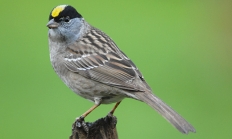
Image: The circles show monitoring stations in the basin and the green shows detection of a tagged salmon. KLAMATH FALLS, Ore. — Salmon are making exciting progress in their return to the upper Klamath Basin, with fisheries biologists from ODFW and The Klamath Tribes celebrating a series of firsts as…
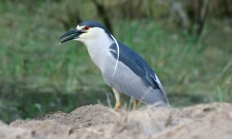
Although quite common in the U.S., the Black-crowned night-heron's nocturnal and crepuscular feeding habits can make it difficult to locate. Its habitat consists of marshes, lakes, rivers, and other wetlands, where it feeds mostly on fish. It is a thick-billed, medium-sized, stocky heron with relatively short neck and legs. Adults have a black back and cap which contrast with the pale gray or whitish underparts. Immatures have brown backs with large pale spots and heavily streaked underparts. A distinctive choking squawk call is often heard at dusk. It is a fairly common summer resident east of the Cascades where it…
Willamette Fishing June 25, 2026 Best bets for weekend fishing: Shad fishing is good in the Oregon City area. Several waterbodies will continue to be stocked with trout this week, however the upcoming hot weather will most certainly impact trout stockings. Many of the valley ponds are already too warm to receive their usual spring stockings. Check the stocking schedule for changes or try warmwater fishing. Spring Chinook continue to be caught in the Willamette below St Johns Bridge. Catch is increasing around Kelley Point Park. Target these fish early in the morning nad on incoming to high tides with…

OTIS, Ore.—ODFW's recent legislatively adopted budget did not include funding to continue the operation of Salmon River Hatchery, one of more than 30 hatcheries that ODFW maintains in the State. The cost of operating and maintaining the hatchery exceeded available revenue, but funding is just one of the issues facing…
Vireos and shrikes are predatory song birds. Their bills are strong and hooked to kill and dismember prey including insects and small birds, mammals and reptiles. These birds hunt from fences, wires and treetops and sometimes hang captured prey on thorns to eat them later.

The ears of the pygmy rabbit are short, rounded, and covered with long silky hairs inside and out; the tail is small and covered with hairs possessing wide buffy bands with narrow blackish tips above and below; and the feet are short, densely furred below, and colored a light orangy-buff. In Oregon, pygmy rabbits have been found east and south of a line connecting Klamath Falls, Fremont, Redmond, and Baker City. This rabbit is closely tied to habitats dominated by big sagebrush. The Pygmy rabbit is an Oregon Conservation Strategy Species in the Northern Basin and Range ecoregion. Photo from…
