
Search myodfw.com
Showing 701 - 720 of 903 results
The buzzy, insect-like song of the Savannah sparrow is a characteristic sound of open landscapes dominated by grasslands throughout Oregon. Savannah sparrows are usually heard or seen when perched atop a fence post, small shrub, or tall weed, or running on the ground between openings in vegetation until the bird abruptly drops down into cover. The Savannah sparrow nests on the ground, often in a slight depression and well concealed by a canopy of dead vegetation or partially tucked under a clump of vegetation. Hear the song of the Savannah sparrow Photo by Dave Budeau, ODFW

The Swamp sparrow uses wet areas that have thick vegetation for cover. Several glimpses of this reclusive bird may be required before it can safely be separated from Lincoln's sparrow or the more common Song sparrow, though its distinctive call will give it away to observers familiar with it. Chestnut coloration on the wing coverts helps separate this species from other wintering sparrows. The Swamp swallow is a rare to uncommon spring and fall transient and winter visitant in western Oregon, especially along the coast. Hear the song of the Swamp sparrow Photo from USFWS

This species breeds from northeast British Columbia to Nova Scotia and south to north Georgia. It winters in Middle and South America. Small numbers regularly occur along the west coast, especially in spring. The majority of Oregon records have occurred from early March through July, mostly from mid-May to mid-June. Individuals are occasionally found from mid-September to mid-January, mostly birds that remained less than five days. Here the song of the Rose-breasted grosbeak Photo by Anna Hesser, Flickr

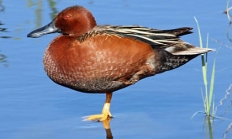
The bright rusty plumage of the male cinnamon teal, a bird of western North America, is a visual delight. In flight, both males and females show powder blue in the wings as they fly fast and low, timed at nearly 60 miles per hour. They weigh only about one pound. They are a common breeder throughout the state except in western Oregon and the high Cascades. They are most common east of the Cascades. Hear the call of the cinnamon teal Photo by Maxine Wyatt
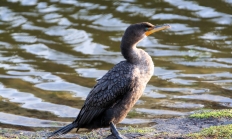
Adaptable and opportunistic, the double-crested is the most abundant and widespread of the three cormorant species found in Oregon, occurring inland and on the coast. Adults have deep, coppery feathers, bordered in black, that glisten with a green iridescent and offset a rich orange throat atop a long curved neck. The bird earns its name from plumes, ranging from white to black, that crown either side of the head during the breeding season. The double-crested cormorant is a common breeder in spring and summer at bays and estuaries, and on islands and cliffs along the coast and lower Columbia River…
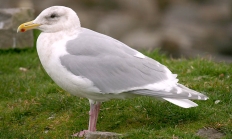
This gull nests on offshore islands, rocky coastal cliffs, and sometimes in grass on level parts of headlands. It forages in the marine and intertidal environments. Glaucous-winged gulls eat just about any animal material they find. They take small fish, barnacles, molluscs, sea urchins, bird eggs, carrion and animal waste discarded from fishing boats. It is rare but regular along the coast and the Columbia River; local and rare in the Willamette Valley. In can be uncommon midwinter at Sauvie Island. Most Glaucous-winged gulls in Oregon nest in the mouth of the Columbia River. Hear the call of the Glaucous-winged…
The Snowy owl is the largest North American owl. Its white plumage makes it uniquely adapted for life in the arctic and sub-arctic. Adult males are nearly pure white, females have black spots and some barring. Young birds can be strongly barred. Every few years, for reasons which are still not fully understood, Snowy owls move south of their normal winter range into Oregon. During these irruptive events, they can be found on coastal dunes, open high desert, agricultural areas, airport margins, and occasionally atop buildings in populated areas. Hear the call of the Snowy owl Photo by Charlotte Ganskopp

This tiny jewel is the smallest breeding bird in North America and the smallest long-distance avian migrant in the world. The average weight of males is approximately 0.09 oz, about half of that of an Anna's hummingbird, and a little more than the weight of a penny. It breeds predominantly in mountain habitats, and despite its diminutive size, successfully withstands the chilly summer nights at high elevations. It is a common summer resident of the Blue and Wallowa Mountains and other high ranges east of the Cascade summit. Spring and fall migrants are rare at lower elevations east of the…

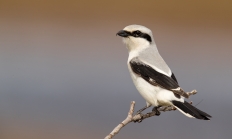
This is the larger of Oregon's two shrikes, and the more likely to be seen in winter. Most of those seen in Oregon are hatch-year birds wearing brownish plumage in the fall and graying as winter passes. Adults stand out from young of the year with more crisp gray, black, and white plumage. Shrikes inhabit open landscapes. They resemble and act like small raptors, however, they capture and kill prey with a hooked bill rather than with talons. The Northern shrike is an uncommon to locally common visitor in open habitats statewide. It is absent some years along the southern…
One of the characteristic birds of woodlands and city streets is this loud, colorful jay. Its bright blue-and-white-plumage and shrill calls are quite distinctive. It is closely related to the Steller's jay and hybrid individuals have been noted where their ranges overlap. It is an opportunistic forager of small animals and invertebrates, but is predominantly a vegetarian. It is a rare to regular visitor to eastern and western Oregon from late September to late April. The Blue jay prefers open mixed forests or deciduous groves and is often found in orchards and parks and along wooded city streets. Hear the…

The name of the Western scrub-jay derives from its preference for "scrub" habitat, consisting chiefly of shrubs or brush intermixed with sparse trees. It calls attention to itself with its raspy metallic shriek. Its harsh voice and fussy, boisterous behavior might lead some to consider the scrub-jay a nuisance, but this bird also possesses abundant character and is considered to be uncommonly smart and adaptable. The Western scrub-jay is a common permanent resident in western interior valleys and foothills between the Coast Range and the Cascades, especially in the Willamette, Umpqua, and Rogue valleys. Hear the call of the Western…

This species reaches the northern limit of its range in southwest Oregon. Oak and Juniper titmice were formerly in the same species as the Plain titmouse but were recognized as a separate species in 1997. The drab, gray color with distinct crest and chickadee-like calls and behavior characterizes these species. Plumage of sexes is identical. The Oak titmouse is a friendly, high-spirited, and melodious bird of oak-dominated habitats of interior valleys and lowlands. It is a common resident in oak woodlands of the interior Rogue Valley, and a rare but permanent resident in Illinois Valley. Hear the call and song…

This eloquent wren is admired for its sweet, descending, liquid notes that echo off canyon walls. It is distinguished from other wrens by its gleaming white throat set off by gray head, rusty brown underparts and back, and bright rufous tail. Appreciated as it is, this is one of our least studied birds in part due to its frequently inaccessible habitat: cliffs, rimrock and deep canyon walls. It is a fairly common but local breeder in Oregon east of the Cascade summit; restricted to rocky cliffs or outcrops. It is more dispersed after breeding season west of known breeding range…

The bold eye-ring, white outer rectrices, and intricate buff wing pattern distinguish this elegant gray thrush at close range. The scaly patterned brown juveniles are quite unique in appearance. The complex song is varied, soft and flute-like at times, strong and powerful at others. The call carries well, and is a characteristic sound of the winter bird community in juniper woodlands east of the Cascades. It is a summer resident in the Coast Range. It breeds in and near open coniferous forest stands, natural forest openings, burned areas, shelterwood cuts and clearcuts to the timberline. Hear the song of the…

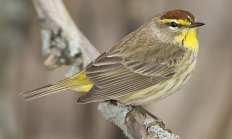
Palm warblers constantly pump their tails in a down-then-up motion, more so than any other warbler. They also walk and run on the ground more than most warblers. A key field mark is the bright yellow undertail coverts which contrast with whiter underparts. Palm Warblers are hardy warblers, migrating early in the spring and late in the fall. Birds presumably Palm warblers are regular fall transients on the outer Oregon coast and irregularly remain through the winter and spring. They are occasional spring and fall transients in the Willamette Valley and have been found wintering there. Hear the song of…
Features: Their eyed-side is greenish-brown to dark brown or black with lighter blotches. Their blind side is white to milky-white. They have a large, stout but flat body, shaped like an elongated diamond . Pacific halibut have been known to reach 500 pounds, but on average are 40 pounds. Habitat: Halibut are a large flatfish and so they spend much time near the bottom of the ocean looking above for food. They prefer chilly water and are primarily found in the Gulf of Alaska. Technique: Boat anglers use heavy rods to fish on or near gravel bottoms in water 150-500…


Big Creek Hatchery began operation in 1941. It was refurbished in 1957 under the Mitchell Act as part of the Columbia River Fisheries Development Program – a program to enhance declining fish runs in the Columbia River Basin. The facility is used for adult collection, egg incubation and rearing of winter steelhead, fall Chinook, and coho.
PENDLETON, Ore. – A $1 million federal investment will jump-start critical engineering and design work on fish passage and alternative solutions at McKay Creek Reservoir Dam, laying the technical groundwork to eventually reconnect more than 100 miles of historic salmon and steelhead habitat. Sens. Jeff Merkley and Ron Wyden helped…