Search myodfw.com
Showing 721 - 740 of 903 results

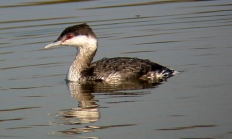
In alternate plumage this striking bird's lower neck, chest, and sides are bright chestnut. Three groups of yellow plumes adorn the sides of the head. Its head and throat are black. This grebe favors areas with much open water surrounded with emergent vegetation. The horned grebe is a rare breeder east of the Cascades. Malheur National Wildlife Reserve averages four to five pairs per summer. It is also rare along the coast in summer and is an uncommon spring and fall transient on lakes, reservoirs, and large rivers west of the Cascades and uncommon to common east of the Cascades…
A big, well-mannered bird of friendly, even playful disposition, with an abundant curiosity as to human presence and activities within the realm of open ocean over which he presides. Long-winged, to seven feet, and dark sooty-brown; adults have a white rump and feathering, which juveniles lack, around the base of a large bill. Every sighting of these gentle giants gliding up to the boat evokes delight. The black-footed albatross is a regular visitant spring through fall offshore, but is irregular in winter. They glean squid, fish and fish eggs from the ocean surface and also eat galley scraps. Hear the…

The Black oystercatcher is easily recognized with its black plumage, long, strait, laterally compressed, orange-red bill with a yellow tip, orange-red eye ring, yellow iris, and pale pink legs. These birds are restricted to rocky coastal shorelines where they feed in the intertidal zone. They are an uncommon to fairly common resident on rocky shores and sand/gravel beaches along the entire coast. Along the sandy central coast, they are present only as an occasional dispersing or wandering individual, typically on jetties. Black oystercatchers are Oregon Conservation Strategy Species in the Nearshore ecoregion. Hear the call of the Black oystercatcher Photo…

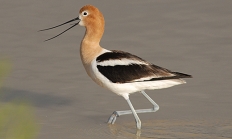
A conspicuous wader of shallow wetland habitats with a striking appearance and graceful movements. These long-legged shorebirds have contrasting black and white upperparts and during the breeding season, the head and neck turn from gray or white to a deep rust color. One of their most notable traits is a long, slender upturned bill. It is a common breeder east of the Cascades at wetlands of south central and southeast Oregon. Distribution and number of breeding birds vary annually depending on regional and local water levels and habitat availability. Regardless, most breeders occur in the western Great Basin counties of…
This unusual shorebird breeds along rivers, streams, and lakes in a variety of habitat types throughout the state, from sea level to near timberline. Conspicuous by its distinctive teetering behavior, boldly spotted underparts, and noisy alarm calls, it is usually the only breeding shorebird present in its preferred habitat. The appearance of a sandpiper along a tiny tributary in the upper reaches of a heavily forested watershed can be startling to one unfamiliar with the species' ubiquitous nature. The Spotted sandpiper is a widespread transient and breeder throughout the state, found in nearly every county in Oregon. Most birds depart…

A large, long-legged wader distinguished from similar species in a flight by flashing rufous underwings and dark brown primaries. Its feet extend beyond tail tip in flight. Flocks generally consist of fewer than 50 birds on the coast. Juveniles migrate south several weeks later than most adults. After mid-November, a few stragglers are seen until late December. The Marbled godwit is a regular spring and fall migrant on the Oregon coast. Spring migration commences in early April and extends through early June on the coast. Its average arrival at the Malheur National Wildlife Reserve is April 27. Hear the call…

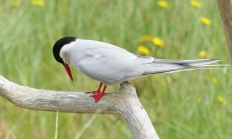
This graceful tern, with its aerodynamic body and streamlined wings, is infrequently seen from land in Oregon. It is most often encountered at sea as it makes one of the most incredible journeys in the animal kingdom, migrating from the Arctic to the Antarctic and back again each year, a journey of nearly 22,000 miles. A medium-sized bird with a reddish bill, it has a black cap and nape, and a white throat and cheek shading to a light gray body. It is a common offshore transient in Oregon waters and an occasional migrant along the coast. The bulk of…
Spirited vocalizations make this handsome clown-faced woodpecker one of the more conspicuous residents of much of Oregon's oak woodland. It is unique among Oregon woodpeckers with its habits of communal living and acorn storage. It is fairly common in the Rogue Valley and adjacent hills and locally common in the Klamath River Canyon in southwest Klamath county and the southern part of the Willamette Valley. Acorn woodpeckers are Oregon Conservation Strategy Species in both the Klamath Mountains and Willamette Valley ecoregions. Loss of oak woodlands poses a major threat to this bird. Hear the call of the Acorn woodpecker Photo…

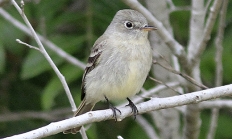
Among the least conspicuous of Oregon's birds, this inhabitant of arid country may be found in pine and juniper woodland and sagebrush shrubland. A particularly drab member of the difficult-to-identify flycatchers, the Gray flycatcher can most readily be recognized by its downward tail-bobbing motion. Other identification features include its overall gray coloration, its relatively long bill and tail, and a habit of frequently dropping to the ground from low perches in pursuit of food. It is an uncommon to locally fairly common breeder east of the Cascade summit and rare but annual along the west slope of the Cascades during…
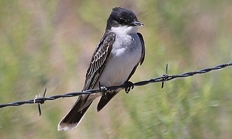
The plumage and perching habits of the Eastern kingbird make it one of the more conspicuous birds in open habitats of eastern Oregon. The plumage is well defined: black on the upperparts and white on the underparts, and a white band on the terminal tip of the tail feathers. It is a relatively large flycatcher, often perching on powerlines, fences, or exposed perches on trees or snags. They hawk aerial insects during the breeding season. The Eastern kingbird breeds throughout non-forest of most of northeast Oregon lowlands with spotty distribution in central and southeast Oregon. They are most abundant in…
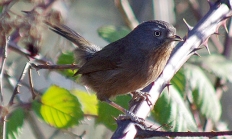
This is a mouse-like bird, only occasionally musters the courage to dart from its shadowy domain. The male and female are generally indistinguishable by external characters. Both sexes are small and brown, with dim streaks on a paler, often pinkish breast; generally paler and grayer in drier regions. Both sexes sing; the female's repeated single note is easily distinguishable from the male's fast trill introduced by several individual notes. The Wrentit is a resident along the coastal slope; in the Columbia River Lowlands and in the south inland to the west Klamath Mountains. It uses a wide range of habitats…
Although common within its range, this handsome sparrow can easily be overlooked. The gray head, black malar stripe, white eyebrow, and prominent black spot set in the middle of a white breast identify the bird. It is widespread throughout the extensive shrub-steppe of central and eastern Oregon. The principal breeding range of Sagebursh sparrow is southeast and central Oregon. It is found throughout the arid expanses of the Great Basin and usually associated with big sage. Although considered by some authors to be a sagebrush obligate, Sagebrush sparrows have been found in other plant communities exclusive of sagebrush. Hear the…

The Brown-headed cowbird was referred to in early literature as the "buffalo bird" presumably because it commonly foraged on insects flushed under the feet of ungulates. It is a brood parasite, laying its eggs in nests of other species and leaving the rearing of young to surrogate parents. This has had serious consequences for many host species within the cowbirds' range. In Oregon, the Brown-headed cowbird is a common migrant and breeder in open habitats and woodland edges in all parts of the state. It is most abundant in agricultural land, sagebrush and juniper steppe, coastal scrub, riparian zones, and…

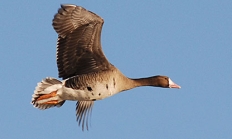
While not as abundant or conspicuous as the more familiar Canada and snow geese, the great white-fronted goose represents one of the first signs of fall. The greater white-fronted goose is gray-brown in body color and has orange feet. Adults have the namesake white forehead, pinkish-orange bill, and black speckled/barred breast and belly. Laugh-like calls from small skeins of these birds are heard high overhead in August through September in the north Willamette Valley and across the Cascades to south central Oregon and northeast California. Hear the call of the greater white-fronted goose Photo by Dave Budeau, ODFW
Inconspicuous and master of stealth, the Least bittern inhabits densely vegetated deep-water marshes, making observations rare and difficult; its call is often the only way to detect this secretive species. The smallest of herons, its long neck and legs make it appear larger. The crown, back and tail of male birds is greenish black; purple-chestnut on female. Neck, flanks, and underparts are brown and white and the wings buff. It is a rare spring and summer resident in larger freshwater marshes of eastern Oregon and a very rare spring through fall visitor in the Rogue and Willamette valleys. At Upper…

Though less conspicuous than Great blue herons, Green herons are well-established residents of western Oregon. They are distinguished by small size, glossy greenish-black cap and back, yellow legs, blackish-green wings, gray underparts, and dark red neck. One of the few tool-using birds, Green herons are experts at making and using baits and lures, such as bread crusts, mayflies, earthworms, sticks, and feathers to catch fish. The Green heron is an uncommon but regular migrant and summer resident throughout west and south central Oregon. Detection of nests is difficult and breeding status uncertain in some areas due to its secretive habits…

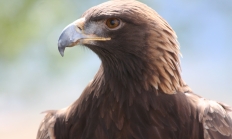
The Golden eagle is the largest soaring raptor inhabiting open country and mountainous terrain in eastern Oregon. A powerful and skillful hunter, the Golden eagle has become the National icon of the American West. A very large, dark raptor, the nape golden in all plumages, the females are slightly larger. Juvenile birds show white patches at the base of the primaries and a white tail with a broad dark terminal band. They are common residents in all Oregon counties east of the Cascade range. The Golden eagle inhabits shrub-steppe, grassland, juniper, and open ponderosa pine and mixed conifer/deciduous habitats. It…
These small, chunky plovers are uncommon to locally abundant migrants statewide, where they are among the most visible and easily identified small shorebirds. The only single-banded plover that occurs in Oregon, they can be remarkably easy to see when they are moving about on mud flats, and remarkably hard to detect when only their unmoving brown backs are visible against the mud. It is an uncommon to locally abundant migrant, with most birds at estuaries and some concentrations in spring at larger lakes of southeast Oregon. In the fall, it's rare in the Cascades; in winter, it's uncommon at larger…

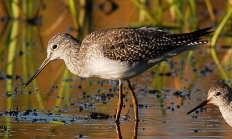
This tall, pale wader is often first detected by its ringing calls as a small flock maneuvers to land in shallow water along an estuary or lakeshore. The long, often slightly upturned bill and very long yellow legs make this one of the easier shorebirds to identify despite its subdued, speckled gray and white plumage. It is an uncommon to locally common migrant on shorelines and open wet areas statewide. It winters on the coast and locally inland. In addition to using shallow water in estuaries and along lake margins, these birds can often be found in flooded pastureland, especially…