
Search myodfw.com
Showing 741 - 760 of 903 results
During the breeding season Pigeon guillemots are easily seen flying low over the water along rocky coastlines or in estuaries. They have striking red feet, legs, and mouth linings and their large white wing patches contrast markedly with the rest of their black plumage. When standing on land they have a distinctive upright posture and often emit a high-pitched squeal. In the non breeding season they move offshore and look entirely different when their black plumage becomes mottled with white. The Pigeon guillemot occurs during the breeding season all along the Oregon coast wherever offshore islands or rocky cliffs are…

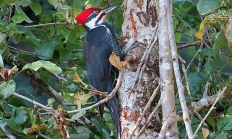
The Pileated woodpecker was the model for the cartoon character, Woody Woodpecker. It is a large black-and-white bird with a bold red feathered crest and distinctive call. You may hear its powerful drumming before you see it. In Oregon, its habitat includes older forests in the Blue Mountains, East and West Cascades, Klamath Mountains, Willamette Valley and Coast Range ecoregions. They prefer mature forests and younger forests with large snags and logs, requiring large diameter snags for nesting and foraging. Pileated woodpeckers are an Oregon Conservation Strategy Species in the Blue Mountains ecoregion. Hear the call and the drumming of…
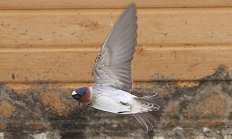
This chunky swallow is readily recognized by its square tail and orangish rump patch. It nests colonially and has taken to human-made structures so well that it has greatly expanded its range into many areas otherwise not suitable for it. It does not do well in urban settings, however, and quickly disappears when areas become densely settled. The unique gourd-shaped mud nest is often usurped by other species for nesting and is often used for protective roosting sites by rosy-finches and other wintering species. It is a locally common to abundant breeding bird near water throughout most of Oregon. Its…
The smallest and hardiest of our resident bird species, Golden-crowned kinglets are remarkable for their ability to survive through severe northern winters when most other small insectivores have migrated to warmer climates. Spending winter nights in a squirrel's nest or huddled together in a sheltered spat are strategies this species uses for winter survival. Their high-pitched calls ring like tiny bells from the canopy as they flutter among the branch tips in small flocks, searching for insects wintering in conifer foliage and dead leaves. The Golden-crowned kinglet is very abundant year-round in coniferous forests from the Cascades and west throughout…

Although they are one of the most abundant breeding birds in forests and woodlands west of the Cascade crest, it can be difficult to actually see Swainson's thrushes. Drab plumage and the habit of sitting very still hides them from the eyes of would-be predators and birdwatchers alike, especially in the shrubby habitats they favor. However, the beautiful song of this minstrel compensates for a lack of colorful plumage. During the longest days of summer, a chorus of liquid notes rising from the deep shadows each dawn and late afternoon reveals the actual abundance of this species in the conifer…

Arguably the most widely recognized of Oregon's birds, the American robin is the largest, most abundant, and most widespread thrush in the state. Ranging from sea level to treeline, the robin's loud, musical voice and conspicuous brick-red chest make it unmistakable to even the most casual of observers. The robin thrives in both human-dominated and natural landscapes and is considered to be a habitat generalist throughout its range. Considering the robin's natural history, we know most about its diet, which comprises primarily of soft invertebrates in the spring and summer and fruit in the fall and winter. It is most…

One of Oregon's rarest and most local breeders, this vocal but somewhat secretive warbler can be heard and sometimes seen in summer in the south central Cascades. The patient observer may catch a glimpse of a chunky, dark-backed bird feeding low in dense willows, sometimes showing its pale underparts with dark streaks. It is otherwise a rare migrant or vagrant statewide, mostly in Spring. An isolated population of this species has summered and presumably bred in the south central Cascades. No nest has been found in Oregon, owing mainly to the impenetrable habitat. Reports suggest that a small population may…

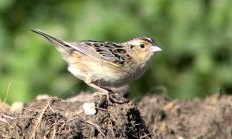
The Grasshopper sparrow is one of the more enigmatic and erratic birds in Oregon. A small population may appear in an area, persist for a few years, and then disappear, only to return at some later time. It is difficult to detect, because of both its quiet, insect-like song and its reclusive habits. Males sing from elevated perches, such as flower stalks or fence posts before diving back among the grasses. It occurs in scattered "colonies" along the unforested northern slopes of the Blue Mountains. The Grasshopper sparrow is an Oregon Conservation Strategy Species in the Columbia Plateau, Klamath Mountains…
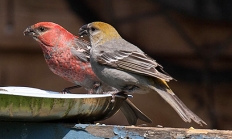
While in Oregon, the Pine grosbeak is tame and not suspicious, usually allowing a close approach as it feeds on buds or dried fruits. The soft-gray females and young males, the latter more or less washed with yellow on the head, far outnumber the rosy males, and observers should look carefully for these duller-colored birds. The song of the Pine grosbeak is often described as similar to the Purple finch, but fuller and with lower pitch. The flight is typically finch-like, but with broad, bounding undulations. The Pine grosbeak breeds in the Wallowas and is suspected to breed in the…
The House finch is the most widespread of Oregon's "red finches." It is a congenial, cheerful singer from urban areas to desert plateaus. The male has a red forehead, throat, eyebrow, rump and varying amounts of red in the breast. It may have small amounts of reddish wash in its otherwise brownish cheek, hindcrown, nape,and streaked back. In some males, red is replaced with red-orange, orange, yellow-orange or yellow. The female is drab grayish-brown, overall, with indistinct streaking above and no red. The House finch is a fairly common resident in lowlands, urban, rural, and agricultural areas throughout Oregon. They…

Although a common breeding bird throughout Oregon's mountains, the Pine siskin retains an air of mystery due to its highly nomadic and unpredictable movements and its fondness for the inaccessible conifer canopy. It is most familiar in winter through early spring when flocks descend to foothills and valleys to feed on alder catkin seeds and many mingle with goldfinches in weed patches and at feeders. It is readily identified by its heavily streaked plumage and by the yellow wing and tail bars that are especially prominent in flight. The Pine siskin is a generally common resident in conifer forests throughout…

Although not as imposing as the Canvasback, the redhead is a large, handsome, fast-flying diver. The drake has a red head, black breast and tail coverts, and steel gray back, flanks and tail. Hens are a medium brown. During courtship, the drake utters a very un-duck-like meow. Known for nest parasitism - laying eggs in the nests of other birds, usually other diving ducks - redhead eggs have also been found in the nests of a variety of species. It is an uncommon summer resident in northeast Oregon, but commonly breeds at Batch and Bogus lakes and locally elsewhere in…

This is one of the most widespread and familiar waterbirds in Oregon. It is the largest heron in North America, standing approximately four feet tall. It is slate gray with a white crown, cheeks, and throat, rusty thighs and a uniformly yellow bill. Adults develop long gray-white plumes on chest, neck, and back during breeding. Juveniles have similar plumage but may be distinguished by absence of breeding plumes, a dark crown, and dark upper bill. Great blue herons frequent many habitats from shallow areas of marshes, lakes, streams, and oceans, where they feed on fish, amphibians, and aquatic invertebrates; to…

Known as "bluebill" to most hunters, this species is one of the most abundant and widespread of North American ducks. The lesser scaup is similar to the greater scaup in appearance and habits, but is smaller and lacks the white on the primaries. In the field, however, the black-and-white drakes and brown hens are very similar to greater scaups. The common vocalization is the purr call of the female; drakes are usually silent, but utter a low single-note whistle in courtship. In general, the lesser scaup is more apt to be found in interior or freshwater habitats while the greater…

The flight of Pacific loons by the thousands along the coast each spring and fall is one of Oregon's most dramatic bird migrations. Stunning plumage often clothes these fast-flying travelers. The straight bill, distinguishing Pacific from red-throated and yellow-billed, is less robust than that of common loons. The Pacific's head is larger and its neck thicker than those of the red-throated. In flight, Pacific's wing-beats are faster than those of common, loons the feet appear larger, the forecrown is rounder, and the hindcrown more sloped than those of red-throated loons. This is the most abundant loon off the Oregon coast…

The pied-billed grebe is an aquatic species that breeds at the edge of open water in freshwater lakes, ponds, sluggish rivers, and marshes. When disturbed, it sinks like a submarine, rather than diving, and re-emerges with only its head above water. This is a brownish grebe with a black vertical bar in the middle of the rather stubby, whitish bill, and jet-black throat patch on both sexes in alternate plumage. It has a surprisingly loud "yelping" call within a marsh. Young have striking stripes on the head. This bird is widespread and common in Oregon. It winters locally in open…

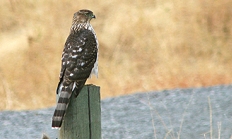
Cooper's hawks are smallish "bird hawks" (slightly smaller than American Crows) with rounded wings, a long rounded tail, and long yellow legs. This is the mid-sized accipiter nesting in Oregon and is larger than the Sharp-shinned hawk, but smaller than the Northern goshawk. The usual mode of flight consists of several rapid wing-beats alternating with brief periods of sailing. Juveniles are dark above with underparts streaked vertically while adults tend to have a bluish cast to their gray upperparts. The long tail is barred dark and light with narrow whitish band at the tip. It is an uncommon breeder in…
Because of its association with old forests, this inconspicuous, dark brown owl has become one of the most controversial birds in the Pacific Northwest. The dark eyes and creamy white mottling on the breast and abdomen are distinctive, as is the lack of fear of humans. Both adults and young will typically allow humans to approach within a few feet, and it is not unusual for curious juveniles to follow hikers through the woods. The Northern spotted owl is a permanent resident in forested regions of western Oregon, from the coastal mountains to the eastern foothills of the Cascade Range…

The Least flycatcher closely resembles the Hammond's flycatcher, but its distinctive voice and choice of habitat help to identify calling birds. It was formerly an unexpected vagrant west of the Rocky Mountains, but since 1981 it has become recognized as a regular migrant and local summer resident in the state. It is found in deciduous groves along streams and in wet lowlands. It desires a deciduous overstory with at least some low brushy undergrowth. It is regular migrant and local summer resident in the state of Oregon with the spring migration from May to mid-June. The majority of sightings are…

On his historic expedition with Meriwether Lewis, Captain William Clark, the bird's namesake, first mistook this species for a woodpecker undoubtedly because of its long, sharp beak. However, this most specialized member of the North American Crow family uses this apparatus to pry loose its favored seeds from unrelenting cones of several pines with which the nutcracker has a symbiotic relationship. The whitebark pine, in particular, is totally reliant on Clark's nutcrackers for seed dispersal and germination. In Oregon the Clark's nutcracker is a resident along the crest of the Cascades, usually above 4,000 feet, lower on the east slope…
