
Search myodfw.com
Showing 781 - 800 of 903 results
This fragile-looking bird with bold black-and-white plumage and exaggerated, long, reddish legs is often associated with American avocets at shallow inland ponds and lakes. Very noisy and aggressive in protection of its nest and young, using a variety of distraction displays, including an impressive broken-leg act to lure away interlopers. The Black-necked stilt is a locally uncommon to fairly common summer resident of Klamath, Lake, Harney and Malheur counties. The largest Oregon breeding colony is at summer Lake. It has become a regular spring and fall migrant through eastern Oregon and irregular spring and casual fall migrant through western Oregon…

This stocky, medium-sized shorebird is a denizen of Oregon's rocky shoreline, foraging as close to the crashing waves as possible, hence its name. It uses the rocky intertidal zone which includes jetties, offshore rocks and rocky shorelines, sea stacks, and tidal pools and is occasionally found on sandy beaches interspersed with groups of rocks, and on mudflats near the mouth of the Coquille River. It sometimes uses freshwater outfalls for bathing. Birds wintering in Oregon have the upperparts, head, neck, and breast slate gray with a whitish eye-ring. Indistinct supercilium and chin are white, wheres the belly and abdomen are…

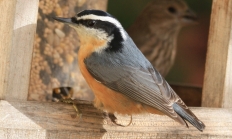
The Red-breasted nuthatch is a happy, jolly little bird, quick and agile in its motions and seemingly always in a hurry to scramble over the branches. It is distinguished from other nuthatches by white eyebrows, black eyelines and cap, reddish breast, and nasal yank yank song. Although males have a blacker cap and redder breast than females, distinguishing sexes in the field is difficult. During winter, is can be observed foraging in mixed-species flocks with Chickadees, Brown creepers, Kinglets, Townsend's carblers, and Dark-eyed junkos. The Red-breasted nuthatch breeds and winters throughout Oregon where conifer or mixed conifer-hardwood forests are present…
All of Oregon's blue-colored birds are appreciated for their dazzling appearance, but the striking plumage of this summer visitor is accompanied by a song described as vivacious, varied, well-articulated and sweet. Males are unmistakable when singing from a prominent perch, flashing deep azure upper parts with rich orange-brown breast and flanks, a white belly, and white wing bars. Females are warm brown and relatively plain, though they share with males the habit of twitching the tail to one side when excited. The Lazuli bunting is fairly common in low-elevation dry valleys in Curry County but are becoming uncommon north through…

Bobolinks summer in Oregon's eastern grasslands and meadows, singing what has been described as a bubbling delirium of ecstatic music that flows from the throat of the bird like sparkling champagne. The yellow-brown female, juvenile or non-breeding male may at first appear to be a sparrow, but the breeding male has an astonishing and diagnostic backwards tuxedo pattern of buff on the nape and white rump and scapulars on an otherwise black body. The Bobolink is a regular, locally common breeder at the Malheur National Wildlife Refuge and a few scattered pairs occur in northeast Oregon. West of the Cascades…

The original Riverside Tract is adjacent to the Malheur River near the former railroad community of Riverside. It was purchased from the Blaylock family in 1976 and has been administered by ODFW as Riverside Wildlife Area since that time. The purpose of this initial acquisition was to provide public fishing and hunting access to a previously privately held portion of the Malheur River canyon. In addition, this purchase provided the opportunity for the department to emphasize fish and wildlife habitat management in the river canyon. Additional acres were added to this tract in 1977. In 1972, the department purchased a…
At certain estuaries and interior alkali lakes, flocks of many thousands of these migrants can be observed swirling around over shallow water, landing to frantically feed, before resuming migration. Falcons often attack Westerns, and their acrobatic, tightly coordinated escape flights are breathtaking to observe. In winter, these small sandpipers are gray above with white underparts. In breeding plumage they have a rich rufous-chestnut back, cheeks and cap, dark-centered scapulars with rufous-chestnut edges, grayish throats streaked with dark chevrons through the flank, and whitish underparts. Longer-billed females generally are larger than males but are otherwise similar in appearance. Along the coast…

SALEM, Ore. – The deadline for applications has been extended to July 11, 2025, for the Landowner Representative. Application forms are available at http://www.dfw.state.or.us/lands/AH/get_involved.asp. The Landowner Representative position is looking for individuals with experience in forestry or agriculture with an interest and experience in hunting and wildlife conservation. You do…
This small, boldly-patterned duck can be found in Oregon throughout the year, either around rocky headlands on the coast or inland on mountain streams. No other breeding duck in Oregon feeds almost exclusively on benthic invertebrates, often swimming underwater and upstream against swift current in search of prey. Though males are striking in appearance, these and the drab brown females can be difficult to see when at rest on a mid-stream rock or dodging behind rocks as they evade observers. Broods have been observed or nests located on tributaries in the river basins of the west Cascades. They are found…

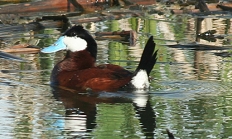
Small in size and displaying a showy, almost comical alternate plumage, the male ruddy duck is an unforgettable sight. Breeding males are unmistakable with their rich chestnut back, black crown, white cheek, sky-blue bill, and proportionately long stiff tail. Female plumage is drab in comparison, being dusky dark brown with a dark facial strip across the mostly white cheek, quite similar to the male's basic plumage. Known for their peculiar courtship display in which the male draws his head down and slaps his bill against his breast repeatedly in increasing tempo, creating a bubbling in the water and a hollow…
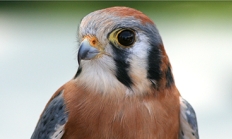
Formerly known in American literature as the Sparrow hawk, this is the smallest (dove-sized) and most familiar and abundant member of the family Falconidae in North America and one of the easiest raptors to observe. It has two considerably different plumages: adult male and female and juvenile males differ somewhat from adult males until post-juvenile mold in fall. Adult males have rufous backs and tails with blue-grey upper wing coverts. The tail has a wide black subterminal band. Juvenile males are similar to adult males but have heavily streaked breasts. Females are slightly larger than males and have reddish-brown backs…
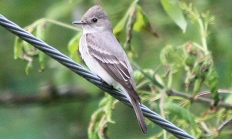
The Olive-sided flycatcher is one of the most recognizable breeding birds of Oregon's conifer forests with its resounding, three-syllable whistle song quick, three beers. It is a relatively large, somewhat bulky, large headed, short-necked flycatcher that perches erect and motionless at the top of a tall tree or snag except when singing or darting out to capture flying insects. The overall olive-gray plumage is generally nondescript except for a whitish stripe down the breast and belly which gives the impression of an unbuttoned vest, and white patches between the wings and lower back. This flycatcher breeds in low densities throughout…
The foothills of interior southwestern Oregon come alive in late April with the bold song of this bright yellow warbler. Here it seems every brushy area or mixed conifer/hardwood forest with dense undergrowth has at least one male singing just beyond the reach of binoculars. Although it can be found in many other places in the state and in a variety of habitats, nowhere else is it as common. Nashville's are one of the few warblers in the West to nest on the ground. They occupy diverse shrub communities, often including or adjacent to a relatively short or open tree…


SALEM, Ore. – ODFW's Oregon Conservation and Recreation Fund (OCRF) is now accepting letters of interest for its summer 2025 Wildlife Crossing Infrastructure Grant Opportunity, supporting capital construction projects that reduce wildlife-vehicle collisions and restore critical movement and migration pathways across Oregon. Letters of Interest must be submitted before 11:59…
With four wing-beats each second pushing them to 62 miles per hour, brant are the fastest and strongest geese in flight and among the swiftest of all large birds. Black brant comprise the vast majority of brant occurring in Oregon. These small geese have smoky black backs and bellies, and dissected white collars and white around the tails provide striking contrast. The black brant can live up to 20 years and are resilient enough to ride out storms on the open ocean. In Oregon, wintering numbers along the coast have seen a 50 percent reduction from previous years due to…

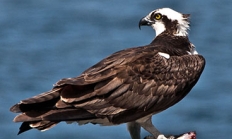
This large bird of prey has dark brown feathers above, white feathers below with a white head and prominent dark eye stripe as well as a visible dark spot at the wrist of the wing when flying. Juveniles have buffy-tipped dark feathers above. In flight, the wings have a noticeable angle or "crook." This highly migratory fish-eating species is frequently found nesting along larger rivers, lakes, and reservoirs. A large bulky nest at the very top of a live, broken top, or dead tree and more recently on utility poles, channel markers, pilings, and cell phone towers near fishable waters…
The Tufted Puffin is extremely charismatic and the most recognized seabird in Oregon. It is easily identified in the breeding season by the colorful laterally compressed bill, a distinct white face with long cream-colored facial plumes, black body, and reddish-orange feet. In winter it moves offshore and loses most of its colorful plumage and bill plates. Tufted Puffins are burrow-nesters and feed at sea. Along the Oregon coast, they primarily nest on soil-covered islands free of mammalian predators. They also occasionally nest on headlands such as Cape Mears, Cape Lookout, Cape Foulweather, and Yaquina Head. Tufted Puffin populations have…

The bright yellow, red, and black plumage of the male Western Tanager, so conspicuous in open situations is very obscure in forested areas where it tends to blend into the shaded foliage. The species perhaps is best known in migration when it visits city parks, orchards, and other open urban and suburban areas. It is attracted to birdbaths but seldom to bird feeders. It breeds in open coniferous forests and mixed coniferous and deciduous woodlands, primarily in mountains. They usually nest in conifers - rarely deciduous trees - at varying heights, usually well out on a branch, often at the…
