
Search myodfw.com
Showing 81 - 100 of 220 results
Hummingbirds are a popular backyard bird watching species, especially at hummingbird feeders. Avoid commercial mixes that contain red dye. Hummingbirds swoop and dive with most performing a low back-and-forth movement called a shuttle display. Feeding on flower nectar, hummingbirds often are stained with pollen and are an important pollinator.

Summer Lake Wildlife Area was established in 1944, with primary objectives of protecting and improving waterfowl habitat and providing a public hunting area. It is now a popular destination for hunting, wildlife viewing and environmental education due to its geographic setting, the abundance of wildlife present and species diversity.

The Rufous hummingbird is the most common and widespread of Oregon hummingbirds. This rusty-red and fearless nectar feeder is a popular yard bird, inspiring even the most modest of nature lovers to set up a feeder. It is a common transient and breeder throughout most of western Oregon, especially in forested regions. Hear the call of the Rufous hummingbird Photo by Charlotte Ganskopp

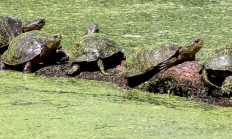
Features: The coot can't be mistaken in a wetland. With a black body, white curved bill and red eyes, these birds often move in rafts on the water. Low flyers, they still require furious wing beats before taking flight. Habitats: These birds can be found in wetlands, estuaries and bays where other waterfowl are found. Techniques: Coots are often taken as they enter decoy spreads. Not widely targeted, hunters may pinch a raft into a choke point to take birds on the wing.

Features: Usually greenish to brown with darker mottling, but most fish have bright red blotches on their sides. They tend to have dark bars or blotches on their fins, and the inside of their mouths are bluish. Habitat: Their habitat is subtidal algal beds and rocky reefs from the Bering Sea to southern California. Technique: Try fishing for rock greenlings from the shore as they are often captured in shallow, rocky areas. These fish have small mouths, so try a #4 or #6 hook to catch these daytime feeders.

Establishment of the Bridge Creek Wildlife Area initially started in 1961 when a parcel of land was purchased from the Frank Hilbert estate. After the initial purchase, several private holdings were acquired to consolidate the land under department ownership. The last parcel was purchased from the Colvin Cattle Company in 1975. The primary purpose of the wildlife area is to maintain and protect a key historic winter range for Rocky Mountain elk ( Cervus elaphus nelsoni).
Coquille Valley Wildlife Area was initially established in 2013 with two equally important primary objectives; (1) To protect, enhance, and restore fish and wildlife habitats located on the WA, and (2) to provide a wide variety of wildlife-oriented recreational and educational opportunities to the public.

This northern grouse reaches Oregon only in the forests of the Wallowa Mountains in the northeastern part of the state. It is dusky and slightly smaller than the ruffed grouse. Sexes are different in coloration; males have a black breast with white spotting on the sides, white spots at the base of a black tail, and a red comb above the eye. Females are heavily barred with dark brown and white and have a dark tail. Hear the call of the spruce grouse Spruce grouse observation form Photo by Dave Budeau, ODFW

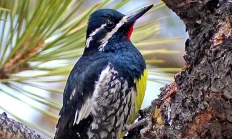
Male and female Williamson's sapsuckers look so different that until 1873, ornithologists thought they represented two distinct species. The mostly black male has a bright yellow belly and red chin. The female is pale brown with barred back and wings and dull yellow belly. It is a summer resident of forests in the Blue Mountains, on the east slope of the Cascades and east to Warner Mountains in the south. It breeds in mid - to high-elevation mature or old-growth conifer forests with fairly open canopy cover, and large dead trees suitable for nest cavities. Hear the call of the…
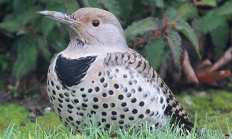
The Northern flicker is larger than most woodpeckers in Oregon. It is primarily lighter shades of brown and gray with black markings: spotted underparts, barred back, and a broad necklace. Its wing linings and undertail range from salmon to yellow, and the rump is white. Males have a red or black mustache. Northern flickers may be encountered in almost any terrestrial habitat, but are generally most abundant in open forests and forest edges adjacent to open country. They venture into nearby habitats, including towns and farms but typically avoid dense forests. It is a common resident throughout Oregon. Hear the…
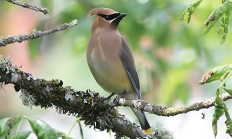
One of Oregon's most efficient fruit-eaters and a perennial irritant to cherry, blueberry, and grape growers, the Cedar waxwing is a sleek, social resident of mixed forests and urban areas throughout the state. Smooth, tan-brown plumage, a black mask with a mall head crest, red waxy wingtips, and a yellow tipped tail give Cedar waxwings a distinctive appearance. The breeding range of the Cedar waxwing covers most of Oregon, except for the extensive conifer forests and expansive treeless areas with greater breeding populations reported in lowlands. Hear the call of the Cedar waxwing Photo by Kathy Munsel, ODFW
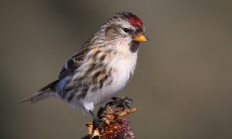
These tiny finches brighten the winter landscape of northeastern Oregon in some years. Their tan and ivory streaked with brown is plain enough, but the red forehead, black chin, and breast suffused in pink add a spot of color to snow-covered trees and shrubs. The Common redpoll is an uncommon to rare, irregular winter visitor, mainly in lowlands of the eastern Blue Mountain ecoregion. In peak years, this species can be locally common in Union, Wallowa, and Baker counties but in other years, it is essentially absent. It is an irregular visitant to Umatilla and Grant counties and in all…
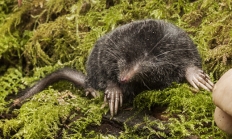
This shrew is the largest member of the genus in North America. Truly a water shrew, it swims easily both on the surface and while submerged, mostly by alternate strokes of the hind feet. When leaving the water, it literally springs from the surface. In Oregon, it occurs in the northern Cascade Range in Clackamas, Hood River, and Multnomah counties, then west in Clatsop, Columbia, and Washington counties along the Columbia River, and southeasterly from Newport through Benton, Lane, Linn, Jackson and Klamath counties. Habitats include alder in riparian zones, skunk cabbage marshes, deep, dark, red cedar swamps, floating mats…
The shrew-mole is the smallest talpid in Oregon. The pelage is black; the eyes are rudimentary. The tail is about 50 percent of the length of the head and body, fat, sparsely haired, blunt ended, covered with transverse annular rows of scales and tufted. In Oregon, the species occurs as far east as Brooks Meadows, Hood River County; Indian Ford Campground, Deschutes County; and Fort Klamath, Klamath County. It is most abundant in moist sod-free ravines with deep, black-silt soils with high humus content and covered with a layer of dead leaves and twigs. Dominant vegetation in these areas is…
The heather vole is among the smaller voles in Oregon. In appearance, it strongly resembles the montane vole. It is gray to brownish on the dorsum, whitish to grayish on the venter. Two of nine nominal subspecies are purported to occur in Oregon: the lighter colored P. I. intermedius in the Blue and Wallowa mountains of northeastern Oregon and the darker P. I. oramontis in the Cascade Range. Heather voles are rather docile creatures; they usually make little attempt to flee or to defend themselves when captured. It is active during daylight hours more frequently than the Southern red-backed vole…
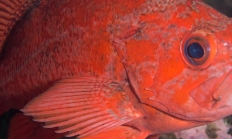
Features: Its deep red sides are mottled with gray. They grow to be 30-inches long. Yelloweye, canary and vermillion rockfish can look similar. See this rockfish identification article for distinguishing features for each species. Habitat: The vermilion rockfish is found near the bottom of the ocean over rocky substrate. Technique: They readily take both bait and lures. Rubber tailed lead head jigs, metal jigs, shrimp flies, and baited hooks will all take vermilion rockfish. Header photo by Ratha Grimes, Flickr
Features: Female pheasants are brown on top and paler underneath. They have black spots on their sides and black bars throughout their tails. The males are much more conspicuous with bright red on their head, a white band around their necks, and an iridescent copper color on their sides and backs. Their tails are long and pointed with barring. Habitat: The ringneck is a farmland species, heavily dependent on cereal grains and other seeds. They also like taller vegetation for cover. Technique: Because pheasants are tied so closely to agriculture, the majority of hunting opportunity occurs on private lands. State…
