
Search myodfw.com
Showing 921 - 940 of 1416 results
The red tree vole is a medium-sized vole. It is uniquely colored among North American voles: bright orangish-red to cinnamon on the dorsum, silvery gray (often with some light orangish hairs) on the venter, and a tail pale orangish on the venter grading to black on the dorsum. This vole is endemic to western Oregon. It occurs at moderate elevations on the west slope of the Cascade Range southward as far as the Douglas-Jackson county line and in the Coast Range to the Oregon-California border. It is largely arboreal and builds nests on suitable foundations (commonly nests of birds or…

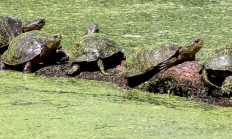
Oregon's native turtles are in trouble. Invasive, non-native turtles such as the red-eared slider and snapping turtle compete with Oregon's turtles for food, habitat and nesting sites. Our native turtles are also preyed upon by bullfrogs and are affected by habitat loss and degradation. Check out this video to learn more about Oregon's native turtles and invasive turtles.
The Wolverine is the largest terrestrial mustelid in Oregon that, to some degree, resembles a small bear. It is powerfully built with a broad, dog-like head; short round ears; small eyes; a slightly humped back; relatively short legs and a bushy, somewhat drooping tale. The pelage consists of a dense, wooly, crimped under fur overlain by course, stiff and somewhat shaggy guard hairs. Fur on the tail is about twice as long as on the body. The base color is blackish brown with a pale brown stripe extending along the sides from the head or shoulders to the base of…

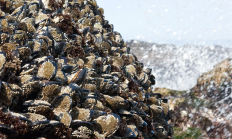
SALEM, Ore. – Mussel harvesting is now open from Cape Blanco to the California border the Oregon Department of Agriculture and the Oregon Department of Fish and Wildlife announced today. Marine biotoxin levels in this area tested below the alert level. People should always call the Shellfish Safety Hotline at…
NEWPORT, Ore – Mussel harvesting is now open coastwide from the Washington border to the California border the Oregon Department of Agriculture and Oregon Department of Fish and Wildlife announced today. Marine biotoxin levels tested below the alert level. People should always call the Shellfish Safety Hotline at 1-800-448-2474 before…
KLAMATH FALLS, Ore. – Sept. 30 will be the last day to fish on Spencer Creek this year, as this tributary of the Klamath River will be closed as of Oct. 1 to protect spawning fall Chinook salmon. Spencer Creek has traditionally been closed to fishing from Nov. 1 to…
In quiet backwaters and wooded wetlands, these stunning ducks can occasionally be seen skulking near the shoreline as they search for fish. The male with a striking black head and extensible white crest, white breast, black back, and chestnut sides is truly a sight to behold. Females and immatures are quite plain by comparison: dull grayish-brown except for a reddish brown crest. Hooded mergansers are surprisingly secretive and local during the breeding season. They breed locally throughout the Willamette Valley west to the coast and south to Coos County. They are casual from April to early October in the Umpqua…

The California kangaroo rat is the largest kangaroo rat in Oregon, but is only of moderate size within the genus. It has a moderately broad face, relatively large ears, and awl-shaped lower incisors. The tail is 150 percent of the length of the head and body. It is the darkest-colored kangaroo rat in Oregon. The pelage of the dorsum is composed of hairs with dark-gray bases, a narrow dark-buff band and black terminus. The venter, feet, upper lip,; and base, sides, and tip of tail are white and there is a white spot above each eye and behind each ear…

LA GRANDE, Ore. – Lookingglass Creek, a tributary to the Grande Ronde River at Palmer Junction, will open for spring Chinook fishing Wednesday, June 18 through Sunday, June 29. The open area is from the mouth upstream to the confluence of Jarboe Creek. After early season projections made it appear…
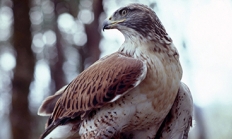
This largest of Oregon's hawks inhabits the most open country of the state's buteos, and watches over its home range on long, motionless wings for extended periods in search of prey. Ferruginous hawks are sensitive to human disturbance and tend to reside in remote areas. They occur in two color morphs, but dark-morph birds are rare in Oregon. Light-morph birds are white below with few markings except for the ruddy-colored leg feathers. The back and wing coverts are rust colored and the tips of the primaries and end of the tail tend toward dark smoky gray. It is an uncommon…
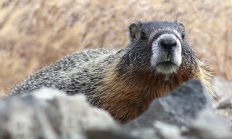
The yellow-bellied marmot is the largest squirrel in Oregon. It has short legs, a short and bushy tail, and ears short and covered with fur. The pelage consists of a dense, wooly underfur covered by long, course guard hairs and is distinctively colored and marked. In Oregon, it occurs in suitable habitats east of a line connecting Mt. Hood, Hood River County, and Mt. Mazama, Klamath County, except for the Columbia Basin. The primary requisites of suitable habitats for the yellow-bellied marmot are boulders or piles of rocks and an abundance of succulent vegetation in close proximity thereto. Occasionally, an…
The Sierra Nevada red fox is a montane red fox subspecies. Its presence in Oregon was confirmed in 2015, specifically in the Mt. Jefferson, Mt. Washington, and Three Sisters Wilderness Areas. The Sierra Nevada red fox is smaller than the red fox and averages about eight pounds. This fox has three color phases: silver (black), "cross" color phase and the more familiar red. The Sierra Nevada red fox is an Oregon Conservation Strategy Species in the East Cascades, Klamath Mountains and West Cascades ecoregions. Research continues on this species in the Oregon Cascades. Biologists captured and radio-collared several Sierra Nevada…

The rock scallop ( Crassadoma gigantea) lives in the swift current shallows of Oregon's nearshore rocky reefs. Due to the coloration at its hinge, it is also known as the purple hinged scallop. These highly specialized scallops cement themselves to rocks, primarily at depths from 10 to 150 feet. They feed on microscopic plankton they filter from the water and reproduce via broadcast spawning. In order for spawning to be successful, they need to be close to one another. For this reason, it is best to harvest solitary rock scallops and minimize harvest pressure on dense aggregations which are more…
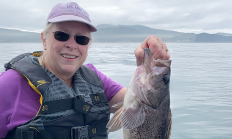
Cara Rupp with her 5 lb. 11 oz. Black rockfish near Beverly Beach State Park. Photo provided by Dennis J Rupp. NEWPORT, Ore. – The General Marine Species daily bag limit is reduced to three fish beginning Sept. 18 to lower the risk of an early season closure. The one-fish…
SALEM, Ore – Mussel harvesting is now closed from Tillamook Head (south of Seaside) to the north Jetty of the Siuslaw River (Florence) the Oregon Department of Agriculture and the Oregon Department of Fish and Wildlife announced today. Recent mussel samples indicate levels of Paralytic Shellfish Poisoning (PSP) – a…
SALEM, Ore – Mussel harvesting is now closed from Tillamook Head (south of Seaside) to the north Jetty of the Siuslaw River (Florence) the Oregon Department of Agriculture and the Oregon Department of Fish and Wildlife announced today. Recent mussel samples indicate levels of Paralytic Shellfish Poisoning (PSP) – a…

The Olive-sided flycatcher is one of the most recognizable breeding birds of Oregon's conifer forests with its resounding, three-syllable whistle song quick, three beers. It is a relatively large, somewhat bulky, large headed, short-necked flycatcher that perches erect and motionless at the top of a tall tree or snag except when singing or darting out to capture flying insects. The overall olive-gray plumage is generally nondescript except for a whitish stripe down the breast and belly which gives the impression of an unbuttoned vest, and white patches between the wings and lower back. This flycatcher breeds in low densities throughout…
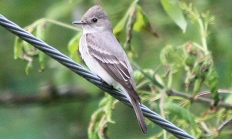
This medium-sized flycatcher has expanded its breeding range from northern California to southwestern Oregon and continues to expand its range in Oregon. First experiences with the species may bring to mind a Slate-colored Junco behaving like a flycatcher. The Black phoebe is dull, sooty black overall, somewhat paler on the back, with a white belly contrasting with the black breast and sides. Bill, legs, and feet are black. The phoebe dips its tail repeatedly. Black phoebes are associated with water. Slow-flowing, idle, or slack water of large rivers, streams, and creeks, ephemeral and permanent ponds, lake shorelines, irrigation ditches, and…

Preble's shrew is the smallest shrew in Oregon; adults commonly weigh less than a dime. The pelage is medium dark-brown to very dark-gray on the dorsum and silvery gray on the venter. The tail is bicolored, medium dark-brown on the dorsal surface, white on the ventral surface and darkening toward the tip. In Oregon, it has been found in Deschutes, Grant, Klamath, Lake, Harney, Malheur, and Wallowa counties. Its habitats include marshes, along streams, dry bunchgrass, and wet, alkaline habitat. Grasses and sagebrush are common to most habitats.