Search myodfw.com
Showing 1001 - 1020 of 1416 results
The Little pocket mouse is one of the smallest rodents in North America and certainly the smallest in Oregon. The dorsal pelage is pinkish buff to ocherous buff with overlying blackish hairs; the venter is buff. The tail is bicolored. In Oregon, this mouse occurs in Harney and Malheur counties. They exhibit their greatest activity from spring through autumn and spend a large portion of their lives in burrows below the surface of the ground. In winter, they remain underground continuously, relying on stored seeds for energy. When active on the surface, a large portion of their time is spent…

CLACKAMAS, Ore.—Following an in-season assessment of the upriver spring Chinook return, fishery managers from Oregon and Washington added more recreational spring Chinook fishing days on the mainstem Columbia during a joint state hearing yesterday. Six additional fishing days downstream of Bonneville Dam and five additional fishing days upstream of Bonneville…
Clark's grebe is very similar in plumage, habitat, and behavior to the western grebe. It breeds in inland lakes with emergent vegetation such as cattails and tules. It requires open water for foraging on the surface or diving below in pursuit of fish. It winters both along the seacoast and on major rivers. Like the western grebe, Clark's grebe is a specialist in fish, which make up over 80 percent of its diet. It will also eat other aquatic organisms like crayfish, amphibians, and aquatic insects. Its breeding range in Oregon overlaps that of western grebe, but Clark's is not…

One of Oregon's characteristic offshore seabirds, these stocky gull-like birds with steep foreheads come in a broad range of color morphs from white to slate gray, with buffy, bluish-gray, mottled and brown intermediates. The round head and pecking motion of birds feeding on the water is reminiscent of the shape and behavior of pigeons. The heavy hooked bills are divided into colorful plates of green, yellow, and orange, with large tubed nostrils atop. They are irregularly common to abundant in Oregon in winter, especially beyond five miles from shore. Hear the call of the Northern fulmar Photo by Martyne Reesman…

The world population of this species, which probably does not exceed 25,000 pairs, is quite low for a seabird. Nevertheless, these are the common light-bellied shearwaters off Oregon in summer. They are larger, bulkier, and fly more deliberately than the usually much more abundant sooty shearwaters with which they associate. They are uniform gray-brown above; the underparts are white; the vent and underwings variably smudged with dusky. The pinkish bill is dark-tipped and the feet are pink. It is a common summer visitor and very common fall transient offshore on shallow shelf waters. It is usually seen seaward, approximately five…

This is a marine gull that breeds on both offshore islands and rocky cliffs along the Oregon Coast. It also uses structures for nesting and, occasionally, will nest on grass-covered headlands. The Western gull's food comes from the marine environment, estuaries, and the immediate shoreline. It eats small fish, clams, mussels, bird eggs, the young of other birds nesting nearby, sea urchins, starfish, squid, crustaceans, marine worms, and carrion. it will scavenge garbage or waste from fishing boats as well. It is present all year along the entire coast of Oregon. Hear the call of the Western gull Photo by…

The most common seabirds breeding in Oregon, Common murres are easily recognized by their distinct black and white breeding plumage and their upright stance at colonies. Wing-beats are rapid and like all alcids they can fly underwater. They are often seen over the ocean in long lines of 10-40 or more birds. They nest on rocky islands and cliffs in colonies of tens or hundreds of thousands of birds packed together almost shoulder to shoulder. Major nesting concentrations in Oregon are on the south and north coasts reflecting the availability of suitable nesting habitat. Hear the call of the Common…
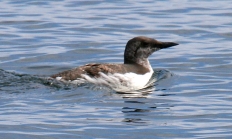
The Northern flicker is larger than most woodpeckers in Oregon. It is primarily lighter shades of brown and gray with black markings: spotted underparts, barred back, and a broad necklace. Its wing linings and undertail range from salmon to yellow, and the rump is white. Males have a red or black mustache. Northern flickers may be encountered in almost any terrestrial habitat, but are generally most abundant in open forests and forest edges adjacent to open country. They venture into nearby habitats, including towns and farms but typically avoid dense forests. It is a common resident throughout Oregon. Hear the…
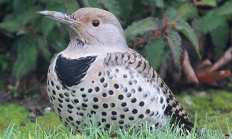
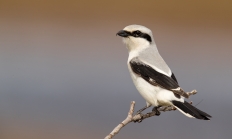
This is the larger of Oregon's two shrikes, and the more likely to be seen in winter. Most of those seen in Oregon are hatch-year birds wearing brownish plumage in the fall and graying as winter passes. Adults stand out from young of the year with more crisp gray, black, and white plumage. Shrikes inhabit open landscapes. They resemble and act like small raptors, however, they capture and kill prey with a hooked bill rather than with talons. The Northern shrike is an uncommon to locally common visitor in open habitats statewide. It is absent some years along the southern…
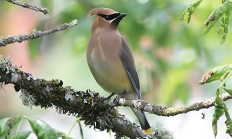
One of Oregon's most efficient fruit-eaters and a perennial irritant to cherry, blueberry, and grape growers, the Cedar waxwing is a sleek, social resident of mixed forests and urban areas throughout the state. Smooth, tan-brown plumage, a black mask with a mall head crest, red waxy wingtips, and a yellow tipped tail give Cedar waxwings a distinctive appearance. The breeding range of the Cedar waxwing covers most of Oregon, except for the extensive conifer forests and expansive treeless areas with greater breeding populations reported in lowlands. Hear the call of the Cedar waxwing Photo by Kathy Munsel, ODFW
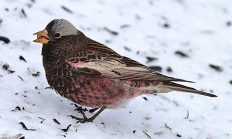
This dark, medium-sized finch with gray and pink highlights is the darkest of the rosy-finches and one of Oregon's rarest breeding birds. It is found in summer in montane areas above timberline, where loose swarms of these birds seem to blow like leaves among isolated cirques, cliffs, and hanging snowfields. In Oregon it breeds on Steens Mountain and may breed occasionally in the Wallowa Mountains. Winter distribution is poorly known, but birds have been found on the lower east side of Steens Mountain and in the Alvord Desert in winter and rarely in central Wallowa County. Hear the song of…
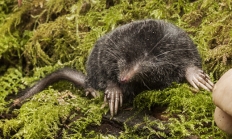
The shrew-mole is the smallest talpid in Oregon. The pelage is black; the eyes are rudimentary. The tail is about 50 percent of the length of the head and body, fat, sparsely haired, blunt ended, covered with transverse annular rows of scales and tufted. In Oregon, the species occurs as far east as Brooks Meadows, Hood River County; Indian Ford Campground, Deschutes County; and Fort Klamath, Klamath County. It is most abundant in moist sod-free ravines with deep, black-silt soils with high humus content and covered with a layer of dead leaves and twigs. Dominant vegetation in these areas is…
The hoary bat has a wingspan of nearly 16 inches. It has dark fur tipped with white, a dark mask on its face, a yellow-orange throat and round ears edged in black. This bat roosts in branches of trees and likes to feed around outdoor lights. Hoary bats migrate south in winter, returning to Oregon in the spring. This bat usually bears twins. Hoary bats are found at scattered localities over most of the region west of the Cascade Range and in montane regions east of the Cascade Range. They are an Oregon Conservation Strategy Species in all ecoregions except…

Summer and winter pelages of white-tailed jackrabbit are drastically different. In summer, the overall appearance is grizzled dark grayish with overtones of pinkish buff, blending lighter on the sides. In winter, it is the color of dirty snow, shading lighter on the sides. In Oregon, the white-tailed jackrabbit occurs east and south of a line connecting Rufus, Maupin and Antelope, John Day, Juntura, Fields, Fort Rock, and Fort Klamath and Klamath Falls. It is associated with bunchgrass habitats. The white-tailed jackrabbit is an Oregon Conservation Strategy Species in the Northern Basin and Range ecoregion. Photo by Wickipedia

The Western pocket gopher is one of the two small pocket gophers in Oregon. Depending on the region, the pelage of this gopher ranges from pure black with purplish and greenish overtones to brown to hazel to yellowish hazel on the dorsom and from lead colored to buff to ocherous on the venter. The face is lead colored to black. The Western pocket gopher constructs burrows beneath the surface with a vertical tunnel connecting deeper burrows that include the nest. This gopher occurs from the Columbia River to the California-Oregon border in the Coast Range and along the coast. It…
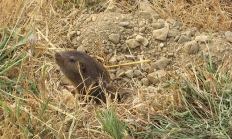
The Great Basin pocket mouse is the largest member of the genus in Oregon. The dorsal pelage of this mouse is pinkish buff or ocherous buff overlain with black hairs; the venter is white to buffy. A lateral line, usually somewhat olive colored, separates the dorsal and ventral pelages. The tail is distinctly bicolored. In Oregon, it occurs thought east of the Cascade Range, except it does not occur in the Wallowa and Blue mountains. The Great Basin pocket mouse constructs burrows below the surface that contain granaries for storage of food, a nest cavity, and several entrances. They spend…

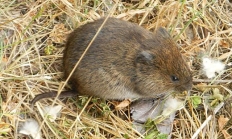
The creeping vole is the smallest vole in Oregon. It has an exceedingly short tail and tiny eyes. The short, dense fur on the dorsum ranges from sooty gray to dark brown or black, with scattered yellowish hairs. Hair on the venter is dusky washed with buff or white; the tail is blackish, slightly darker above that below; and the fur on the ears is black. In Oregon, it ranges from Brooks Meadows and Crater Lake west to the Pacific Ocean. The species has been seen at some localities in the Willamette Valley. However, hiatuses in the distribution occur in…
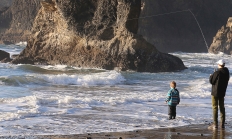
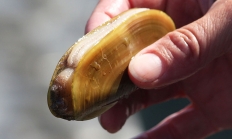
Features: This clam has a long, narrow, thin shell with a smooth brown coating. Habitat: Razor clams are found in stable, sandy, surf-swept beaches of the open coast and some coastal bays. Razor clams have the ability of digging up to a foot per minute and have been found more than four feet deep in the sand. The 18 mile stretch of Clatsop beaches account for 90% of Oregon’s razor clam harvest. The razor clam population in this area is much denser than any other area in the state. Other areas that also have razor clams include Indian Beach (Cannon…