
Search myodfw.com
Showing 1021 - 1040 of 1416 results
Commonly found along beaches and about estuaries, this large, ponderous bird is a conspicuous member of the summer coastal community, easily recognized by its large size, massive bill, and brownish plumage. Highly gregarious, it often forms large flocks; regularly observed foraging over the ocean just offshore. Brown pelicans often join mixed flocks of birds attracted to schools of small fish. They are common spring, summer, and fall visitors along the Oregon coast. Brown pelicans are an Oregon Conservation Strategy Species in the Nearshore ecoregion. Hear the call of the brown pelican Photo by Michael Lazott

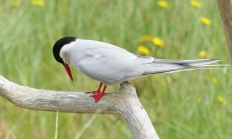
This graceful tern, with its aerodynamic body and streamlined wings, is infrequently seen from land in Oregon. It is most often encountered at sea as it makes one of the most incredible journeys in the animal kingdom, migrating from the Arctic to the Antarctic and back again each year, a journey of nearly 22,000 miles. A medium-sized bird with a reddish bill, it has a black cap and nape, and a white throat and cheek shading to a light gray body. It is a common offshore transient in Oregon waters and an occasional migrant along the coast. The bulk of…
A slender, orange bill, pearl gray upperparts, and fringed black crest adjoining a white face and neck indeed render this graceful hunter from the south elegant. The foreheads of adults turn white in post-breeding plumage, their usual state in Oregon. These terns frequent quiet waters or lagoons when diving for fish, but also dive in calm ocean waters. They roost with flocks of gulls and other terns on coastal spits, estuarine sandbars, and on mudflats close to bay mouths. Virtually all records of the Elegant tern in Oregon are coastal or within half a mile of shore. None have been…

This small, brown, earless owl with a black framed, square face was long thought to be restricted to the boreal forests of Canada and Alaska but during the 1980s, it was found breeding in the Rocky Mountains of Idaho and Colorado. In Oregon, these shy owls are strictly nocturnal and live in remote mountain forests often covered by deep snows and with few passable roads. It is presumed to be a permanent resident in Oregon. It has been regularly observed about the Wenaha-Tucannon Wilderness in northeast Umatilla and northwest Wallowa counties and on the south slopes of South Sister Mountain…

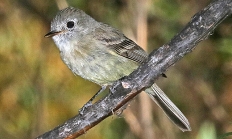
The Dusky flycatcher inhabits open conifers, conifer-hardwoods, or shrubs in the mountains of Oregon. A medium-sized Empidonax with a small head and rounded crown, the upperparts are grayish olive to grayish brown, the throat grayish, and the underparts mostly whitish with an olive-gray wash (sometimes yellowish). The wings have two narrow, usually whitish wingbars. The narrow white eye ring and pale lores give the appearance of spectacles. This flycatcher is a common summer resident in most of its breeding range in Oregon. It is found the entire length of the Cascades, but habitat is limited west of the summit in…
The Chipping sparrow is a small and slender sparrow that has a distinctive sharp chip note and simple, trilling song. Breeding adults display a chestnut crown, a black eye-stripe, and crisp white eyebrow. After nesting season, both male and female lose their distinctive bright cap for a streaky dull brown head pattern that is similar to other winter sparrows. It is a common summer resident in open forests and drier woodland edges throughout Oregon and is especially abundant in the Blue Mountains. The Chipping sparrow is an Oregon Conservation Strategy Species in the Willamette Valley ecoregion. Hear the song of…

Although not brilliantly plumaged, the conspicuous Song Sparrow is one of the more regularly seen birds in Oregon. Defensive and curious, when approached it readily announces its presence with loud chips and often excitedly rises to a conspicuous perch to confront the interloper. The Song sparrow is well named as both male and female have a variety of songs that may be heard at any time of year, and juvenile birds begin to sing full songs within two months of hatching. The Song sparrow is a common and widespread resident of western Oregon. Hear the song of the Song sparrow…

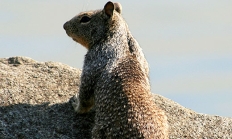
The California ground squirrel is a large, long-tailed gray squirrel with a large, nearly-black, triangular patch between light-gray shoulder patches. The gray dorsal pelage is speckled with buffy white spots. The tail is bushy, but not so full and spreading as those of tree squirrels. In Oregon, it occurs throughout the area west of the Cascade Range and throughout much of Central Oregon. It is considered among the most generalized of the ground squirrels as it inhabits a variety of habitats. Although it is a ground-dwelling squirrel, it has a strong propensity to climb. It is commonly observed sitting on…
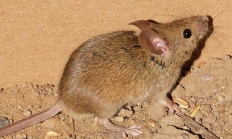
The house mouse is the smallest member of the subfamily in Oregon and smaller that most other members of the family. The ears are large and membranous; the tail is long, tapering, and scaly; and the soles of the feet are naked. The pelage is short, harsh, and usually grayish brown to nearly black dorsally, lighter brown or buffy ventrally. Albino, spotted, and other colormorphs are known to occur. House mice occur throughout the world in association with humans. In Oregon, this mouse is found in 30 of the 36 counties. House mice are usually more active at night, but…
Ensatina salamanders are a lungless species with a short body and yellow or orange legs. There are two sub-species in Oregon: the Oregon ensatina ( E. e. oregonensis) is solid red, orange, brown or tan, while the painted ensatina ( E. e. picta) has small yellow, black or white spots on the back and tail. Ensatinas grow to just over four inches in total length. Ensatinas live in humid forests, woodlands and other areas with woody debris. They hide under logs, bark piles at the base of snags (standing dead trees), stumps and even woodpiles in residential areas for cover…

LA GRANDE, Ore. – Lookingglass Creek, a tributary to the Grande Ronde River at Palmer Junction, will open to fishing for hatchery spring Chinook on Friday, May 15. The open area is from the mouth upstream to the confluence of Jarboe Creek. Depending on which happens first, the fishing season will remain open through June 14 or until…
NEWPORT, Ore – Mussel harvesting is now open coastwide from the Washington border to the California border the Oregon Department of Agriculture and Oregon Department of Fish and Wildlife announced today. Marine biotoxin levels tested below the alert level. People should always call the Shellfish Safety Hotline at 1-800-448-2474 before…
Though less conspicuous than Great blue herons, Green herons are well-established residents of western Oregon. They are distinguished by small size, glossy greenish-black cap and back, yellow legs, blackish-green wings, gray underparts, and dark red neck. One of the few tool-using birds, Green herons are experts at making and using baits and lures, such as bread crusts, mayflies, earthworms, sticks, and feathers to catch fish. The Green heron is an uncommon but regular migrant and summer resident throughout west and south central Oregon. Detection of nests is difficult and breeding status uncertain in some areas due to its secretive habits…

These small, chunky plovers are uncommon to locally abundant migrants statewide, where they are among the most visible and easily identified small shorebirds. The only single-banded plover that occurs in Oregon, they can be remarkably easy to see when they are moving about on mud flats, and remarkably hard to detect when only their unmoving brown backs are visible against the mud. It is an uncommon to locally abundant migrant, with most birds at estuaries and some concentrations in spring at larger lakes of southeast Oregon. In the fall, it's rare in the Cascades; in winter, it's uncommon at larger…

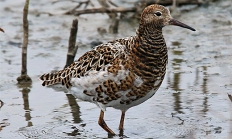
The male Ruff is a relatively large, distinctive, Eurasian shorebird that in breeding plumage sports head tufts and neck plumes from which it gained its name. However, most Ruffs seen in Oregon are juveniles that appear as lanky, buff-colored, pot-bellied, short-billed sandpipers showing white on both sides of the rump in flight. Females are about 20 percent smaller than males and are referred to as reeves. It is usually found on mudflats of coastal estuaries and adjoining wet meadows. The Ruff takes mostly aquatic insects, but will take crustaceans, mollusks, and some worms as well. The Ruff is a rare…
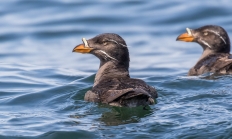
Rhinoceros auklet are one of the rarer breeding alcids in Oregon. Adults are easily recognized during the breeding season by the vertical "horn" at the base of the upper mandible. Birds in breeding plumage have brownish gray backs, a gray-brown chest, and a dirty white belly. Two distinct plumes are present on the head, one above and one below the eye. The bill is orange. In non-breeding plumage the horn is greatly reduced, the plumes absent or reduced, and the bill duller. It nests in small numbers in Oregon with Goat and Hunter Islands having the largest concentrations of breeding…
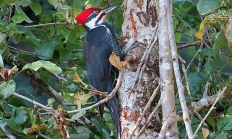
The Pileated woodpecker was the model for the cartoon character, Woody Woodpecker. It is a large black-and-white bird with a bold red feathered crest and distinctive call. You may hear its powerful drumming before you see it. In Oregon, its habitat includes older forests in the Blue Mountains, East and West Cascades, Klamath Mountains, Willamette Valley and Coast Range ecoregions. They prefer mature forests and younger forests with large snags and logs, requiring large diameter snags for nesting and foraging. Pileated woodpeckers are an Oregon Conservation Strategy Species in the Blue Mountains ecoregion. Hear the call and the drumming of…
This striking songbird is best known for its habit of impaling prey on thorns and barbed wire, or wedging items in a v-shaped branch for easier handling and storage. The Loggerhead shrike breeds in open habitats east of the Cascades where they are rare but regular in the winter, especially at low-elevation sites. They are uncommon and declining in northeast Oregon. West of the Cascades, there are usually a few records each year during fall, winter, and spring in open habitats of the coast and the Willamette, Umpqua, and Rogue valleys. The Loggerhead shrike is an Oregon Conservation Strategy Species…

Brown creepers are the only North American birds that rely on both the trunk and bark of trees for both nesting and foraging. They are small birds, about five inches in length, and have a long, slender, down-curved bill used to probe for insects hidden in the furrows of tree bark. Their brown back, streaked with white, makes creepers on of the best-camouflaged girds of the forest. They most often forage upward from the base of a tree, using their long, stiff tail for support. The Brown creeper breeds and winters throughout forested areas of Oregon, from the coast to…

Arguably the most widely recognized of Oregon's birds, the American robin is the largest, most abundant, and most widespread thrush in the state. Ranging from sea level to treeline, the robin's loud, musical voice and conspicuous brick-red chest make it unmistakable to even the most casual of observers. The robin thrives in both human-dominated and natural landscapes and is considered to be a habitat generalist throughout its range. Considering the robin's natural history, we know most about its diet, which comprises primarily of soft invertebrates in the spring and summer and fruit in the fall and winter. It is most…
