Search myodfw.com
Showing 121 - 140 of 272 results
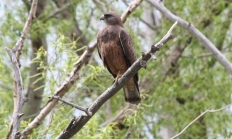
Swainson's hawks are medium-sized buteos, smaller than Red-tailed and Ferruginous hawks. Plumage beneath varies along a continuum from very pale to nearly black below. Lighter-plumaged birds have a distinct chest band. They have relatively long, pointed wings that contribute to superior flying skills. The dark flight feathers contrast with paler wing lining in all but the darkest birds. It breeds in the bunchgrass prairies east of the Cascades with the highest concentration in the foothills of the Blue and Wallowa mountains. It prefers open country and has little need for numerous trees since it forages extensively while in flight and…
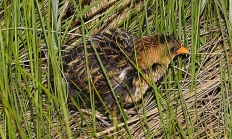
The Yellow rail is a small, secretive rail that is seen and heard far less than any other rail in Oregon. Males vocalize during the breeding season with a five-note tic-tic, tic-tic-tic repeated incessantly during hours of dark, and call infrequently during the day. The call sounds much like two small rocks being tapped together. Yellow rails are quite small and have a white patch on the trailing edge of the inner wing, more extensive than that on juvenile Soras. Males in the breeding season have a distinct yellow bill and are slightly larger but otherwise sexes are alike. Chicks…
This fragile-looking bird with bold black-and-white plumage and exaggerated, long, reddish legs is often associated with American avocets at shallow inland ponds and lakes. Very noisy and aggressive in protection of its nest and young, using a variety of distraction displays, including an impressive broken-leg act to lure away interlopers. The Black-necked stilt is a locally uncommon to fairly common summer resident of Klamath, Lake, Harney and Malheur counties. The largest Oregon breeding colony is at summer Lake. It has become a regular spring and fall migrant through eastern Oregon and irregular spring and casual fall migrant through western Oregon…

These small, fast flying seabirds are unique among alcids in North America in their use of coastal coniferous forests, primarily old-growth trees, as nesting habitat. Their solitary nests are usually concealed within the forest canopy, and breeding birds are cryptic and primarily crepuscular at nest sites. Because of their secretive behavior and elusive nests, Marbled murrelets were considered the "enigma of the Pacific" and were one of the last ornithological mysteries in North America, as the first nest was not discovered until 1974. Distribution at inland nesting sites is fragmented, as birds occur only in areas where suitable habitat remains…

The chat's coming in the spring is like the arrival of a brass band. Male chats are loud, continuous singers, sometimes heard through the night. Chats inhabit lowland tangles and thickets along rivers and floodplains. It is the largest of North American warblers. In western Oregon, the chat is an uncommon to common summer resident of the interior Rogue Valley. It is a locally uncommon summer resident in the interior Umpqua Valley. In the Willamette Valley it is a locally rare to uncommon summer resident, and rare east to Oakridge. In eastern Oregon, the chat is a rare spring migrant…

The Cascade torrent salamander generally has numerous medium-sized black spots and white-gray flecking along its tan back and sides and a bright yellow belly that has fewer spots. Adults can grow to just over four inches in total length. Cascade torrent salamanders spend their lives in and near permanent, cold, fast-flowing and clear water including headwater streams, waterfall splash zones and seeps in older coniferous forests. Adults need gravel streambeds or other gravel areas with constant and shallow water flow for foraging and cover. The Cascade torrent salamander is an Oregon Conservation Strategy Species in the West Cascades and Willamette…

Adult frogs have moist bumpy skin that is tan or olive-green colored on their topsides. On their heads, backs, sides and legs, they have dark spots with light centers that darken with age. They also have red bellies and orange-red underlegs. Adult females grow to four inches in length and males to three inches in length. Columbia spotted frogs live in wet areas that provide abundant aquatic vegetation such as marshes, permanent ponds, lake edges and slow streams. When frightened, they hide in dense vegetation or under debris at the bottom of shallow wetlands. Adult frogs overwinter in springs, spring-fed…

Bobolinks summer in Oregon's eastern grasslands and meadows, singing what has been described as a bubbling delirium of ecstatic music that flows from the throat of the bird like sparkling champagne. The yellow-brown female, juvenile or non-breeding male may at first appear to be a sparrow, but the breeding male has an astonishing and diagnostic backwards tuxedo pattern of buff on the nape and white rump and scapulars on an otherwise black body. The Bobolink is a regular, locally common breeder at the Malheur National Wildlife Refuge and a few scattered pairs occur in northeast Oregon. West of the Cascades…

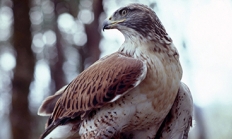
This largest of Oregon's hawks inhabits the most open country of the state's buteos, and watches over its home range on long, motionless wings for extended periods in search of prey. Ferruginous hawks are sensitive to human disturbance and tend to reside in remote areas. They occur in two color morphs, but dark-morph birds are rare in Oregon. Light-morph birds are white below with few markings except for the ruddy-colored leg feathers. The back and wing coverts are rust colored and the tips of the primaries and end of the tail tend toward dark smoky gray. It is an uncommon…
The Long-billed curlew is the largest North American shorebird. Its most striking morphological characteristic, the long decurved bill, is an adaptation for foraging on earthworms or burrow-dwelling organisms like shrimp and crab. Body plumage is a rich buff with a tinge of cinnamon or pink. Sexes have similar plumage, but females are larger with a longer bill. It can be distinguished from other curlews in flight by its bright cinnamon underwings. When observed on the ground, the Long-billed curlew's head lacks the strongly streaked pattern of other cerlews or Whimbrel. It is a locally common breeder in open grassland areas…

In length, the Great gray owl is Oregon's largest owl, though it weighs less than the Great horned and Snowy owls. It is sooty gray to brownish above and lacks ear tufts. The prominent facial disc, outlined in black, contains a series of fine concentric rings that surround piercing yellow eyes. Despite its large size, both feet and bill are small. Sexes are similar. It is an uncommon to rare inhabitant of forests adjacent to openings above 3,000 feet in the Cascades, Blue, and Wallowa mountains. Most observations in the Cascades are from east of the crest, though they have…

All have cause to marvel at the sight of a gorgeous male Purple martin. Adult males are entirely glossy bluish-purple, although they may look black in poor light. Females and yearling males are grayish below and darker above with a paler forehead and nape. The world's largest swallow, martins are uncommon in Oregon. They nest both solitarily and colonially in nest boxes specially put up for them, in crevices in human-made structures, and in cavities in snags and pilings. They are an uncommon local summer resident, principally inhabiting the Coast Range and Willamette Valley. They are also locally common at…
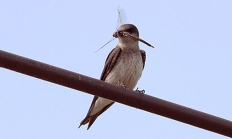
The Sierra Nevada red fox is a montane red fox subspecies. Its presence in Oregon was confirmed in 2015, specifically in the Mt. Jefferson, Mt. Washington, and Three Sisters Wilderness Areas. The Sierra Nevada red fox is smaller than the red fox and averages about eight pounds. This fox has three color phases: silver (black), "cross" color phase and the more familiar red. The Sierra Nevada red fox is an Oregon Conservation Strategy Species in the East Cascades, Klamath Mountains and West Cascades ecoregions. Research continues on this species in the Oregon Cascades. Biologists captured and radio-collared several Sierra Nevada…

The coloring of adult coastal tailed frogs often matches the color of local rocks ranging from brown or reddish-brown to gray with little flecks of yellow or gray. They have grainy textured skin that further enhances their camouflage. Male coastal tailed frogs have a short tail, the signature for tailed frogs. Adult males grow to one and three-quarter inches long and adult females to two inches long. They live in very shallow and heavily shaded water of fast running, small, permanent mountain streams with cold and clear water, rocky substrates and little silt in older forests. These streams are often…

The Rocky Mountain tailed frog’s coloring often matches the color of local rocks ranging from brown or reddish-brown to gray. They have grainy textured skin that further enhances their camouflage. Males have a short tail, the signature for tailed frogs. Adult males are slightly smaller than adult females that grow to two inches in length. Rocky Mountain tailed frogs are found in the water or close by it. They live in very shallow and heavily shaded water of fast-flowing, small, permanent streams in older mountain forests with cold and clear water, rocky substrates and little silt. These streams are often…

Adult frogs are gray or brown with yellow underbellies and thighs. Their color and grainy textured rough-looking skin helps camouflage them, making them hard to see among rocks. Adults can grow to three inches in length; males are slightly smaller than females. Foothill yellow-legged frogs live in or along edges of permanent streams and rivers with exposed rocky streambeds and off-channel waters that are slow flowing and quiet. In summer, they are likely to hide under rocks in streams or among clumps of vegetation along pools. They use rocks or debris at the bottom of the streams as refuge from…

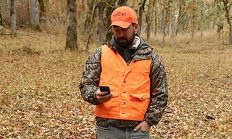
Peregrine falcons are among the most charismatic and noted of the world's birds. They are described as the fastest animal on the planet, and have been recorded reaching speeds in excess of 240 miles an hour in dives after prey. They are one of Oregon's boldest raptors, and have been observed usurping active Golden eagle nest sites, stealing fish from Ospreys and ground squirrels from adult Bald eagles who stray into their territory. It has, for perhaps 4,000 years, been used by falconers because of its skill in capturing game birds in tandem hunts with humans. Peregrines are medium-sized raptors…
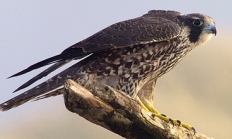
This small owl is unusual in that it nests in earthen burrows in open shrub-steppe regions and grasslands. This habit is even more curious in Oregon since most burrows used for nesting were previously excavated by badgers, a major predator of Burrowing owl eggs and young. These long-legged, short tailed owls are generally brownish buff with spots across the back and barring across the front. Males are usually lighter colored than females, possibly because they spend more time exposed to the elements. Males also average five percent larger than females, a situation rare among owls. The Burrowing owl is a…
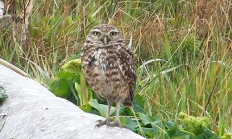
The Olive-sided flycatcher is one of the most recognizable breeding birds of Oregon's conifer forests with its resounding, three-syllable whistle song quick, three beers. It is a relatively large, somewhat bulky, large headed, short-necked flycatcher that perches erect and motionless at the top of a tall tree or snag except when singing or darting out to capture flying insects. The overall olive-gray plumage is generally nondescript except for a whitish stripe down the breast and belly which gives the impression of an unbuttoned vest, and white patches between the wings and lower back. This flycatcher breeds in low densities throughout…