Search myodfw.com
Showing 121 - 140 of 396 results
SALEM, Ore.—Manulife will not renew its cooperative agreement with ODFW's Access and Habitat program, the company informed ODFW late last week. This means Manulife properties in northeast Oregon and Jackson County that are currently open to hunter access through the Access and Habitat "Welcome to Hunt" program will no longer…
NW BIG GAME HUNTING April 23, 2026 Currently open Controlled Spring Bear, Cougar ( check current harvest numbers), Coyote Announcements, resources Here's the local scoop for your hunt area in the 2026 Spring Bear Forecast. Submit your applications for 2026 controlled hunts by May 15. Big game harvest statistics - You'll find links to population, harvest and point summary reports that can help you decide what hunts to apply for this season. Please report elk with hoof disease - If you see elk showing signs of elk hoof disease, including lame or limping elk or elk with damaged, injured, missing…
Features: Common carp are deep-bodied, heavy-looking fish with short heads and forked tails. They have large (really large) scales ranging from grey to bronze. Two barbels hang from each side of the upper lip of their subterminal (near the bottom of the head) mouth. This distinguishes them from goldfish that have no barbels. The dorsal fin is elongated. Habitat: Though tolerant of most conditions, common carp prefer large bodies of slow moving or standing water with soft sediments like mud or sand, and good growths of aquatic vegetation. They’re omnivorous bottom feeders that prefer aquatic insects, worms, mollusks and zooplankton…

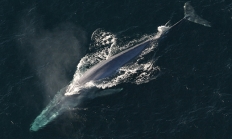
Blue whales are occasionally spotted off Oregon, but usually no closer than 10 miles offshore. These whales are part of the Eastern North Pacific population that range from Alaska to Costa Rica. They migrate between feeding areas along the west coast of the United States and Canada and breeding and calving grounds off Mexico and Central America. They are thought to be among the most endangered of the great whales. Photo by NOAA

This species breeds in upland deciduous and mixed forests with dense understory from southeastern Canada south to Georgia. It winters in the Caribbean and Middle America and casually in the United States. It migrates primarily along the east coast and regularly in small numbers along the west coast. It is rare but regular in Oregon during the fall from early September to mid-November. Hear the song of the Black-throated warbler Photo by Kenneth Schneider, Flickr


This is a sparrow of the dry brushlands. The Clay-colored sparrow breeds chiefly across the northern prairies from northeast British Columbia east to Michigan and south into Colorado. It winters in the southern United States and Mexico. It has expanded its range westward and northward in recent years and is now nesting in small numbers in eastern Washington. It was seldom reported west of the Rocky Mountains prior to 1960. Since that time, it has become a regular migrant and wintering bird along the west coast. Hear the song of the Clay-colored sparrow Clay-colored sparrow. Photo by "Always a birder"…

This thrush-like ground-foraging warbler breeds from southeast Yukon and eastern British Columbia across Canada and through the eastern United States and locally elsewhere east of the Rocky Mountains. It migrates east of the Rocky Mountain to winter in Middle America. It is occasionally found in winter in its breeding range and in California. Small numbers regularly occur in western North America. Most Oregon records are from the southeast part of the state. Spring records range from early-May to mid-June. Fall records are fewer than in spring, and occur between late August and early September. Hear the song of the Ovenbird…

Familiar to anyone from the eastern United States and Canada, this sparrow is much less common in Oregon. Adults show both a white-striped and tan-striped morph, while first year birds resemble tan-striped adults but are typically more heavily streaked underneath. Even the dullest first-year birds have a distinct rectangular white throat patch, often set off with a partial black border. The White-throated sparrow is an uncommon migrant and winter visitor, mainly in western Oregon. Hear the call of the White-throated sparrow Photo by ©Keith Kohl, ODFW


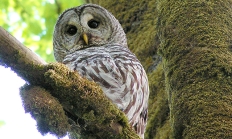
The Barred owl expanded its range from the eastern United States. It was first reported in Oregon in the early 1970s and has since spread to forested areas throughout most of the state. Sometimes confused with the closely related Northern spotted owl, the Barred owl is large with grayish-brown and white feathers and stripes on its chest and throat. It is easily distinguished from the Northern spotted owl by the pronounced horizontal barring across the throat and upper breast, and vertical brown streaks on the lower breast and abdomen. The Barred owl is now a permanent resident in forests of…
The haunting cries of these wanderers evoke a variety of reactions from curiosity to wonder. Highly social, the Pinyon jay epitomizes the dynamics of flock behavior such as colonial nesting, communal feeding of young and non-territoriality. Although Pinyon jays are nomadic and unpredictable, each flock is a tight-knit, integrated unit occupying a home range that does not overlap with other flocks. Flocks may wander widely outside their home range if sufficient food is not available. The Pinyon jay is a permanent resident in juniper and ponderosa pine woodlands of central Oregon. Oregon's known breeding population is confined to the Metolius…

Whether it's concerns about your local fishery, questions about an upcoming hunt, or comments about an agency policy, we want to hear from you. Please feel free to call or send us an e-mail.
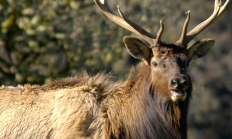
Features: Roosevelt elk are one of two subspecies of elk found in Oregon, with an estimated population of 59,000 in the state. “Rosies” are darker in color than other elk subspecies and the largest in terms of body size, with bulls generally weighing 700-1,100 pounds. Habitat: Roosevelt elk occupy most of western Oregon, with concentrations in the Cascade and Coast ranges. All elk west of Hwy 97 are considered to be Roosevelt elk, though there is some overlap of Oregon’s two subspecies in the Cascades. Techniques: Roosevelt elk make their home in the thick and lush forests of western Oregon…
SALEM, Ore.—As 2025 deer and elk hunting seasons begin, ODFW is ramping up its Chronic Wasting Disease (CWD) surveillance statewide. Hunters are encouraged to take advantage of streamlined testing options and reminded that CWD check stations are mandatory to stop at when transporting harvested deer or elk. Sampling is quick…