
Search myodfw.com
Showing 141 - 160 of 897 results


In the Pacific Northwest, the night snake frequents arid desert scrub habitats near rocky outcrops or rimrock. It takes refuge in talus slopes or rocky crevices during the day. Night snakes tend to feed on cold-blooded prey, especially lizards and their eggs, frogs, toads, salamanders, large insects, and small snakes. These snakes are primarily nocturnal, and are more active on relatively cool nights of early summer. Photo by Ken-ichi Ueda, Flickr

MARINE WILDLIFE VIEWING June 25, 2026 The Oregon coast is a great place to come and view a variety of wildlife. Enjoy the great diversity of life: from giant whales and barking sea lions to majestic bald eagles and diving pelicans, to showy Harlequin ducks and flocking shorebirds, to the tiny anemones and crabs inhabiting tidepools. There is always something new to discover. Visit our wildlife viewing map for locations to visit and view wildlife along the Oregon coast. Maximize your viewing of coastal creatures by bringing binoculars for close-up views. Beach Safety: Check conditions here Whales, orcas and porpoises…
These lizards are found in open desert shrublands, particularly where islands of sand have accumulated around shrubs and are absent where a dense grass understory would inhibit their ability to run. The Long-nosed leopard lizard eats large insects, such as grasshoppers, crickets, and beetles, and also takes small vertebrates, including pocket mice, side-blotched lizards, whiptails, and Western fence lizards. Some plant material (flowers, berries) is eaten when available. Photo by Charlotte Ganskopp

This northern grouse reaches Oregon only in the forests of the Wallowa Mountains in the northeastern part of the state. It is dusky and slightly smaller than the ruffed grouse. Sexes are different in coloration; males have a black breast with white spotting on the sides, white spots at the base of a black tail, and a red comb above the eye. Females are heavily barred with dark brown and white and have a dark tail. Hear the call of the spruce grouse Spruce grouse observation form Photo by Dave Budeau, ODFW

SE BIG GAME HUNTING June 25, 2026 Currently open Cougar ( check current harvest numbers), Coyote Announcements and resources Check the Leftover Tag List for an opportunity to hunt this year. View the Big Game raffle and auction hunt results along with the 2026 seed number drawing results. Big game harvest statistics - You'll find links to population, harvest and point summary reports that can help you decide what hunts to apply for this season. Please report elk with hoof disease - If you see elk showing signs of elk hoof disease, including lame or limping elk or elk with…
Although they occur in a wide variety of habitat types, from deserts and chaparral to open forests across Oregon, Western rattlesnakes usually occur near rocks, cliffs, or downed logs. They overwinter in dens typically located on south-facing rocky hillsides exposed to sunshine. Western rattlesnakes feed mainly on small mammals, including mice, gophers, squirrels and rabbits, but will also take birds lizards, and amphibians. The Western rattlesnake is an Oregon Conservation Strategy Species in the Willamette Valley. Photo by Simon Wray, ODFW

The long-legged myotis lives in forests and comes out early in the evening to hunt. It is a fast flier and will chase insects for a long distance. One baby is born in the summer, and the species hibernates in winter. In general, the long-legged myotis is a species associated with montane coniferous forests, but it also occurs in some desert and riparian habitats. The long-legged myotis is an Oregon Conservation Strategy Species in these ecoregions: Blue Mountains, Coast Range, East and West Cascades, Klamath Mountains, and Northern Basin and Range. Photo by ©Michael Durham
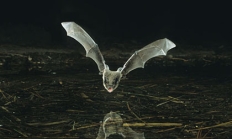
SALEM, Ore.—Everyone can fish, clam and crab for free in Oregon on Saturday and Sunday, June 7-8, 2025. No fishing/shellfish licenses or tags (including a Combined Angling Tag or Columbia River Basin Endorsement or Two-Rod Validation) are required on these days. Both Oregon residents and nonresidents can fish for free. Oregon…
Features: Bluegills are distinguished from other panfish by the black ear flap and black spot at the rear base of the dorsal fin. Five to eight greenish, vertical bars are faintly visible on their sides. The body is olive-green in color, bluish above and silvery below. Breeding males develop a bright orange to red flush on the throat area. Adults in most waters measure 5- to 8-inches, but the state record bluegill exceeded 12-inches. Habitat: Bluegills prosper in clear, clean ponds, lakes and backwaters of slow streams with abundant vegetation. They feed on both plant and animal life, but primarily…


White River Wildlife Area was established in 1953. Located along the east slope of the Cascade Mountains in the north central part of Oregon, the wildlife area encompasses 29,480 acres. An additional 1,280 acres of land owned by the Bureau of Land Management (BLM) is managed by the ODFW bringing the total acres managed by the department to 30,760. The primary purpose of White River Wildlife Area is to provide winter range habitat for black-tailed deer and Rocky Mountain elk and to minimize big game damage to adjacent private agricultural lands.
High overhead at the top of the rimrock in Oregon's desert country, the White-throated swift swoops, soars, and darts about erratically, hunting and catching insects. At great speed, it disappears into a crevice on a cliff without appearing to slow down. Its long, strong claws enable it to crawl deep inside these crevices to roosting and nesting areas, which often cannot be seen from the entrance. This bird is a locally common to abundant breeder, primarily on eastern Oregon cliffs. It is an occasional spring and sporadic fall migrant in western Oregon along the coast, in the Willamette Valley, and…
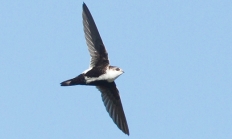
The arrival of this stalwart flycatcher in February prematurely announces spring east of the Cascades. It specializes in the capture of low-flying and ground-dwelling insects, enabling it to survive harsh conditions. Its near-ground niche allows it to reside from the arctic tundra to the deserts of southern Mexico. Its subtle song and coloration fit in well with the open country it occupies. Although not shy, it is easily passed unnoticed by the casual observer. The Say's phoebe breeds from the east base of the Cascades eastward in arid, sparsely treed, open country such as sagebrush plains, dry foothills, canyons, rimrock…
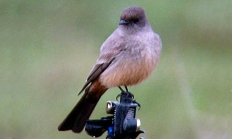
The song of this bird is one of the characteristic sounds of spring evenings in much of the high desert country of eastern Oregon. This temperate migrant is a ground-nesting, ground-foraging bird of most of the grassland, agricultural land, and shrubs steppe habitats of Oregon. The streaked brownish plumage of the Vesper sparrow is similar to that of several small to medium-sized sparrows, except for white outer tail feathers, shown most conspicuously in flight. The Oregon vesper sparrow is an Oregon Conservation Strategy Species in the Klamath Mountains and Willamette Valley ecoregions. Hear the song of the Vesper sparrow Photo…

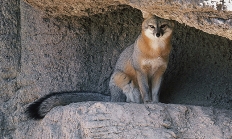
The gray fox is among the smaller canids in Oregon. The basic color of the gray fox is grizzled gray, but the stiff middorsal hairs have long black tips that extend onto the tail as a black mane. Guard hairs are banded white, gray, and black. The throat, venter, and inside of the legs are white; a cinnamon-rufous border to the white throat extends on the flanks and underside of the tail A blackish patch on the side of the face extends onto the lower jaw and a grayish black "exclamation point" extends upward from the interior margin of each…
The House finch is the most widespread of Oregon's "red finches." It is a congenial, cheerful singer from urban areas to desert plateaus. The male has a red forehead, throat, eyebrow, rump and varying amounts of red in the breast. It may have small amounts of reddish wash in its otherwise brownish cheek, hindcrown, nape,and streaked back. In some males, red is replaced with red-orange, orange, yellow-orange or yellow. The female is drab grayish-brown, overall, with indistinct streaking above and no red. The House finch is a fairly common resident in lowlands, urban, rural, and agricultural areas throughout Oregon. They…
