Search myodfw.com
Showing 141 - 160 of 1673 results
The Sharp-shinned hawk is North America's smallest and most migratory accipiter. As a hunter of songbirds (and sometimes young chickens) it historically endured harsh reproach, and was often depicted as a blood-thirsty villain, even by some ornithologists. Across the U.S., many thousands were shot in the first half of the 20th century. But prevailing attitudes have changed, and today a glimpse of this slender, secretive hawk darting through the treetops is more likely to elicit admiration than malice. Adult plumage, nearly identical to the slightly larger Cooper's hawk, consists of slate gray back and wings, breast and sides barred with…
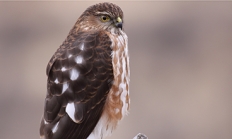
Cooper's hawks are smallish "bird hawks" (slightly smaller than American Crows) with rounded wings, a long rounded tail, and long yellow legs. This is the mid-sized accipiter nesting in Oregon and is larger than the Sharp-shinned hawk, but smaller than the Northern goshawk. The usual mode of flight consists of several rapid wing-beats alternating with brief periods of sailing. Juveniles are dark above with underparts streaked vertically while adults tend to have a bluish cast to their gray upperparts. The long tail is barred dark and light with narrow whitish band at the tip. It is an uncommon breeder in…
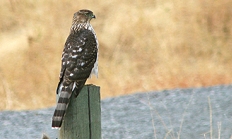
Of the three U.S. and Canadian forest hawks known as accipiters, this is by far the most impressive because of its size and aggressiveness. Like others of the genus it is morphologically adapted to maneuvering through forest landscapes and usually uses an ambush approach to capturing prey; although if prey tries to escape, it quickly pursues. From Turkey to Japan, goshawks are favored over falcons for falconry, and a limited number of permits are issued in Oregon for taking goshawks for falconry purposes. The Northern goshawk has short, broad, round-tipped wings and a long tail. It is approximately the size…

A medium-sized hawk, the Red-shouldered hawk has bold black-and-white flight feathers and rusty shoulder patches. Seen in flight from underneath, especially when lit from the sun, its wings show a translucent 'window' near the tips. It relies on perches for hunting and is closely affiliated with wooded wetlands and riparian bottomlands. In the breeding season this hawk is found in moist woodlands with at least a few deciduous trees. It prefers riparian bottoms, especially those near shallow wetlands or open meadows. In winter, it may use more open lands such as found in the Rogue and Willamette valleys, depending on…
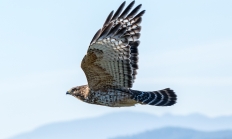
Swainson's hawks are medium-sized buteos, smaller than Red-tailed and Ferruginous hawks. Plumage beneath varies along a continuum from very pale to nearly black below. Lighter-plumaged birds have a distinct chest band. They have relatively long, pointed wings that contribute to superior flying skills. The dark flight feathers contrast with paler wing lining in all but the darkest birds. It breeds in the bunchgrass prairies east of the Cascades with the highest concentration in the foothills of the Blue and Wallowa mountains. It prefers open country and has little need for numerous trees since it forages extensively while in flight and…
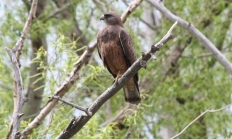
One of the most familiar sights along the roads of Oregon is a Red-tailed hawk soaring high on the sky over a field, or perched on a utility pole, waiting patiently for prey. Red-tailed hawks are large-bodied raptors with relatively broad wings. The back is mottled brown, and the tail of mature birds is orangish red with a thin, dark subterminal band. Perched birds can be identified from behind even when the tail is concealed by the white mottling on the scapulars forming a faint 'V'. Most individuals can be assigned to one of two color morphs, light or dark…

This largest of Oregon's hawks inhabits the most open country of the state's buteos, and watches over its home range on long, motionless wings for extended periods in search of prey. Ferruginous hawks are sensitive to human disturbance and tend to reside in remote areas. They occur in two color morphs, but dark-morph birds are rare in Oregon. Light-morph birds are white below with few markings except for the ruddy-colored leg feathers. The back and wing coverts are rust colored and the tips of the primaries and end of the tail tend toward dark smoky gray. It is an uncommon…
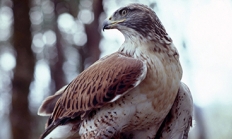
Characteristic of open country and cold weather, the Rough-legged hawk can be found soaring over exposed terrain or perched on utility poles across much of the state in winter. The rough appearance of its legs comes from the feathers covering their length, an adaptation that provides extra warmth in frigid weather. In flight, dark wrist patches and belly help identify this large buteo, though like other hawks it is subject to much variation in plumage. From a distance it frequently appears to have a frosty upper half. It often hovers over fields while hunting, a behavior that is rare among…
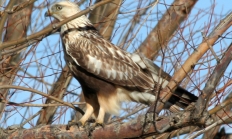
The Golden eagle is the largest soaring raptor inhabiting open country and mountainous terrain in eastern Oregon. A powerful and skillful hunter, the Golden eagle has become the National icon of the American West. A very large, dark raptor, the nape golden in all plumages, the females are slightly larger. Juvenile birds show white patches at the base of the primaries and a white tail with a broad dark terminal band. They are common residents in all Oregon counties east of the Cascade range. The Golden eagle inhabits shrub-steppe, grassland, juniper, and open ponderosa pine and mixed conifer/deciduous habitats. It…
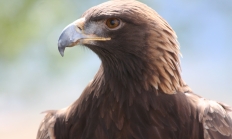
Formerly known in American literature as the Sparrow hawk, this is the smallest (dove-sized) and most familiar and abundant member of the family Falconidae in North America and one of the easiest raptors to observe. It has two considerably different plumages: adult male and female and juvenile males differ somewhat from adult males until post-juvenile mold in fall. Adult males have rufous backs and tails with blue-grey upper wing coverts. The tail has a wide black subterminal band. Juvenile males are similar to adult males but have heavily streaked breasts. Females are slightly larger than males and have reddish-brown backs…
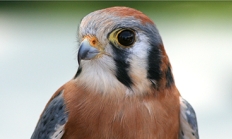
With short pointed wings and long narrow tails, these small falcons are well built for fast pursuit and mid-air attacks. Sexes differ in color and size, with adult males about 25 percent smaller by weight than females. Males range from blackish gray to pale blue-gray on the back with a reddish wash along sides of the breast and a banded tail; females have brownish backs. In winter, it can be found throughout the state in open or semi-open habitats, but it is most regular near major estuaries, lakes, reservoirs, and occasionally in cities where food supplies are reliable. For nesting…

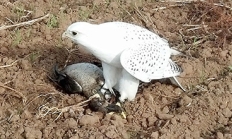
This is a large and power falcon. The majority of Gyrfalcons seen in Oregon are immatures or adults of the "gray" type, but there are several reports of "white" birds. The Gyrfalcon is a regular winter visitant to Oregon. The majority of sightings come from coastal and Willamette Valley lowlands near waterfowl concentrations. Individuals have been seen chasing and feeding on geese, ducks and gulls. Gyrfalcons forage by flying low over the ground and flushing prey, then often giving spectacular tail chases. If a bird refuses to flush the hunt is usually unsuccessful. East of the Cascades it occurs around…
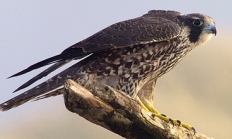
Peregrine falcons are among the most charismatic and noted of the world's birds. They are described as the fastest animal on the planet, and have been recorded reaching speeds in excess of 240 miles an hour in dives after prey. They are one of Oregon's boldest raptors, and have been observed usurping active Golden eagle nest sites, stealing fish from Ospreys and ground squirrels from adult Bald eagles who stray into their territory. It has, for perhaps 4,000 years, been used by falconers because of its skill in capturing game birds in tandem hunts with humans. Peregrines are medium-sized raptors…
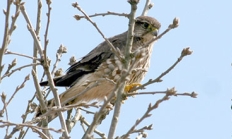
One of the most impressive sights in the unforested regions east of the Cascades is a Prairie falcon strafing a Belding's ground squirrel colony repeatedly at full speed in hopes of catching one emerging from its burrow at just the wrong moment. Prairie falcons are most common in rimrock country where they nest, but may travel great distances in search of prey. Prairie falcons are large, sandy brown above and off-white with variable amounts of streaking below. The face has a vertical stripe below the eye, as do many falcons. In flight, the long, pointed wings and long tail identify…
You'll find rails, coots and cranes in marshy areas feeding on plants and small animals. Oregon has two species of rails, one coot and one crane.
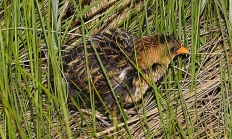
The Yellow rail is a small, secretive rail that is seen and heard far less than any other rail in Oregon. Males vocalize during the breeding season with a five-note tic-tic, tic-tic-tic repeated incessantly during hours of dark, and call infrequently during the day. The call sounds much like two small rocks being tapped together. Yellow rails are quite small and have a white patch on the trailing edge of the inner wing, more extensive than that on juvenile Soras. Males in the breeding season have a distinct yellow bill and are slightly larger but otherwise sexes are alike. Chicks…
With its long, decurved bill, the black and cinnamon Virginia rail probes the mud for much of its food. Its narrow body is specially designed for slipping through a densely vegetated marsh, so it rarely has to move away from cover. Known for its staccato kidik, kidik call, this rail also contributes grunts, clicks, churs, squeaks, skeeuws, and quack-like noises to the marsh chorus. In Oregon, this is a rare to locally abundant breeder. In western Oregon it breeds in freshwater and brackish marshes. In eastern Oregon, large marshes in Klamath, Lake, and Harney counties host numerous breeders each year…

Smaller than a robin, this shy skulker is difficult to see, even though it is present during the nesting season in marshes throughout the state. The Sora is mostly brown with a black face and a stout yellow bill. Its chicks are small black balls of fluff with a bit of orange feathering under their chins. In the breeding season, Soras use wet meadows, including sedge, rush, and hair grass types but also wet areas with emergent vegetation, particularly cattails and tulles. They eat invertebrates, seeds, plant leaves, and stems. Hear the call of the Sora Photo by Kathy Munsel…

Often mistaken for a duck, the American coot is actually a member of the rail family. It is a smallish, slate-gray water bird with a white bill. At home swimming in ponds and marshes, it seems to propel itself through the water by rhythmically extending its neck. During the nesting season it can be seen enthroned on a sizable nesting platform built from marsh vegetation. It has the largest Oregon breeding population of any waterfowl. Rafts of thousands of coots stage for migration in spring and fall on lakes throughout Oregon. Hear the call of the American coot Photo by…

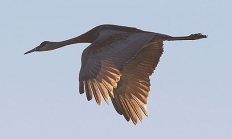
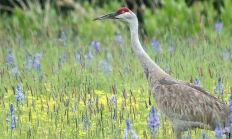
The Greater sandhill crane is Oregon's tallest bird. This large majestic crane has a guttural gurgling or bugling call, and is easily noticed in flight by its profile, with long neck and head extending straight ahead and long legs trailing behind. The Greater sandhill crane is distinguished by its red crown and white cheek patches, contrasting with with a light gray body. Fledged young resemble adults, but have a feathered forehead, a lighter tawny plumage, and lack the red crown and white cheek patches during their first fall. Fledged young have a squeaky cheap call often heard in flight during…