
Search myodfw.com
Showing 321 - 340 of 509 results
Trask River Hatchery was constructed in 1916 to replace an earlier hatchery that was located three miles upstream from the present site. Many improvements have been made to the hatchery since original construction including a new alarm system, early rearing building, and a 40’ x 60’ pole building. Trask Pond was constructed in 1970 and Tuffy Creek was constructed in 1988. The hatchery is used for adult collection, incubation, and rearing of fall and spring Chinook, coho, wild winter steelhead and hatchery winter steelhead.
Willamette Trout Hatchery and the adjacent Oakridge Salmon Hatchery were combined in 1983 and operate today as Willamette Hatchery. The trout hatchery was constructed in 1922 and the salmon hatchery in 1911. The U.S. Army Corps of Engineers (USACE) rebuilt the salmon hatchery in 1952 to mitigate for fishery losses caused by Hills Creek, Lookout Point and the Dexter hydroelectric/flood control projects. The trout side was rebuilt between 1950 and ‘56. Today, Willamette Hatchery is used for adult holding/spawning, egg incubation and rearing of spring Chinook and rainbow trout. In addition, both summer and winter steelhead are reared at this…
Oak Springs Hatchery was constructed in several phases beginning in 1922 with the last major construction in 1996. The facility is currently used for egg production, incubation and rearing of rainbow trout, incubation and rearing of summer and winter steelhead, and maintains one resident rainbow trout and one resident cutthroat broodstock.
The McKenzie River originates in the Cascade Range and empties into the Willamette River near Eugene, which then flows northward into the Columbia River. McKenzie Hatchery was first constructed in 1938 and rebuilt in 1975. Today, 30 rearing ponds, a visitor's center, spawning room, egg incubation facility, office, feed storage, shop area, fish ladder and picnic area are the main components of the facility layout. McKenzie Hatchery is temporarily closed to comply with Oregon Department of Environmental Quality permit conditions. Visitors should be aware that no fish are present in the facilities' production raceways and show ponds. Fish have been…
Wallowa began operation in 1920 as a resident trout hatchery. In 1985, the hatchery was renovated as part of the Lower Snake River Compensation Program (LSRCP) – a program to mitigate for spring Chinook and summer steelhead losses caused by the four federal dams constructed on the lower Snake River. Wallowa Hatchery is used for adult collection, spawning, acclimation and release of summer steelhead.
Gnat Creek Hatchery was constructed in 1960 as part of the Columbia River Fisheries Development Program (Mitchell Act)—a program to enhance declining fish runs in the Columbia River Basin. The facility is used for egg incubation and rearing of spring Chinook and winter steelhead. Most of the production is released off-station. The hatchery is an easy drive toward Oregon’s coast on Highway 30 and a visitor-friendly place for the entire family. With lots to do, located on beautiful Gnat Creek and tucked away amid the rainforest, this is a worthwhile stop on the way to the coast.
This release was updated April 25 to correct two errors (the first name of the OSP Lieutenant who testified on Sauvie Island parking issues and that the Don Lindly property was sold to Lincoln County not Lincoln City.) LINCOLN CITY, Ore.—The Commission adopted a limited entry parking program for summer…

Willamette Trout Hatchery and the adjacent Oakridge Salmon Hatchery were combined in 1983 and operate today as Willamette Hatchery. The trout hatchery was constructed in 1922 and the salmon hatchery in 1911. The U.S. Army Corps of Engineers (USACE) rebuilt the salmon hatchery in 1952 to mitigate for fishery losses caused by Hills Creek, Lookout Point and the Dexter hydroelectric/flood control projects. The trout side was rebuilt between 1950 and ‘56. Today, Willamette Hatchery is used for adult holding/spawning, egg incubation and rearing of spring chinook and rainbow trout. In addition, both summer and winter steelhead are reared at this…
The Klamath Fish Hatchery was originally constructed in 1929. Many improvements have been made since original construction. The hatchery produces legal and trophy sized rainbow trout, fingerling rainbow trout, brown trout, and cutthroat trout for release throughout the Klamath Basin, Deschutes Basin, Umpqua Basin and the southeast part of the state. The hatchery assist with remote egg takes for wild rainbow and brown trout at Crane Prairie and Wickiup Reservoirs.
In 1925 the first fish hatchery on the South Santiam River began operations about 5 miles upstream from today’s present site, rearing annually approximately 100,000 spring Chinook in dirt ponds for release into the South Santiam River. The present site came about with the construction of Foster Dam. In 1968 the facility was dedicated for the rearing of spring Chinook and summer steelhead. This facility was built and annually funded in part by the US Army Corps of Engineers to compensate for the loss of spawning and rearing areas above the dams on the South Santiam River.
SALEM, Ore. – ODFW staff at the Ashland Boat Inspection Station found quagga mussels on a motorboat that was being transported from Lake Havasu, Arizona into Oregon on March 21. This was the first instance in 2026 where crews found invasive freshwater mussels on a boat entering Oregon. The watercraft…
SALEM, Ore.—ODFW is seeking to fill three vacant positions on the Salmon and Trout Advisory Committee (STAC). One position will represent the Mid-Coast District, the second will represent the Upper Rogue District, and the third will represent the Umpqua District. Interested individuals are encouraged to apply by 5:00 p.m. on…
Along coastal shores and islands, the chatter and flight calls of Black turnstones invite an observer to look more closely at the rocky substrates to find these birds busily picking about in their search for food. They primarily use rocky shores, jetties, and offshore islands, but may also be found on shorebird flats and sandy beaches. The Black turnstone is a common transient and winter visitant on the coast. Hear the call of the Black turnstone Phogo by ©Keith Kohl, ODFW

The Costa's hummingbird is a very rare spring and summer visitant to central and southwestern Oregon. Males are sometimes present for the entire year in the Rogue Valley. Males have been observed in canopy-free riparian habitat along Bear Creek and semi-open tall white oaks at the edge of Agate Lake. Many of these birds go undetected in Oregon because of their similarity with other hummingbird species. Hear the call of the Costa's hummingbird Photo by Mick Thompson, Flickr

Note: Recreational ocean crabbing is closed through Nov 30. SALEM, Ore.- Get outdoors with friends and family and enjoy free fishing, crabbing and clamming on Friday and Saturday, Nov. 28 and 29. Statewide free fishing days are a great chance to take someone new fishing and celebrate Oregon's natural resources…
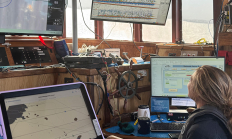
ODFW Marine Resources Program's Alex Copeland monitors scientific fish finders on board the research vessel. ODFW photo. NEWPORT, Ore. – Oregon Department of Fish and Wildlife's Marine Fisheries Research team is conducting a nearly 10-week at-sea survey to better understand the population status of black, blue, and deacon rockfish—three species…
CLACKAMAS, Ore.— Anglers can double the odds of catching salmon in the Upper Willamette River this fall as coho again return to areas above Willamette Falls. Effective Aug. 1 through Dec. 31, anglers with the two-rod validation may use two rods in all areas of the Willamette River upstream of…
This winter visitor is a study in gray and tan, with a small dark spot on an otherwise gray breast, dull rufous stripes on the side of the head and crown, and brown wings with distinct white stripes. Tree sparrows visit Oregon only in winter, mainly in lowlands within the Blue Mountains and Owyhee upland regions with a few farther west in some years. They frequent willow clumps in grassy areas and occur occasionally at feeders. Hear the song of the American tree sparrow Photo by Eric Began, Flickr
