
Search myodfw.com
Showing 361 - 380 of 897 results
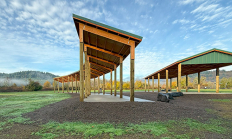
Veterans invited to grand reopening event set for Nov. 15 MONMOUTH, Ore.—ODFW Hunter Education Coordinator Jered Goodwin used to see a group of disabled Veterans regularly visiting the shotgun shooting range at E.E. Wilson Wildlife Area, a former military base turned wildlife area and popular outdoor destination in the Willamette…
Find maps, boundary descriptions and hunts available in the new Steens Hunt Area. Download printable PDF map
Find maps, boundary descriptions and hunts available in the new DeGarmo Hunt Area. Download printable PDF map
Find maps, boundary descriptions and hunts available in the new Fox Hunt Area. Download printable PDF map
Find maps, boundary descriptions and hunts available in the new Juntura Hunt Area. Download printable PDF map
Find maps, boundary descriptions and hunts available in the new Klamath Basin Hunt Area. Download printable PDF map
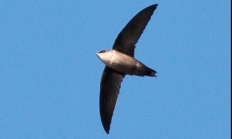
This small swift is best known for its quick flight and dazzling aerial agility, perching only when nesting or roosting. It is aerodynamically designed for fast speeds with long, pointed wings, short stout legs, and a compact body. The Vaux's swift is a transient and summer resident nesting in older forests and brick chimneys statewide except the southeast part of Oregon. Hear the call of the Vaux's swift Photo by Julio Mulero, Flickr
With its long, forked tail and long wings, it is the most graceful of all land birds and reminds one of the smaller terns not only in shape but in behavior. The Barn swallow has taken so completely to nesting on human-made structures that one forgets they were once restricted to caves and rock crevices. Almost every farm in the state has a pair or two nesting in an outbuilding, and very few bridges do not have a pair or two. It is the best known of the swallows. It is a fairly common to locally abundant summer resident and…

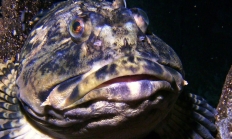
Features: Cabezon are a dark green to dark brown with mottling along their sides and with smooth, scaleless skin. The largest cabezon caught was over 20 pounds, but on average they weigh approximately 4 pounds. Habitat: Cabezon live around kelp beds and rocky headlands over hard bottoms. Technique: Cabezon are best caught using rubber tailed jigs tipped with bait. Make sure you are fishing within just a foot or two of the bottom as Cabezon like to hold tight to cover. CAUTION: While Cabezon meat can be safely consumed, its roe is poisonous to humans. Photo credit: Brandon Ford

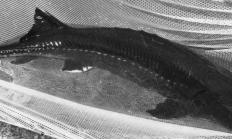
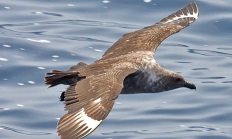
Skuas are the size of a Western gull, dark with a pale nape and large white patches on the bases of the primaries on both the upper and lower surfaces. This is a solitary bird. Its flight is low and direct with heavy flapping and little gliding. It steals food from other seabirds, and is aggressive, bordering on predatory. It may grab a shearwater's head, wing, or tail and shake and kick the bird until it regurgitates its food. Chances of detection are best around flocks of shearwaters feeding behind fishing boats. It is a rare to uncommon fall transient…
Brown creepers are the only North American birds that rely on both the trunk and bark of trees for both nesting and foraging. They are small birds, about five inches in length, and have a long, slender, down-curved bill used to probe for insects hidden in the furrows of tree bark. Their brown back, streaked with white, makes creepers on of the best-camouflaged girds of the forest. They most often forage upward from the base of a tree, using their long, stiff tail for support. The Brown creeper breeds and winters throughout forested areas of Oregon, from the coast to…

Features: The females are freckled all over with small reddish-brown to golden spots on gray to brownish background. Their fins are mostly yellowish-orange. The males are gray to brownish-olive, with irregular blue spots on the front of their bodies; each spot is surrounded by a ring of small reddish-brown spots. The inside of this species' mouths are yellowish. Habitat: Kelp greelings can be found to depths of 150 feet. They prefer rocky inshore areas and are common in kelp beds and on sand bottoms. Technique: It is best to target kelp greenlings by placing a line near the base of…

Features: Trout-like in appearance, the body is silvery in color with a bronze or dark back. They can be distinguished from trout by the forked tail and the small, down-turned mouth. Lengths run to 20-inches. Whitefish are often erroneously called graylings by many anglers. Habitat: Mountain whitefish inhabit many Oregon streams and lakes, thriving best in clear, cold water. Techniques: Whitefish tend to go for flashy flies, but are known for quickly spitting them out. Many sportsmen look with disfavor on the whitefish and often throw it away as undesirable. However, the flesh of the whitefish is firm and tasty…

Find maps, boundary descriptions and hunts available in the new Devils Garden Hunt Area. Download printable PDF map
Find maps, boundary descriptions and hunts available in the new Devils Garden Hunt Area. Download printable PDF map
Find maps, boundary descriptions and hunts available in the new Fox Hunt Area FX-02. Download printable PDF map
Find maps, boundary descriptions and hunts available in the new Keno Hunt Area. Download printable PDF map
Find maps, boundary descriptions and hunts available in the new Trout Creek Hunt Area. Download printable PDF map