
Search myodfw.com
Showing 401 - 420 of 699 results
With its long, forked tail and long wings, it is the most graceful of all land birds and reminds one of the smaller terns not only in shape but in behavior. The Barn swallow has taken so completely to nesting on human-made structures that one forgets they were once restricted to caves and rock crevices. Almost every farm in the state has a pair or two nesting in an outbuilding, and very few bridges do not have a pair or two. It is the best known of the swallows. It is a fairly common to locally abundant summer resident and…

These small, buff ground-dwellers are often seen in migration as they pass overhead in lisping flocks or as they walk deliberately along a muddy shore, tilled field, or short-grass upland with their tails slowly bobbing. Breeding birds are grayish above and lightly streaked below; winter birds are more heavily streaked below and brownish above. All plumages have cream-buff undersides (brightness varies) and a dark tail with white outer feathers. The American pipit is locally common in lowlands in winter, especially in western Oregon and on the coast. Hundreds of pipits can be found some years in preferred habitat in the…

This well-known ground-dwelling bird is black above on the male and brown on the female, including the entire head and upper breast. On both sexes the upperparts are spotted with white on the wings and the long tail. It has rufous sides and a white belly. It frequents brushy areas and is common at bird feeders wherever seed is scattered on the ground, but does not feed far from cover. The varied song usually has one to three parts. The Spotted towhee breeds statewide and winters primarily west of the Cascades and in small numbers in lowland areas east of…

The song of this bird is one of the characteristic sounds of spring evenings in much of the high desert country of eastern Oregon. This temperate migrant is a ground-nesting, ground-foraging bird of most of the grassland, agricultural land, and shrubs steppe habitats of Oregon. The streaked brownish plumage of the Vesper sparrow is similar to that of several small to medium-sized sparrows, except for white outer tail feathers, shown most conspicuously in flight. The Oregon vesper sparrow is an Oregon Conservation Strategy Species in the Klamath Mountains and Willamette Valley ecoregions. Hear the song of the Vesper sparrow Photo…

Although not brilliantly plumaged, the conspicuous Song Sparrow is one of the more regularly seen birds in Oregon. Defensive and curious, when approached it readily announces its presence with loud chips and often excitedly rises to a conspicuous perch to confront the interloper. The Song sparrow is well named as both male and female have a variety of songs that may be heard at any time of year, and juvenile birds begin to sing full songs within two months of hatching. The Song sparrow is a common and widespread resident of western Oregon. Hear the song of the Song sparrow…

The noisy and frenetic Ruddy turnstone is a stocky, plover-like bird who's breeding plumage is a clown like pattern of black, rust and white. Ruddy turnstones have been found foraging in the company of many other shorebird species. Found on rocky shores, jetties, open ocean beaches, mud flats, salicornia marshes, grass flats and flooded fields, the Ruddy turnstone is an opportunistic feeder. It is an uncommon to common spring and fall transient along the coast; a few birds remain to winter there each year. The largest flocks are seen during spring and fall migration at Bandon. They are an irregular…

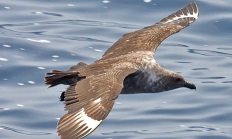
Skuas are the size of a Western gull, dark with a pale nape and large white patches on the bases of the primaries on both the upper and lower surfaces. This is a solitary bird. Its flight is low and direct with heavy flapping and little gliding. It steals food from other seabirds, and is aggressive, bordering on predatory. It may grab a shearwater's head, wing, or tail and shake and kick the bird until it regurgitates its food. Chances of detection are best around flocks of shearwaters feeding behind fishing boats. It is a rare to uncommon fall transient…
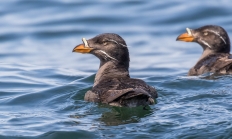
Rhinoceros auklet are one of the rarer breeding alcids in Oregon. Adults are easily recognized during the breeding season by the vertical "horn" at the base of the upper mandible. Birds in breeding plumage have brownish gray backs, a gray-brown chest, and a dirty white belly. Two distinct plumes are present on the head, one above and one below the eye. The bill is orange. In non-breeding plumage the horn is greatly reduced, the plumes absent or reduced, and the bill duller. It nests in small numbers in Oregon with Goat and Hunter Islands having the largest concentrations of breeding…
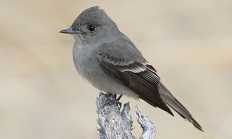
The down-slurred pee-eer call of this flycatcher is one of Oregon's most characteristic summertime bird sounds. Wherever there is a canopy of mature deciduous trees, one is likely to hear the call during warm afternoons when most other birds are silent. Because the call can easily be heard, it can usually be found perched near the tip of a dead branch from which it frequently flies a short distance to capture a flying insect, or to chase an intruder from its territory. The Western wood-pewee is a common migrant and fairly common breeder statewide in open groves of trees or…
A colorful harbinger of spring, the hardy Tree swallow arrives from the south during February each year. It is a highly social species that is usually observed in large flocks often with Violet-green and other swallow species. It is not colonial but several pairs may nest together if available cavities are clustered. The Tree swallow is a bird of open places near water and is seldom seen in residential neighborhoods or built-up urban areas. It is the only swallow that eats berries and small seeds as well as insects. In Oregon, it is a locally abundant summer resident and breeding…

Brown creepers are the only North American birds that rely on both the trunk and bark of trees for both nesting and foraging. They are small birds, about five inches in length, and have a long, slender, down-curved bill used to probe for insects hidden in the furrows of tree bark. Their brown back, streaked with white, makes creepers on of the best-camouflaged girds of the forest. They most often forage upward from the base of a tree, using their long, stiff tail for support. The Brown creeper breeds and winters throughout forested areas of Oregon, from the coast to…

Skulking through wetlands, the American bittern is rarely seen - it has an extremely slow and stealthy walk, and when a threat approaches it freezes and mimics marshland plants with upright posture and beak pointed skyward. These behaviors combined with its cryptic plumage effectively camouflage the bird. However, it is occasionally seen in flight, and its low, gurgling song can be heard over long distances. An uncommon to fairly common breeder east of the Cascades and a rare migrant in Malheur county it has also been noted at mountain lakes east of the Cascades in Lake County. In western Oregon…

At first look, the Willet is a rather drab and nondescript medium-sized shorebird found in wetland habitats and nearby uplands. However, further observation reveals subtle patterning in its relatively uniform grayish plumage and birds in flight expose a distinct, bold white wing bar that contrasts with a black border. Sexes are similar in appearance at all times of the year. Willet are present on breeding grounds in Oregon for a short period of time during spring and summer, but displaying birds are conspicuous and emit a loud and persistent "pill-will-willet" call. These vigilant and vocal individuals often hover overhead and…

This medium-sized shorebird is the most common dowitcher in eastern Oregon and inland locations, where it sometimes gathers in large flocks feeding in shallow water. It is also the only dowitcher in the state that regularly winters. Although breeding plumage adults are reddish below and heavily patterned above, most birds seen in Oregon are duller postbreeding adults or browner immatures. During winter, when shorebirds are hard to find, a small flock of chattering dowitchers, even in plain gray basic plumage, often brightens a day in western Oregon. In migration, it can be found at almost any shallow water site in…

This drab, greenish, diminutive species is similar in appearance to the Hutton's vireo, and sometimes confused with that species in western Oregon. Slighter-billed and smaller than the vireo, this little bundle of energy seems always to be moving as it flicks its wings and hops from twig to twig. The male Ruby-crowned kinglet sports a bright red crown spot, typically visible only when the bird is agitated, and in spring pours fourth a delightful melody, surprising for such a small, drab bird. This species breeds in high elevation forests, primarily east of the Cascade crest, where it is common in…

One of the most numerous breeding birds in Douglas-fir and true fir forests of western Oregon is the Hermit warbler, yet it is often overlooked. This may be surprising, given the male's bold colors; however, it seldom descends from the higher reaches of the forest canopy. If you are familiar with its song, you can often hear three to five males singing on a spring morning from many places in appropriate habitat. The male Hermit warbler has a bright yellow head, set off by a black throat and nape. The gray back is marked with black stripes that vary in…

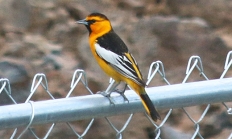
A boldly colored medium-sized bird, the Bullock's oriole builds its characteristic hanging nest in broadleafed trees and tall shrubs, especially when the trees or shrubs are spaced widely and situated along the edges of streams and fields. In Oregon, the Bullock's oriole is a rare to fairly common breeder, especially along major rivers and around farmsteads. It is most widespread in southwest and northeast Oregon. In particular, on the Derby Road in Jackson County. It nests primarily in open spaced cottonwoods, maples, and other tall, forking broadleaf trees. The nest is constructed of plant fibers, hairs, fine grass, and moss…
Oregon's diverse habitats and terrain offers something for every hunter. From the densely forested Coast Range to the expansive sage steppe of the Great Basin, hunting opportunities are practically unlimited. Visit e-regulations
This medium-sized, shy grebe has bright white cheeks that contrast sharply against a dark crown and rust red neck during the breeding season. An aquatic bird, it breeds in lakes and ponds, usually in forested areas. In Oregon, it is found in waters with hardstem bulrush intermixed with open water over five feet deep. Five to 20 birds at Rocky Point in the Upper Klamath Lake National Wildlife Reserve form the only consistent breeding population in Oregon. The red-necked grebe reaches its greatest numbers during winter along the coast. The red-necked grebe is an Oregon Conservation Strategy Species in the…

This is the world's smallest "peep" and can usually be picked out by its brownish coloration, dull yellowish legs, and hunched, creeping foraging style. Least can be found in small flocks in Oregon almost year-round. The Least sandpiper feeds on open mud with Western sandpipers but often feeds where some grass, salicornia or other cover is present, avoiding walking in the water as Western often do. It is uncommon to locally abundant statewide in migration, with most birds along the coast and at larger lakes and marshes inland. It is locally common on the coast in winter; smaller numbers winter…
