
Search myodfw.com
Showing 421 - 440 of 699 results
Cryptically colored, usually solitary and somewhat secretive, the Wilson snipe is often flushed before being seen, sometimes exploding from practically underfoot and rocketing off in a corkscrew flight. This plump-bodied, long-billed bird of open marshland is primarily crepuscular, peaking in feeding activity at dusk and dawn, and often sleeping during the day. In breeding season they become more flamboyant, appearing atop fence posts and displaying their unique winnowing flights from high in the air, their outer tail feathers vibrating with an eerie whistling sound. They are uncommon and local west of the Cascades in the summer and uncommon and local…

The Juniper titmouse presents the demeanor of a miniature jay with its crest jutted proudly upright. It is a pale gray bird above and underneath, with little or no brown coloration. Songs and calls are useful in locating hidden titmice. The Juniper titmouse occurs in pinyon pine-juniper woodlands in the bulk of its range. This bird is a cavity nester. The nest is often placed in a crevice of a twisted trunk of large, older junipers. It primarily forages in junipers and juniper seed are important in the winter diet. An Oregon Conservation Strategy Species in the Northern Basin and…

Swainson's hawks are medium-sized buteos, smaller than Red-tailed and Ferruginous hawks. Plumage beneath varies along a continuum from very pale to nearly black below. Lighter-plumaged birds have a distinct chest band. They have relatively long, pointed wings that contribute to superior flying skills. The dark flight feathers contrast with paler wing lining in all but the darkest birds. It breeds in the bunchgrass prairies east of the Cascades with the highest concentration in the foothills of the Blue and Wallowa mountains. It prefers open country and has little need for numerous trees since it forages extensively while in flight and…
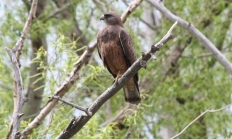
These small, fast flying seabirds are unique among alcids in North America in their use of coastal coniferous forests, primarily old-growth trees, as nesting habitat. Their solitary nests are usually concealed within the forest canopy, and breeding birds are cryptic and primarily crepuscular at nest sites. Because of their secretive behavior and elusive nests, Marbled murrelets were considered the "enigma of the Pacific" and were one of the last ornithological mysteries in North America, as the first nest was not discovered until 1974. Distribution at inland nesting sites is fragmented, as birds occur only in areas where suitable habitat remains…

The European starling is considered an invasive species in Oregon. It was introduced from Europe. They most closely resemble blackbirds, with which they often flock in fall and winter. While both have iridescent plumage, starlings can be told from blackbirds by their two-toned wing pattern - dark upperwing, pale underwing - and during the breeding season by the bright yellow bill. Starlings adapt readily and quickly to human habitation and are highly efficient and successful breeders. However, the abundance of the bird, the rapidity with which it has spread across North America, and its propensity to cause damage to crops…

The exuberant bounding flight, musical calls, and flashy yellow and black plumage of the American goldfinch in breeding-season make them one of the most recognized and welcome of Oregon birds. Found in flocks nearly year-round, these goldfinches are a familiar site in riparian woodlands, orchards, weedy fields, and agricultural land. They are among the last of Oregon's songbirds to nest and are highly nomadic in the nonbreeding season. They may form mixed flocks with Lesser goldfinches and Pine siskins at bird feeders and weed patches throughout Oregon, as well as with Common redpolls some years in northeast Oregon. Their diet…
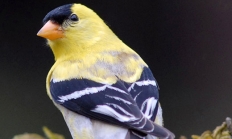
This largest of Oregon's hawks inhabits the most open country of the state's buteos, and watches over its home range on long, motionless wings for extended periods in search of prey. Ferruginous hawks are sensitive to human disturbance and tend to reside in remote areas. They occur in two color morphs, but dark-morph birds are rare in Oregon. Light-morph birds are white below with few markings except for the ruddy-colored leg feathers. The back and wing coverts are rust colored and the tips of the primaries and end of the tail tend toward dark smoky gray. It is an uncommon…
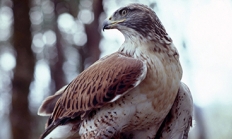
So familiar is the American crow that it has been said if a person knows only three species of birds, one of them will be the crow. Recognized by its coal-black plumage, fan-shaped tail, and nasal caw call, it is found throughout most of North America, and its seemingly mischievous character has been immortalized in folk tales and fables. These shrewd birds possess a superior intelligence and an ability to learn and make decisions. They are also sociable, joining together in large roosts, especially in fall and winter. Able to thrive in a wide variety of environments, crows are expanding…

The thick, dense feathering on its underparts allows this dainty shorebird to float high on the water. Its lobbed toes give it considerable maneuverability while swimming. It is equally at home on the roughest seas and the smallest farm pond. A highly sociable bird and extremely trusting. Smaller size and slender bill separate this species from the Wilson's and Red phalaropes. Offshore it concentrates along tide rips and over upwellings. In shallow waters it stirs the bottom with its feet or spins rapidly to expose the tiny organisms that it picks up with its needlelike bill. An opportunistic forager of…

This sturdy-looking bird has a large head, short tail, and massive conical bill adapted for seed eating. The male plumage features bold patches of lemon yellow shading into olive, then brown and black, with white secondaries creating a flashy wing-patch easily seen in flight. The male's bill is chalky white in winter, but changes in early spring to a pale green that matches the new growth at the tips of spruce boughs, where they often nest. Many encounters with this species are of individuals heard flying high overhead, leaving the observer with little else to note. The Evening grosbeak is…
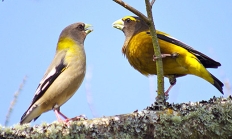

Rosy-finches are the highest-altitude breeding birds throughout most of their range. They are long-winged and generally dull-looking unless seen at close range, when the pinkish hues and combinations of brown, gray, and black can be seen. Their conical bill is usually dark, during spring and early summer and yellowish especially in fall and winter. These birds usually perch on the ground, but occasionally alight on buildings, trees, bushes, phone, and fence wires. They typically walk rather than hop, but do the latter occasionally. They also swipe with their bill rather than digging with feet as some sparrows and finches do…

Round Butte Hatchery was constructed in 1972 to mitigate for the fishery losses caused by Pelton/Round Butte (PRB) Hydroelectric Complex. Round Butte and its satellite, Pelton Ladder, are used for adult collection, egg incubation and rearing of spring Chinook, summer steelhead, and sockeye salmon.
SALEM, Ore.—Oregon's Fish and Wildlife Commission will meet Sept. 17-18 in La Grande to adopt 2027 Big Game Regulations. See the meeting agenda at https://myodfw.com/articles/commission-agenda-september-17-18-2026 Meetings are livestreamed and can be viewed on MyODFW.com website or the agency YouTube channel. On Thursday, Commissioners will tour key sites across the Blue…

The Klamath Fish Hatchery was originally constructed in 1929. Many improvements have been made since original construction. The hatchery produces legal and trophy sized rainbow trout, fingerling rainbow trout, brown trout, and cutthroat trout for release throughout the Klamath Basin, Deschutes Basin, Umpqua Basin and the southeast part of the state. The hatchery assist with remote egg takes for wild rainbow and brown trout at Crane Prairie and Wickiup Reservoirs.
Large and primarily white, the American white pelican has the longest wingspan of any bird in Oregon. It also has an enormous orange bill, and flies with neck withdrawn. During the breeding season the top of the bird's head becomes dusted with black and a horn grows on the upper mandible; this projection serves as a target for aggressive encounters to avoid injury to the essential bill pouch, but is shed after the eggs are laid. This pelican makes unusually long flights for feeding and migration, and at great distances, soaring flocks have been reported as UFOs. In Oregon, it…

Features: The color of all trout varies with environment. In general, the rainbow is bluish-green on the back, silvery on the sides and belly, and has a white edge to the dorsal, anal, and pelvic fins. A generous sprinkling of black spots appear along the back, and on the dorsal, adipose and caudal fins. A pinkish band usually extends along the sides. Habitat: Rainbow trout are the most widely stocked and distributed trout in Oregon. They occur naturally in many rivers and streams, and each year ODFW stocks millions more in ponds, lakes and streams. Prime trout waters are clear…
